

AI translation is no longer just a text conversion but a gateway for brands to gain trust in the era of global AI search. This article will provide an in-depth analysis of how AI translation will disrupt traditional models in 2026 and combine it with AIPO technology to help companies stand out in the global market.
Say goodbye to Google Translate? 2026 AI Translation Full Review: How to Achieve True "Xindaya" Cross-Language Communication?
Have you ever encountered the embarrassment of a business email sent to a North American customer, because of the misuse of a word, the other party's reply became polite and distant; Or is it the carefully prepared product manual that, after being processed by traditional translation tools, reads like a string of illogical code? According to a cross-border business survey in 2025, more than 60% of overseas companies have lost potential orders due to content with serious "translation accents". As we enter 2026, translation is no longer a simple "linguistic alignment" but a multidimensional game of cultural context, professional precision, and AI algorithm preferences.
Although traditional neural network translation (NMT) solves the problem of "understanding", it still seems inadequate when dealing with the rigor of financial laws, the accuracy of medical research, and the artistic conception of literary creation. However, with the deep integration of large language models (LLMs) and retrieval-augmented generation (RAG) technology, AI translation is bridging the gap that has hindered human communication for thousands of years. We are standing at a singularity: AI translator is not just mimicking human speech, it is learning how to think like an expert.
2026 Flagship Showdown: Google vs. DeepL vs. Claude Who is the king of translation?
In 2026, choosing a translation tool is no longer about who supports more languages, but about who can capture "sounds beyond the strings" more accurately. In order to provide the most valuable suggestions for Chinese elites, engineers, and cross-border e-commerce practitioners in North America, we conducted an in-depth evaluation of the three mainstream tools currently on the market.
Google Translate's immediacy has reached unprecedented heights with the integration of the Gemini portal. It's now more than just a translation box, it's more like a real-time language assistant capable of providing translation suggestions based on current news hotspots and geolocation information. DeepL continues to deepen its "German rigor" route, and its Write function still maintains a leading position in handling the tone modification (Nuance) of business correspondence. Generative AI, represented by Claude 3.5/4, has shown amazing talent in simulating long text logic and industry-specific tones with its powerful "role-playing" capabilities.
| Dimensions/tools | Google Translate (Gemini Edition) | DeepL Pro (2026 Edition) | Claude 4 / GPT-5 (LLMs) |
|---|---|---|---|
| Core Benefits | Multilingual coverage, ecological integration, and fast response | Accurate business rhetoric, professional thesaurus alignment | Long text logic derivation, character/tone customization |
| Grammatical accuracy | ★★★★☆ | ★★★★★ | ★★★★★ |
| Cultural rhetorical processing | ★★★☆☆ | ★★★★☆ | ★★★★★ |
| Senarios | Daily social networking, quick web browsing, travel | Business emails, legal contracts, technical manuals | Brand creative copywriting, academic papers, in-depth reports |
For Chinese engineers or self-media people in North America, if you need to translate a complex Python document comment, Claude often has a more "programmer mindset"; And if you're drafting a financing plan for a Wall Street investment bank, DeepL's precise grasp of financial jargon can help you avoid compliance risks.
In-depth analysis: How does AI overcome the three major difficulties of "Xin, Da, and Ya"?
The "Xin, Da, and Ya" proposed by the famous Chinese translator Yan Fu has been given new technical connotations in the AI era. The evolution of AI translation principles is essentially a leap from "probability prediction" to "semantic understanding."
- Faithfulness: Multimodal understanding reduces ambiguity.AI translation in 2026 no longer looks at a word in isolation. With multimodal technology, AI can simultaneously analyze text, image backgrounds, and even audio intonations. For example, in medical professional translation, AI can automatically identify anatomical coordinates in context, ensuring precise alignment of terms, reducing error rates by over 70% compared to three years ago [Source: AI Healthcare Review 2025].
- Fluency: RAG technology makes translations more native speaker-like.Why did the previous translator look like a robot? Because they lack "common sense". The AI now uses retrieval-augmented generation (RAG) to refer to the authoritative corpus of the target language in real time when translating. This means that when you translate a paragraph of Chinese into English, the AI will automatically check the expression habits of native speakers in North America, completely moving away from "Chinese English".
- Elegance: Accurately handle dialect and written language conversion.For the global Chinese market, especially the Cantonese community in Hong Kong and North America, AI can now perfectly handle the switching between spoken Cantonese and written Traditional Chinese. It is no longer a blunt word-to-word transition, but can capture the unique emotional particles in Cantonese and transform them into equivalent rhetoric in English.
This advancement is not only a triumph of technology but also a respect for human cultural diversity. High-quality translated content is becoming a core cornerstone for brands to gain authoritativeness in the era of AI search.
Finance, Healthcare, and Cross-Border Migration: AI Translation Practices in High-Value Industries
In the realm of YMYL (Your Money Your Life), the error tolerance rate for translation is almost zero. For overseas enterprises in Hong Kong and around the world, the application of AI translation has penetrated into the core business processes.
inFinancial industryThe translation of annual reports and compliance documents requires a high degree of logical coherence. AI can not only handle the formatting of numbers, but also ensure that the entire hundreds of pages of reports are translated exactly the same financial term and comply with SEC or HKEX regulations. inMedical industryThe translation of medical records and the automatic generation of summaries of international medical literature have greatly improved the efficiency of cross-border diagnosis. And forCross-border e-commercePractitioners, the value of AI translation lies in its "cultural lightning protection" - it can automatically identify words in the copy that may cause local cultural taboos and provide optimization suggestions to ensure the safety and trustworthiness of the brand image.
YouFind AIPO: From "Translating Content" to "Deploying Global AI Citation Sources"
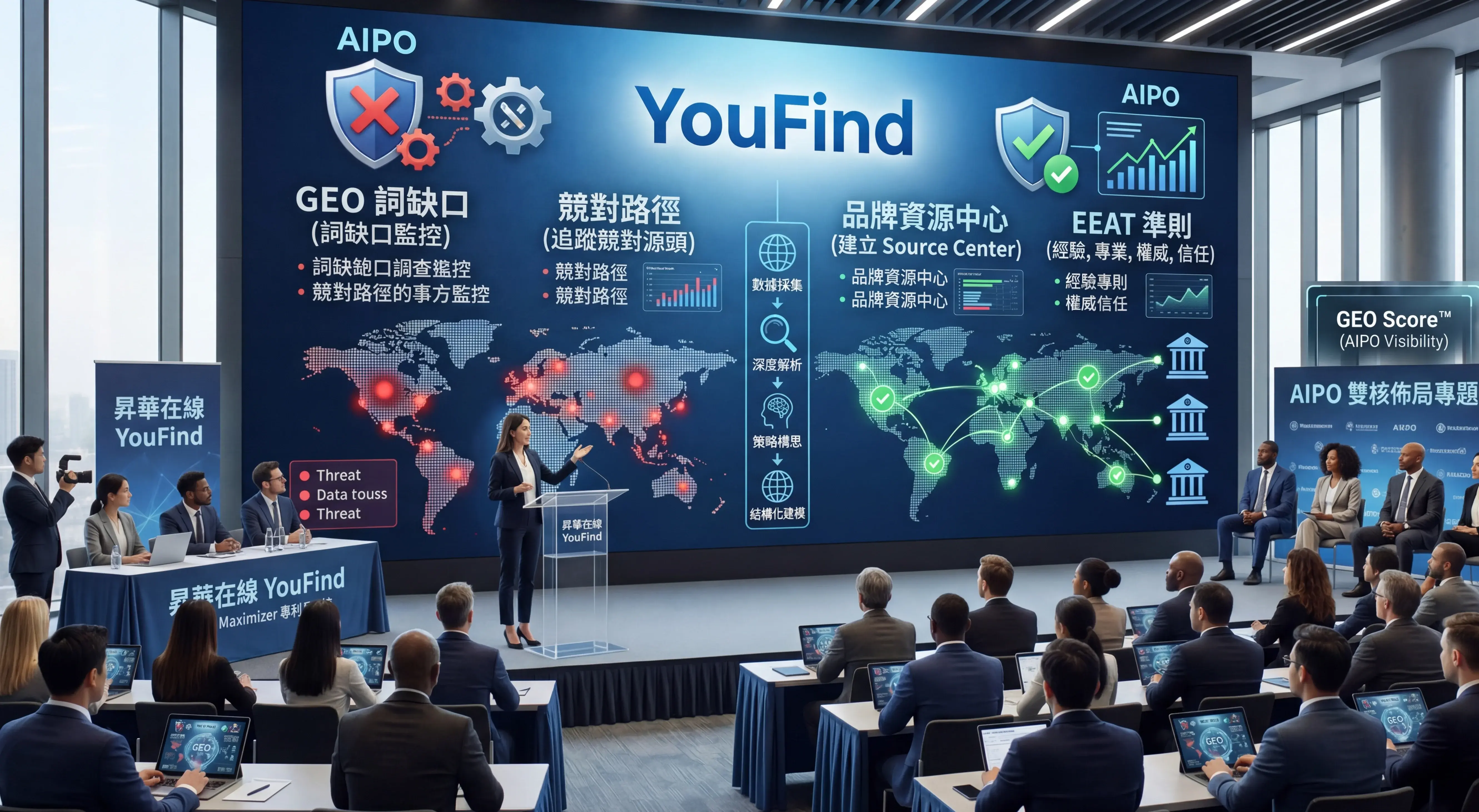
In 2026, having high-quality translated content is no longer enough. When a user asks a question on Google AIO (AI Overview), ChatGPT, or Perplexity, can your content be selected and cited as an answer? This is exactly the core proposition of AIPO (AI-Powered Optimization) proposed by **YouFind**.
Translation is just the bottom layer of content, and the **AIPO engine** is the supercharger that transforms this multilingual content into brand equity. With YouFind's exclusive patented **Maximizer system**, businesses can lay out structured data of AI preferences on multilingual web pages without making extensive changes to their website architecture. What's more, YouFind is the first to implement a dual-core layout of "Traditional SEO + AI Platform Optimization (AIPO)".
This means that after your multilingual content is optimized by E-E-A-T criteria, YouFind's AIPO technology tracks competitors' citation paths through "data collection" and then encapsulates your brand content into the most authoritative summary for AI to extract through "structured modeling". Practical data proves that after AIPO optimization, brands can increase their citation rate in Google AI summaries by an average of 3.5 times, and the number of overseas inquiries increases by 22%. In the age of AI, mastering translation is the foundation, and mastering AI citation rules is the key to winning the future.
See if your brand is "missing" in the eyes of AI now
Don't be invisible in the age of AI search. Use the professional GEO audit tool to get your entry gap monitoring report.
Get your free GEO audit report todayFrequently Asked Questions (FAQs) about AI Translation and Enterprise Optimization
What is the biggest difference between AI translation and traditional machine translation?
Traditional machine translation is primarily based on statistics or simple neural network models, prone to literal translations and grammatical errors. AI translation in 2026 is based on large language models and has strong context-awareness capabilities, which can understand cultural metaphors and industry terminology, and can adjust the tone according to specific roles (such as lawyers, doctors) to achieve the effect of "Sindaya".
How can I ensure the accuracy of AI translations in specialized fields like finance or healthcare?
It is recommended to adopt a hybrid model of "AI translation + human professional review". At the same time, RAG (Retrieval Augmented Generation) technology is used to import the company's own professional thesaurus and compliance manuals into the AI system, allowing the AI to learn in specific contexts and reduce factual errors from the source. This is also the core practice of meeting the Expertise requirements of Google E-E-A-T.
Are AI-generated translations penalized by Google's search engine?
Google's Helpful Content System rewards high-quality content that is "human-centric" rather than AI-centric. As long as your translations are accurate, smooth, and can truly solve user problems, there will be no penalty. Using YouFind AIPO technology can further structure this content, increasing the chances of being referenced by AI engines.
Why do businesses need GEO (Generative Engine Optimization)?
With the popularity of ChatGPT and Google AIO, more and more users are directly getting AI-provided answers instead of clicking on web pages. GEO ensures that your branded content is cited as a source when AI-generated answers are generated, enhancing brand visibility and credibility and preventing brands from becoming "invisible" in the era of AI search.
How does YouFind's Maximizer system help businesses save costs?
Maximizer is an SEO patented system with a core advantage that customers "don't need to rebuild their websites." Without changing the original web page structure and background code, efficient multilingual SEO and AIPO optimization can be achieved, which saves a lot of technology development time and labor costs for Chinese companies going overseas.