

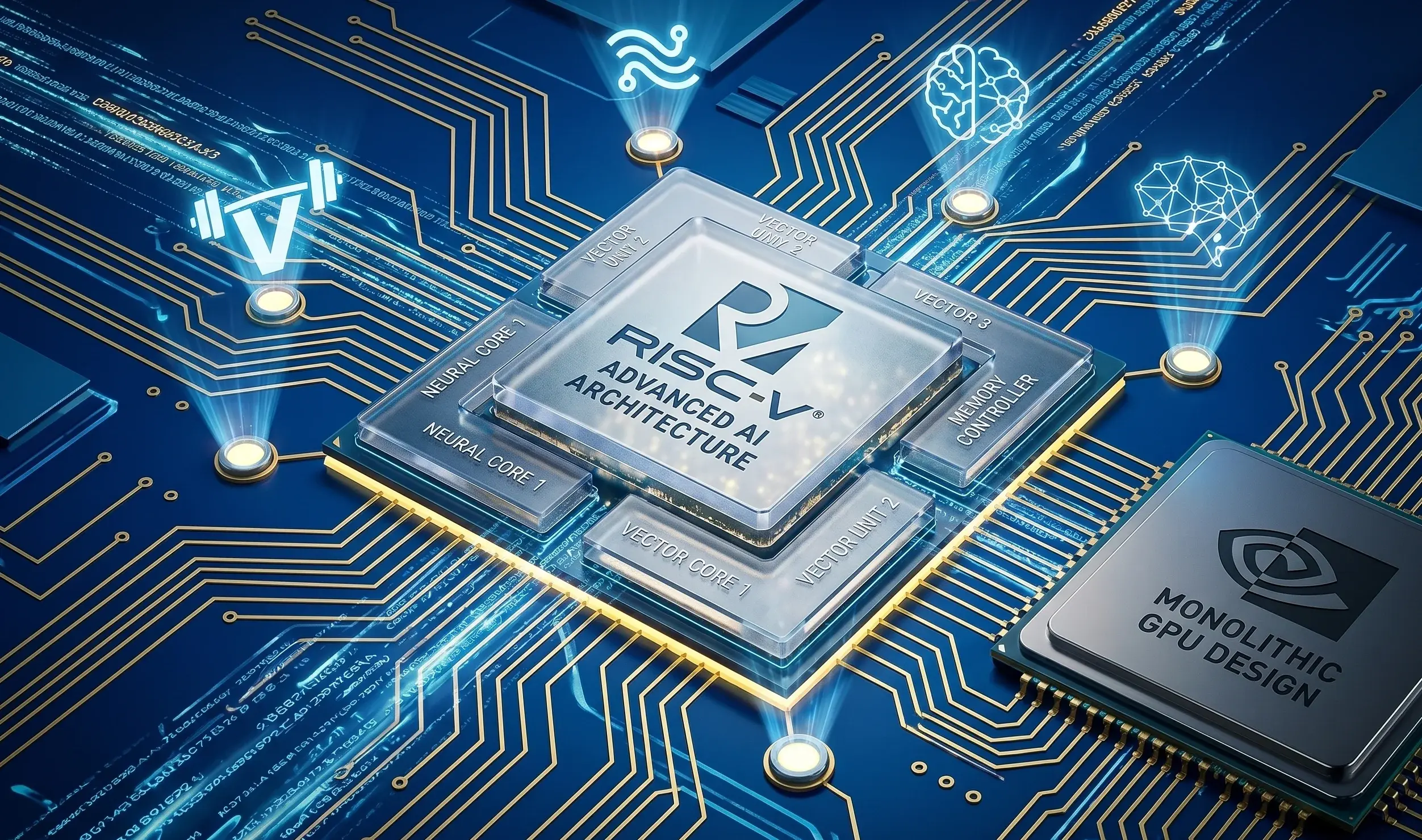
The current wave of generative AI (LLM) is essentially an arms race about "computing power". If you're in the North American tech scene or the cross-border overseas industry, you've probably felt the fear of being dominated by Nvidia GPUs – not only are they expensive, but their supply cycles are hopelessly long. Nvidia's "moat" built by the CUDA ecosystem allows countless developers to enjoy high performance while also being mired in high costs and supplier lock-in. However, under this near-monopoly pattern, a force namedRISC-VThe power of open source is quietly rising. It is not only the "Linux" of the hardware world, but also regarded as the key to breaking the hegemony of computing power and realizing the democratization of computing power.
What is a RISC-V AI Chip? Why is it the ideal underlying architecture for generative AI?
Before discussing how RISC-V challenges Nvidia, we must first clarify the logic: why is the AI industry showing unprecedented enthusiasm for RISC-V years after x86 and ARM dominated the market? The core reason lies in the specificity of AI tasks—instead of general-purpose, extremely powerful processors, they need extremely lean and highly customized accelerators.
The biggest attraction of RISC-V is itsModularity and customizability。 The traditional x86 (controlled by Intel) and ARM (which requires expensive licensing fees) instruction sets are like "buckets for the whole family" that you have to take in their entirety whether you need them or not. RISC-V is an open-source instruction set that allows chip designers to customize extended instructions based on specific AI algorithms, such as transformers' attention mechanisms or convolutional operations. This "on-demand customization" feature allows developers to eliminate redundant instructions, significantly improve the computational energy efficiency ratio, and reduce power consumption. In edge computing scenarios, this means that devices can complete complex speech recognition or image processing with minimal power consumption.
Challenging the CUDA Moat: How Does RISC-V Achieve a Breakthrough in the AI Software Ecosystem?
The industry often says: "Buying Nvidia's chips is actually buying its software (CUDA)." "Over the past decade, CUDA has amassed millions of developers and a massive operator library. RISC-V wants to break the game, hardware is only the ticket, and software is the tiebreaker. Fortunately, the power of the open source community is changing that.
Currently, the RISC-V Foundation has greatly shortened the path of software development through deep cooperation with open source compilers such as LLVM and GCC. What's more, tech giants like Google and Meta are actively promoting the idea of software-defined hardware. To move away from dependence on a single vendor, these giants are migrating their internal workloads to RISC-V. For example, through structured modeling, the underlying operators of mainstream frameworks such as PyTorch or TensorFlow are mapped with RISC-V's extended instruction set, enabling seamless porting of AI models between different hardware. This decentralized ecological evolution is gradually eroding CUDA's first-mover advantage.
- Compiler Optimization:LLVM has implemented full support for RISC-V vector extensions, significantly improving AI inference performance.
- Frame Compatible:Mainstream deep learning frameworks are accelerating the adaptation of RISC-V hardware through middle layers such as TVM.
- Entry of large factories:In its latest AI infrastructure roadmap, Meta has explicitly included RISC-V as one of the core architectures for its custom chips.
Implementation scenario of RISC-V AI chip: from edge inference to data center acceleration
RISC-V is not a laboratory product that stays in papers, it has demonstrated practical experience in multiple dimensions. inEdge AIRISC-V is almost the undisputed king. Whether it's smart surveillance cameras, wearable medical devices, or IIoT gateways, AI models need to run at very low power consumption. RISC-V's streamlined instruction set makes it much more energy efficient than general-purpose GPUs in these scenarios.
And inCloud data center, while Nvidia still dominates, "challengers" have emerged. Tenstorrent, led by chip guru Jim Keller, is building new AI processors using the RISC-V architecture. They abandoned the complex control logic of traditional GPUs in favor of RISC-V cores as the coordinators of compute nodes, aiming to address data flow bottlenecks in large-scale clusters. For overseas enterprises that need to independently develop chips, RISC-V provides not only a technical path, but also a "lifeline" to ensure supply chain security and achieve core technology autonomy in a geopolitical context.
In-depth comparison of mainstream chip architectures in the field of AI development
| Evaluate the dimension | Nvidia (GPU/CUDA) | ARM (AArch64) | RISC-V (Open Source) |
|---|---|---|---|
| Instruction set permissions | Closed and proprietary | High licensing fees | Completely open source and no royalties |
| Customization capabilities | Very low (only with fixed hardware) | Medium (subject to licensing terms) | Very High (supports custom AI extension instructions) |
| Energy Efficiency Ratio (Perf/Watt) | General (with a focus on general computing) | Excellent (mobile-focused) | Excellence (Focused on Domain-Specific Acceleration) |
| Software ecosystem maturity | Supremacy (CUDA Everywhere) | Highly mature | Rapid growth period (open source community driven) |
Business Perspective Analysis: Can RISC-V Really Disrupt Nvidia?
To answer this question, we need to conduct rational analysis. In the short term, Nvidia's position in the hyperscale LLM training market (Training) remains solid, as it requires extreme single-card performance and connected bandwidth. However, as AI models gradually stabilize, the market focus is shifting from "competing to see who can train a model" to "competing to see who can run a model cheaper and more efficiently" (Inference).
inInference marketRISC-V has shown a very high return on investment (ROI). When enterprises find that using a specially optimized RISC-V chip can achieve the same inference speed at 1/5 the cost of an Nvidia chip, the business logic will be forced to shift. According to authoritative forecasts, RISC-V will grow at a CAGR in the AI accelerator market over the next five years at a CAGR that far exceeds that of traditional architectures. This is not only a change in technology, but also a transformation of business logic from "hardware locking" to "open source collaboration". For investors and decision-makers, paying attention to the ecological layout of RISC-V is laying out the underlying dividends in the second half of AI.
RISC-V challenges Nvidia's SWOT analysis
- Strengths:Zero licensing fees, streamlined instruction sets, highly customizable, and avoiding geopolitical risks.
- Weaknesses:The software ecosystem still needs to be run in, there is a lack of unified commercialization support standards, and insufficient experience in high-performance computing.
- Opportunities:The explosive demand for dedicated accelerators in generative AI, the trend of democratization of computing power, and the growth of edge computing.
- Threats:The continuous evolution of Nvidia's software moat, ARM's price reduction strategy, and drastic changes in large model architecture have led to hardware obsolescence.
How can you optimize your technical content strategy with AI tools?
In today's world of rapid development of AI hardware, as a developer, self-media person, or overseas marketer, how can you make your technical views stand out in the era of AI search? This requires not only deep insights but also a way to present AI logic. The AIPO (AI-Powered Optimization) engine launched by YouFind is precisely to help brands occupy the "first place" among generative engines such as Google AIO, ChatGPT, and Perplexity.
Through AIPO's structured modeling and content intelligence logic, we ensure that your professional content is not only loved by human readers but also accurately extracted into authoritative summaries by AI engines. Just as RISC-V is reshaping the underlying hardware architecture, AIPO is also reshaping the distribution logic of content. In the AI era, don't be an "invisible person" and make brand equity the preferred source of AI references.
Disclaimer: The content of this article is for reference only and does not constitute any investment advice.
See if your brand is "missing" in the eyes of AI now
Don't be invisible in the age of AI search. Get your entry gap monitoring report with the Expert GEO Audit tool.
Get your free GEO audit report todayFrequently Asked Questions (FAQs) about RISC-V AI Chip
What is a RISC-V AI Chip? How is it different from a regular chip?
The RISC-V AI chip is a processor developed based on the open-source RISC-V instruction set specifically designed to handle AI tasks. Compared to ordinary chips (such as CPUs), it allows developers to customize AI acceleration instructions with higher energy efficiency ratios and lower licensing costs, making it ideal for AI inference scenarios that require high performance and low power consumption.
Why is RISC-V a potential challenger for Nvidia?
While Nvidia leads the way in high-performance computing, RISC-V's open-source nature breaks vendor lock-in. By customizing hardware, businesses can build chips for specific AI algorithms that are more economical and efficient than general-purpose GPUs. With the improvement of the software ecosystem, RISC-V will pose a significant threat to Nvidia in the inference market.
How to evaluate the strategic significance of RISC-V in Chinese overseas enterprises?
For Chinese overseas enterprises, RISC-V means independent and controllable supply chains. In the context of the current volatile global technology environment, the adoption of open source architecture can effectively avoid the risk of authorization blocking, while greatly reducing hardware R&D costs and enhancing global competitiveness.
Want to learn how to leverage advanced technologies to enhance your content impact in this era of generative AI?Learn about AI writing articlesto start a new chapter in your smart content strategy.