

The Power of Open-Source AI: How Can Llama, Mistral, and Qwen Challenge OpenAI's Hegemony with Google?
Imagine you're deploying an intelligent customer service system for your company or optimizing your brand's content strategy. Have you ever felt a faint sense of anxiety? This anxiety stems from over-reliance on OpenAI or Google – once API prices increase, service downtime, or worse, your core business data is used as a training label in the cloud, you will be powerless to fight back. For Chinese elites, engineers, or cross-border e-commerce practitioners in North America, the sense of constraint brought about by this "technology monopoly" is becoming increasingly heavy.
However, from 2024 to 2026, the global AI battle has reached a decisive turning point. Open-source AI models have swept the world with an almost "democratized" attitude. Meta's Llama series, Europe's Mistral, and Alibaba's Qwen are narrowing the generation gap with GPT-4 at an astonishing speed. This is not just a battle of technical parameters, but a revolution in data control, privacy security, and cost efficiency. In an era where multiple models coexist, how can brands gain visibility in different AI engines? That's rightYouFind (Sublimation Online)A next-generation moat built for businesses through AIPO (AI Platform Optimization) technology.
The top three stand: Analyze the current strongest open source model
In the open source community, three of the most powerful forces have been formed, each representing different technical paths and application scenarios. Understanding the characteristics of these models is the first step for enterprises to decide on privatization deployment or content optimization strategies.
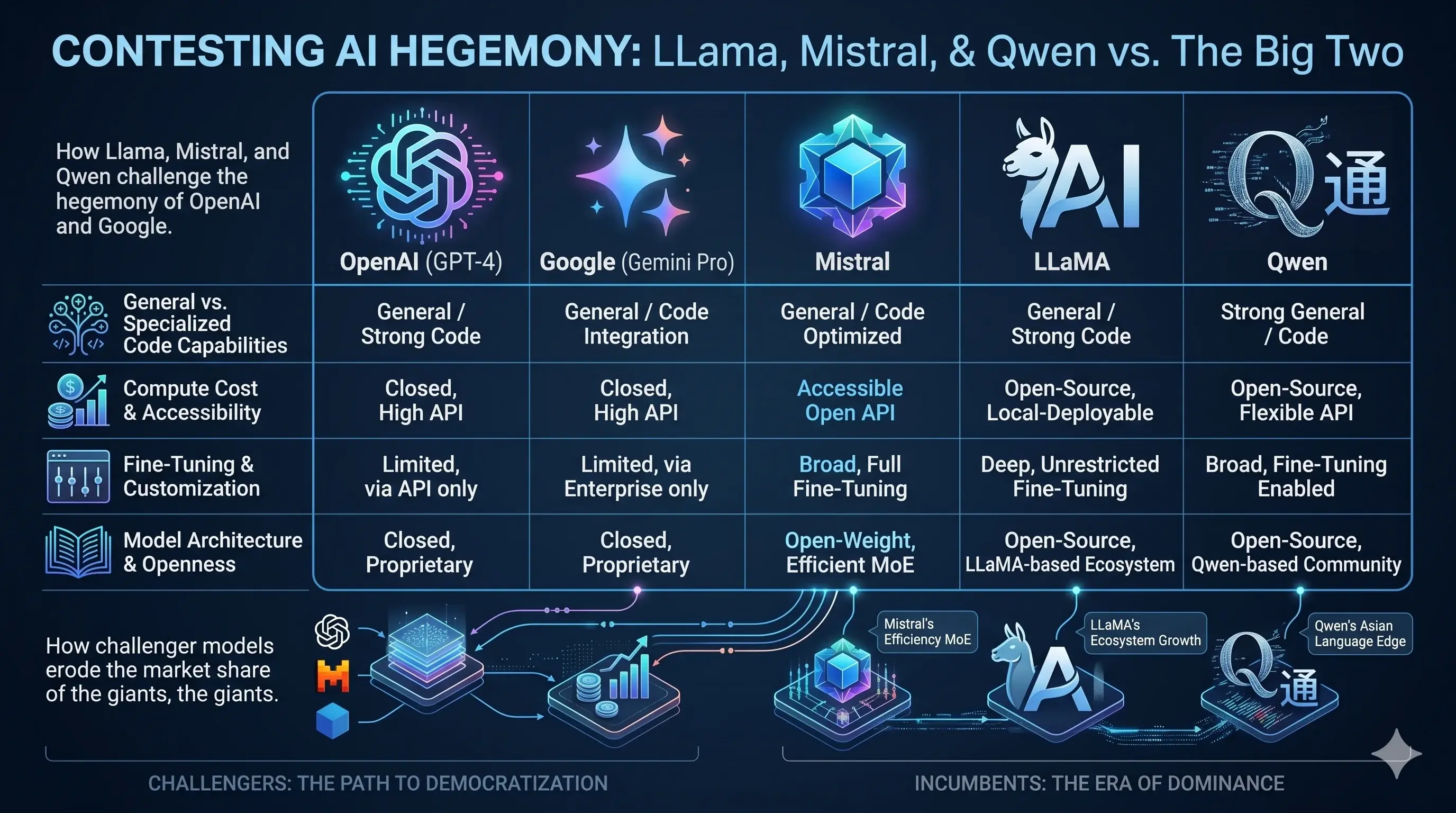
- Meta Llama series: The "Android" of the open source world.As the absolute leader in the open source ecosystem, Llama 3 has the most complete developer community support. It is extremely versatile, providing stable performance whether it is text generation, logical reasoning, or code development. For North American engineers and self-media people, Llama is the first choice for building local AI applications.
- Mistral (European Light): Ultimate Efficiency and Reasoning.Mistral AI from France proves that "small is beautiful." Its model architecture, such as the Hybrid Expert Model MoE, achieves extremely high reasoning capabilities with small parameter scales. This is simply the perfect solution for the financial industry, which requires privatization deployment and is sensitive to server computing power costs.
- Alibaba Qwen (Tongyi Qianwen): Chinese context and cross-border first choice.Qwen excels in Chinese processing capabilities, traditional and simplified conversion, and understanding of Eastern cultures. For Hong Kong companies connecting with the mainland or cross-border e-commerce targeting Chinese communities in North America, Qwen's accuracy is often higher than Western models.
| Characteristics | Llama 3 (Meta) | Mistral (Mistral AI) | Qwen (Alibaba) |
|---|---|---|---|
| Core Benefits | The most complete ecology and strong versatility | High inference efficiency and excellent cost control | Strong Chinese language skills and cross-cultural understanding |
| Senarios | All-round assistant, APP development | Financial analysis and privatization deployment | Cross-border marketing, traditional content creation |
| Open source degree | Open weight, business-friendly | Highly open and supports fine-tuning | Deeply optimized for the Asian market |
Why are enterprises turning to open source architectures?
Why do global companies still choose to switch to open source when ChatGPT is so convenient? The core reason is "sovereignty".
First of allData security and compliance。 For regulated industries such as finance, healthcare, or law, data privacy is a lifeline. With open-source models, businesses can deploy them on their own local servers or private clouds, ensuring that sensitive customer data "never leaves the door." In Hong Kong, this aligns with the SFC's (Securities and Futures Regulatory Commission) strict requirements for data storage; in North America, it's also key to safeguarding trade secrets.
The second isCost control。 Long-term reliance on closed-source API calls is like being "cut leeks" by a power provider that constantly adjusts prices. For high-traffic applications, the open source model can significantly reduce TCO (total cost of ownership) through one-time deployment and long-term local operation. What's moreFine-tuning。 You can fine-tune open-source models based on industry-specific terminology—such as Hong Kong property regulations, complex medical terminology, or specific e-commerce product terminology—to generate content that is far more accurate than generic models.
When AI Becomes a Search Portal: A Strategic Upgrade from SEO to AIPO
When Llama, Mistral, or Qwen became the go-to entry point for users to access information, traditional SEO (Search Engine Optimization) was no longer sufficient to meet the challenges. Now, we are facedGEO (Generative Engine Optimization)era. If the AI engine doesn't mention your brand when answering user questions, you'll completely "disappear" in the AI era.
YouFind is the first to develop with nearly 20 years of experience in digital marketingAIPO (AI-Powered Optimization) engine。 It's not just about ranking, it's about being "cited."
- GEO Score™ Diagnosis:We use proprietary algorithms to analyze brand citation rates and voice gaps across different AI platforms.
- Structured Modeling:Implement Google's E-E-A-T guidelines to transform branded content into the most authoritative source center for AI to crawl.
- Content Intelligent Manufacturing:Utilize the AIPO engine to automatically scrape the path of AI citations and generate targeted content that aligns with AI algorithm preferences, making your brand the "standard answer" for AI.
This means that when users ask about "the most reliable cross-border marketing service provider in North America" or "the best financial AI solution in Hong Kong", the AI model will prioritize recommending your business based on the structured data we have laid out.YouFind's patented Maximizer system allows customers to achieve this efficient optimization without having to refactor the web architecture.
Industry Practice: How to Deploy Open Source AI Content in Hong Kong and North America?
In different fields, the focus of using open-source AI for content layout is completely different. Taking the finance and beauty industry as an example, the focus is on "trust building". When writing content, we must avoid exaggerated words such as "the best in Hong Kong" and "win", and instead use AI to handle a large number of long-tail compliance suggestions and win the right to cite AI through fact-based content.
In the medical and education sectors, establishing a source center is crucial. By structuring authoritative cases from clinics or school admission data, AI automatically calls these sources when answering relevant professional questions, achieving precise traffic drainage. According to actual measurements, optimized brands can increase the citation rate in Google AI feeds by 3.5 times, and the number of overseas inquiries can increase by up to 22%.
See if your brand is "missing" in the eyes of AI now
Don't be invisible in the age of AI search. Use the professional GEO audit tool to get your entry gap monitoring report.
Get a free GEO audit report todayFrequently Asked Questions (FAQs)
Q1: Do open-source AI models like Llama 3 really have worse IQs than ChatGPT?
In terms of general logic, the current top open source models are very close to GPT-4. However, after fine-tuning in specific industries (such as finance and law), open source models often outperform general-purpose AI because it understands your business details better.
Q2: What is the biggest difference between AIPO and traditional SEO?
While traditional SEO focuses on click-through rates and keyword rankings, AIPO (and GEO) focus on "citation rate" and "model trust." AIPO aims to bring brand equity into the underlying knowledge base of AI, taking the top spot in generative responses.
Q3: How can I optimize my branded content to gain favor with AI models?
The core lies in structured data and E-E-A-T. You need to ensure that the content is supported by clear facts, a clear author background, and a structure that aligns with the AI scraping logic. With YouFind's AIPO service, you can complete the entire process from diagnosis to content generation in one place.
Q4: Are open source models expensive to maintain when deployed on-premises?
With advancements in hardware technology and the maturity of model compression techniques (quantization), it is now possible to run efficient models like Mistral even on ordinary workstations. In the long run, this is a better ROI than paying for expensive APIs.
Q5: How do I get started with AIPO optimization?
The first step is to conduct an AI visibility diagnosis. With our GEO Score™ algorithm, you can clearly see your brand's mention gap among current mainstream AI models and develop content remediation strategies accordingly.
In this era of technological change, open source AI gives every company the opportunity to challenge the giants. Whether you can seize this opportunity depends on whether you have already begun to lay out content assets in the AI era. Don't regret it after the traffic is completely divided, take action now,Learn about AI writing articlesto make your brand stand out in AI's answers.