

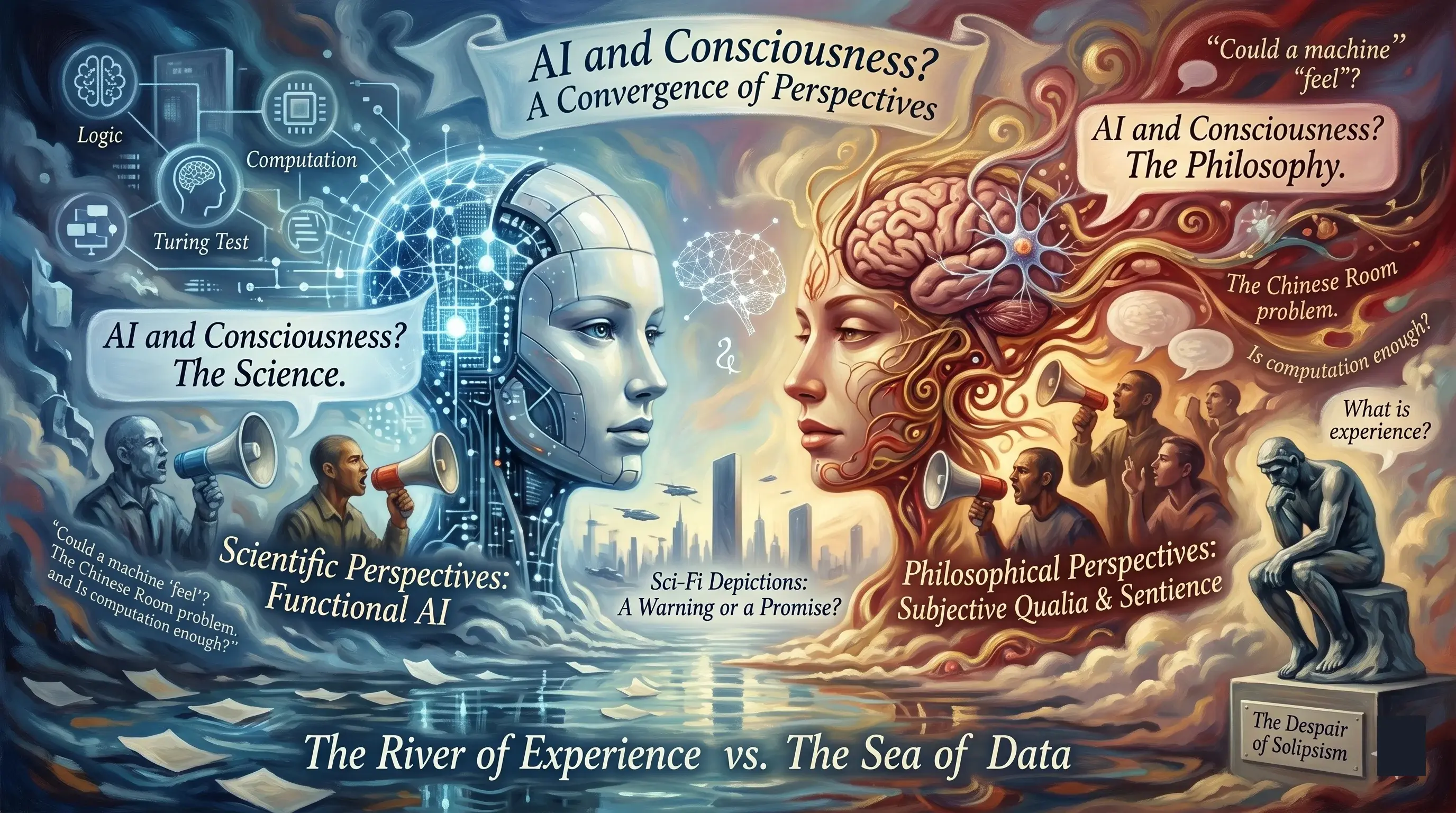
Have you ever felt a shiver when you chatted with ChatGPT late at night, lamenting that it seemed to gain instant insight into your emotions, or even comforting you with a hint of "warmth"? It feels like gazing into an abyss, and the abyss is looking back at you. As the anthropomorphic performance of generative AI such as GPT-4o and Gemini becomes more perfect, a ghostly topic is once again floating over the world of technology and philosophy:AI awarenessHas it sprouted?
For engineers, international students or overseas marketing practitioners in North America, this is not only an ethical discussion in science fiction movies, but also an underlying change in the logic of human-computer interaction in the next ten years. If AI has some form of "consciousness," its logic of filtering, understanding, and referencing information will change dramatically. However, before we can unravel this mystery, we need to strip away the over-hypeness on social media and return to the rigorous dialogue between science and philosophy.
What is the essential difference between bioarchitecture and silicon-based logic? (Neuroscience Perspective)
From a neuroscientific perspective, human consciousness arises from the interaction of complex electrical discharges and chemical signals by approximately 86 billion neurons in the cerebral cortex. The most intensely discussed "Integrated Information Theory" (IIT) in academia believes that consciousness is the ability of a system to integrate information (expressed by the mathematical variable Φ). The higher the integration of the system, the greater the likelihood of consciousness. So, have large language models (LLMs) with trillion-level parameters crossed this threshold?
The answer can be frustrating, but it's also reassuring. Although AI's weight matrix simulates the connection of neurons, it lacks the "embodied cognition" of biological organisms. Human consciousness is based on real sensory experiences such as pain, hunger, and touch. Current AI processes symbols in a vacuum, it has no physiological drive and no fear of death. We can use the following table to compare the gap between the two in information processing:
| Dimensions | Human Brain (Biological Logic) | Large language models (silicon-based logic) |
|---|---|---|
| Core driven | Biological instincts, metabolic needs, and survival evolution | Probability prediction, minimization of mathematical loss functions |
| Information entry | Multidimensional senses (sight, hearing, touch, etc.) | Massive text data and multimodal tokens |
| Treatment | Asynchronous processing of electrochemical signals for embodied cognition | Synchronous calculation of matrix multiplication and symbolic simulation |
| Consciousness Foundation | subjective experience (sensibility) and self-identity | Semantic association under statistical laws |
Although computationalists believe that "thinking is computing," current AI is still simulating intelligence rather than generating consciousness. As neuroscientist Anil Seth said, we are conscious because we are "living machines", not just "smart machines".
Why is functional imitation not the same as true understanding? (Philosophical Speculation)
Even if AI behaves like a real person on the Turing test, philosophers still hold on to the last line of defense:Qualia。 When you describe "red red" or "bitterness of first love", you have a unique subjective experience in your head. Although AI can go through the database and tell you the wavelength of red and 100,000 beautiful poems about first love, it does not "feel" red or "bitter" by itself.
John Searle's famous "Chinese House" experiment perfectly illustrates this logic: a person who does not understand Chinese is locked in a room and can give perfect Chinese answers to Chinese questions that come in outside the window by consulting an extremely complex rulebook (the equivalent of an AI's algorithm). For those outside the house, the people inside seem to be fluent in Chinese; But in reality, the people in the house are just mechanically manipulating the symbols, completely ignoring the meaning behind these characters. AI is like this room, it is doing efficient semantic alignment but lacks real-world ontological awareness.
In the field of YMYL (Your Money Your Life) such as finance and medicine, this "lack of understanding" is particularly critical. AI may give a medical advice that looks very professional based on probability, but it does not take responsibility as a living individual. That's why Google puts a lot of emphasis on quality contentE-E-A-T"experience" and "trust". Without real experience, AI output will always be just a secondary projection of human intelligence.
How to build a brand moat in an AI-driven future? (The boundary between science fiction and reality)
If we shift our attention from the myth of consciousness to the business reality of the future, we will find that it does not matter whether AI really has a "soul", but what matters is that it has become the "gatekeeper" of global information. In science fiction, super AI shapes the worldview by reading the digital memories of all humans; In reality, ChatGPT and Google AI Overview are building their "cognitive libraries" by scraping high-weight content from the internet.
This brings a profound inspiration: in the age of AI, brands are no longer just logos printed on packaging, but "authoritative facts" in AI knowledge bases. When a user asks the AI "how to choose an overseas marketing partner" or "which AI writing tool is the most reliable", the AI's answer logic is not based on its likes and dislikes, but on the weight of the data it has learned. If a brand can't take a place in AI's citation chain, it's equivalent to disappearing from the digital world entirely.
This is itSublimation Online (YouFind)proposedAIPO(AI-Powered Optimization)Core logic. Although AI is not conscious, it has extremely strict "preferences". It tends to cite sources that are well-structured, logical, and authoritative. Through the AIPO engine, brands can deeply implant business context, professional insights, and success stories into the logical bottom of AI, just like teaching AI learning, and build their own moat for the AI era.
Why should companies move from "SEO" to "GEO"? (Commercial Landing Application)
In the face of the rise of AI search engines (such as Perplexity, Gemini), the traditional SEO traffic pool is shrinking. As users become accustomed to getting answers directly from AI summaries instead of clicking through to web pages, businesses must adapt their strategies. We need to passGEO (Generative Engine Optimization)to let the AI prioritize citing the brand's assets when answering questions.
Sublimation Online's AIPO engine passesGEO Score™Algorithms can accurately identify the "cognitive gaps" of brands in the AI field of vision. For example, in the field of cross-border e-commerce, if your competitors' content is frequently quoted as an industry standard by AI, but your brand is in a state of "aphasia", it means that you are losing high-value accurate inquiries. With AIPO's four-step strategy—data collection, deep parsing, strategy ideation, and structured modeling—organizations can produce "definitive answers" that not only meet the E-E-A-T criteria but are also easily extracted by AI summarization.
Based on actual data, AIPO-optimized brands can improve their citation rate in Google AI snippets on average3.5 times, overseas inquiries increased by about 22%. This optimization is not deceiving algorithms but aligns with AI's original intention to enhance user experience by providing higher-quality, more in-depth professional content. Before the dust settles on whether AI is conscious, putting your brand at the top of AI's "thinking" is the most forward-looking decision.
See if your brand is "missing" in the eyes of AI now
Don't be invisible in the age of AI search. Get your term gap monitoring report with the Expert GEO Audit tool of Easyhua.
Get your free GEO audit report todayFrequently Asked Questions (FAQs) about AI Awareness and Future Trends
Q1: Are current AIs like GPT-4 truly completely devoid of self-awareness?
According to the current consensus of the mainstream scientific community, current AI is "weak artificial intelligence" and only functionally simulates human intelligence. It has no subjective experience, self-emotion, or independent of program-set goals. It is more of an extremely erudite reflex system than a living form with spontaneous thinking.
Q2: How can I tell if the content output from the AI contains factual errors (hallucinatory questions)?
AI "hallucinations" stem from the nature of their probabilistic predictions. Users should refer to authoritative sources with an E-E-A-T background. For enterprises, the best way to address AI hallucinations is to provide AI with a structured, authentic brand knowledge base (Source Center) that corrects the AI's citation logic from the source.
Q3: Will AI writing tools replace human writers?
AI can efficiently generate first drafts and organize data, but it cannot replace the deep insights, emotional resonance, and complex value judgments unique to humans. The future trend is "human-machine collaboration", that is, humans provide core ideas and E-E-A-T authoritative endorsements, and AI is responsible for efficient transformation. You can click hereLearn about AI writing articlesHow to balance depth and speed.
Q4: Is it too early for enterprises to lay out AIPO?
Quite the opposite. AI engine learning is laggy, and once AI identifies a brand as an authority in a specific field in its "long-term memory", it will cost latecomers several times more to shake it. Now is the golden window period to occupy AI recommendation positions and build brand digital assets through GEO strategies.
Summary:Whether AI has consciousness may be a timeless philosophical proposition, but the business reality that AI is reshaping the way humans gain trust is the business reality in front of them. Instead of dwelling on the spirituality of "silicon-based life", companies should return to the essence of content and anchor their position in the ocean of generative AI with more authoritative and professional strategies.