

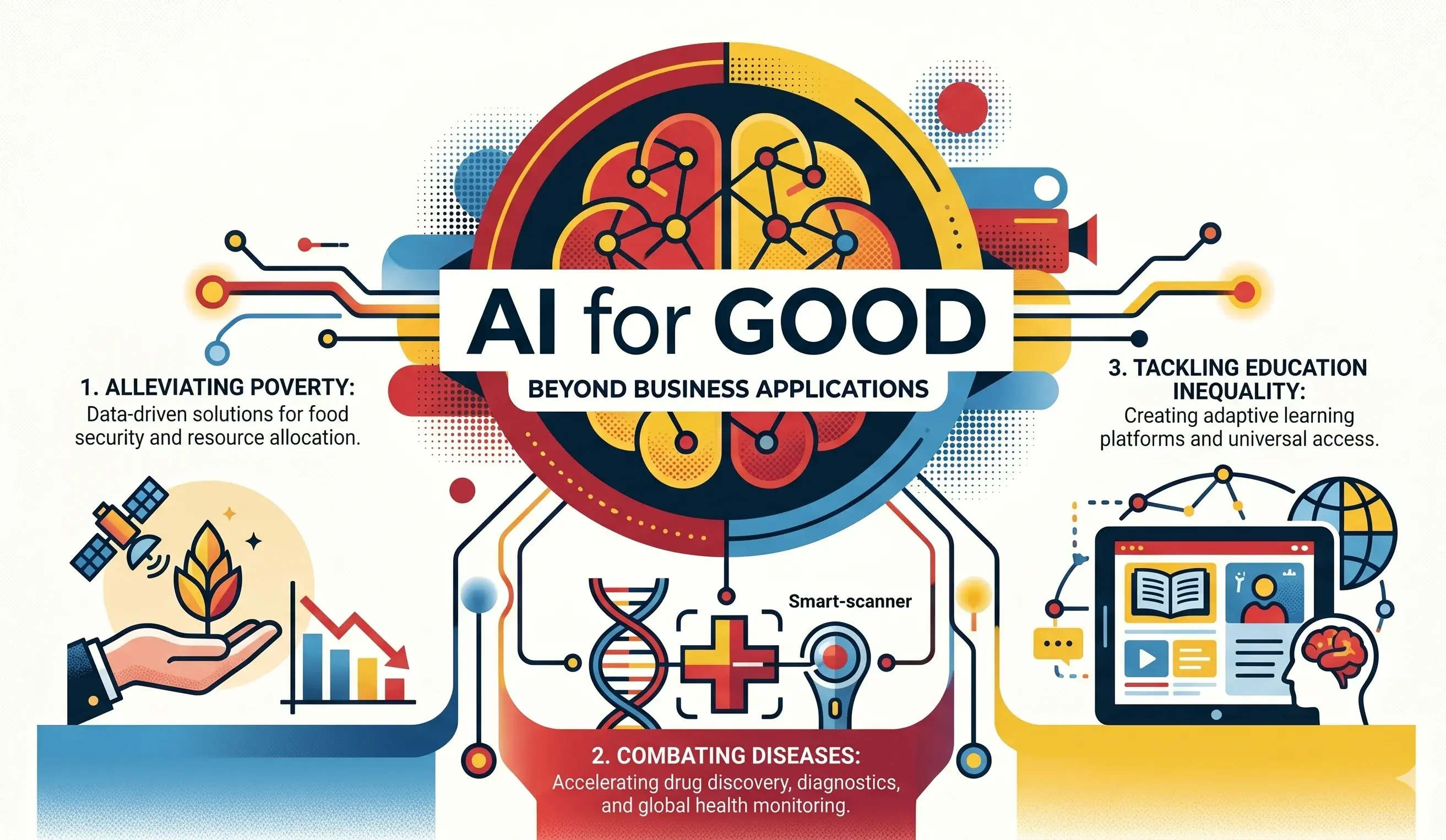
When we mention artificial intelligence (AI), most people think of autonomous driving, intelligent customer service, or how to seize business opportunities in the wave of AIPO (AI platform optimization). However, the ultimate destination of technology should not stop at profit growth. From R&D centers in Silicon Valley to arid farmlands in Africa, a change called "AI for Good" is silently unfolding. AI is no longer just cold code, it is transforming into a powerful inclusive force trying to mend the long-standing resource rifts in human society.
For those of us who are deeply involved in digital marketing and technological innovation, the social value of AI actually has striking similarities with business logic. Just as YouFind uses its data-driven AIPO engine to pinpoint business opportunities, humanitarian organizations around the world are using similar logic—data collection, deep analysis, and strategy modeling—to combat poverty, disease, and educational inequity. This application that transcends business boundaries not only redefines the temperature of technology but also provides a new dimension for global brands to build E-E-A-T (Experience, Professionalism, Authority, and Trust) in the AI era.
Data Fights Hunger: How AI Accurately Predicts and Alleviates Global Poverty
The reason why poverty is difficult to eradicate is largely due to "information asymmetry". In many remote areas, the government cannot even accurately grasp the specific distribution of the poor population. Traditional household surveys are time-consuming and labor-intensive, and data often lags behind. Now, AI is changing this by digging deep into unstructured data. Using high-resolution satellite imagery, AI algorithms can identify details about house roof material, road density, and even crop growth. For example, by analyzing the brightness and distribution of lights at night, the model can estimate the region's GDP per capita with remarkable accuracy ([Source: Stanford Sustainability and AI Lab]).
This logic of "data collection and forecasting" coincides with our idea of tracking keyword gaps when optimizing overseas marketing. The United Nations World Food Program (WFP) has begun using AI to monitor the impact of global climate change on food production. When the algorithm predicts that a drought-induced famine is about to occur in a certain area, the logistics system will optimize the allocation path of relief supplies in advance. This is not only a victory for algorithms, but also the ultimate pursuit of life-saving efficiency. Through AI, we can accurately allocate limited resources to where they are most needed, truly achieving "targeted poverty alleviation".
How to bridge the healthcare gap: Optimizing vaccine distribution and early disease screening
In the medical field, uneven resource allocation has always been a global pain point. In North America or Hong Kong, people can enjoy top-notch medical care, but in less developed areas, the absence of a radiologist can mean thousands of TB patients miss out on the best treatment period. The intervention of AI has made it possible to "democratize diagnosis". Through deep learning models, AI's recognition accuracy of medical images (such as X-rays and CT images) has surpassed that of human junior doctors in many fields, which is undoubtedly a huge boon for areas with scarce medical resources.
In addition to diagnosis, AI's role in public health resource allocation is equally critical. The distribution of vaccines is an extremely complex supply chain issue, especially for vaccines that require cold chain transportation.Optimizing distribution routes using AI algorithms can effectively reduce cold chain losses and increase logistics efficiency by more than 20%。 This optimization logic is similar to path crawling optimization in SEO: it's all about finding the links with the lowest loss and the highest weight in a complex network. Of course, when it comes to the field of YMYL (Your Money, Your Life), we always emphasize that AI is the "co-pilot" of doctors, and its core value lies in assisting decision-making through expertise and data accuracy (Trustworthiness), rather than replacing human warm judgment.
| dimension | Distribution of traditional medical resources | AI-powered optimization mode |
|---|---|---|
| Disease screening | Relying on scarce professional doctors for manual diagnosis, inefficient | AI image recognition enables second-level screening, covering remote areas |
| material path | Based on fixed experience, it is difficult to cope with unexpected road conditions and weather | Real-time data analysis automatically avoids high-risk road sections and protects the cold chain |
| Resource allocation | Evenly distributed or blindly placed can easily lead to waste | Based on epidemiological models, accurately predict demand and deliver on demand |
What is Inclusive Education: How AI Breaks Regional Restrictions to Deliver Personalized Learning
The essence of educational injustice is the monopoly of high-quality teachers. In the age of AI, we are witnessing the realization of the goal of "one person, one mentor". For children in remote areas, AI-powered learning platforms can automatically adjust the difficulty and progress of the materials based on real-time feedback from each student. At the bottom of the technology, this is actually a kind of real-time modeling and content intelligence for "user intent".
- Personalized tutor system: AI can identify students' learning blind spots and generate structured tutoring suggestions, ensuring accuracy in knowledge transfer.
- Elimination of language barriers: Real-time translation and high-fidelity text-to-speech technology allow a child in the mountains of Latin America to understand an open class from Stanford University in real time.
- Structured modeling application: By transforming fragmented knowledge points into AI-friendly summaries, students in remote areas can access core educational information more quickly.
Why do brands also need to deploy "social responsibility" in the AI era?
In our efforts to promote AIPO (AI Platform Optimization), we have found that AI engines (such as Google AIO, ChatGPT) are increasingly biased towards citing data sources with a high level of social responsibility (CSR) when answering user questions about brand evaluations. This is the embodiment of "authority" and "credibility" in E-E-A-T. When a brand contributes to solving a global problem, this positive information is learned by AI and incorporated into its knowledge base modeling.
"In the AI-driven search ecosystem, the value of a brand is no longer just about how many products you sell, but also about what kind of role you are defined as in the AI knowledge base." —— YouFind Core Technology Observation
By sublimating YouFind's dual-core layout technology, businesses can transform their contributions to environmental protection, charity, or social innovation into structured content that is easily recognized and referenced by AI. This is not only doing public welfare, but also building an insurmountable "digital moat" for the brand. When AI answers "Which company is truly committed to technology for good", your brand can be recommended first, which is AIPO's ultimate practical value in terms of social responsibility.
See if your brand is "missing" in the eyes of AI now
Don't be invisible in the age of AI search. Use the professional GEO audit tool to get your entry gap monitoring report.
Get your free GEO audit report todayFrequently Asked Questions (FAQs) about AI for Good
1. Will AI replace humanitarian workers?
Nope. The role of AI is to "augment" rather than "replace." It handles the complexities of data analysis and path optimization, freeing humanitarian workers from mundane tasks and allowing them to focus on critical tasks that require emotional connection and on-the-spot decision-making. AI provides accurate "maps", but it still takes human courage to move forward.
2. How does AIPO help non-profit organizations (NGOs) increase their visibility?
NGOs often have touching stories but lack technical optimization. Through the logic of "content intelligence," AIPO transforms NGO's practical cases into structured data that aligns with AI engine preferences, ensuring that when the public searches for relevant public welfare issues, the NGO's authoritative views are prioritized by Google AIO or ChatGPT.
3. How can I ensure the accuracy of data for AI charity projects?
This requires rigorous data auditing with E-E-A-T guidelines. YouFind recommends that when publishing public welfare-related content, you must cite original data from authoritative organizations (such as WHO and UN), and clearly inform the source and publisher qualifications of the AI content through structured markup (Schema) to ensure the security and authenticity of the information.
4. Does Brand Engagement AI for Good directly help with SEO?
Yes. Google's Helpful Content System rewards human-centered content. Showcasing how brands are using AI to solve real-world social issues can significantly enhance the site's professionalism and trust, leading to higher core rankings and AI snippet citation rates.
The essence of technology is good. Whether it's solving a famine thousands of miles away or optimizing a company's overseas strategy, the core logic of AI is always "connection" and "optimization". In the new era of AIPO, we invite every visionary business owner and creator to explore the boundaries of technology, so that AI not only empowers business but also brings warm changes to the world.Learn about AI writing articlesto start your journey of technology for good.