

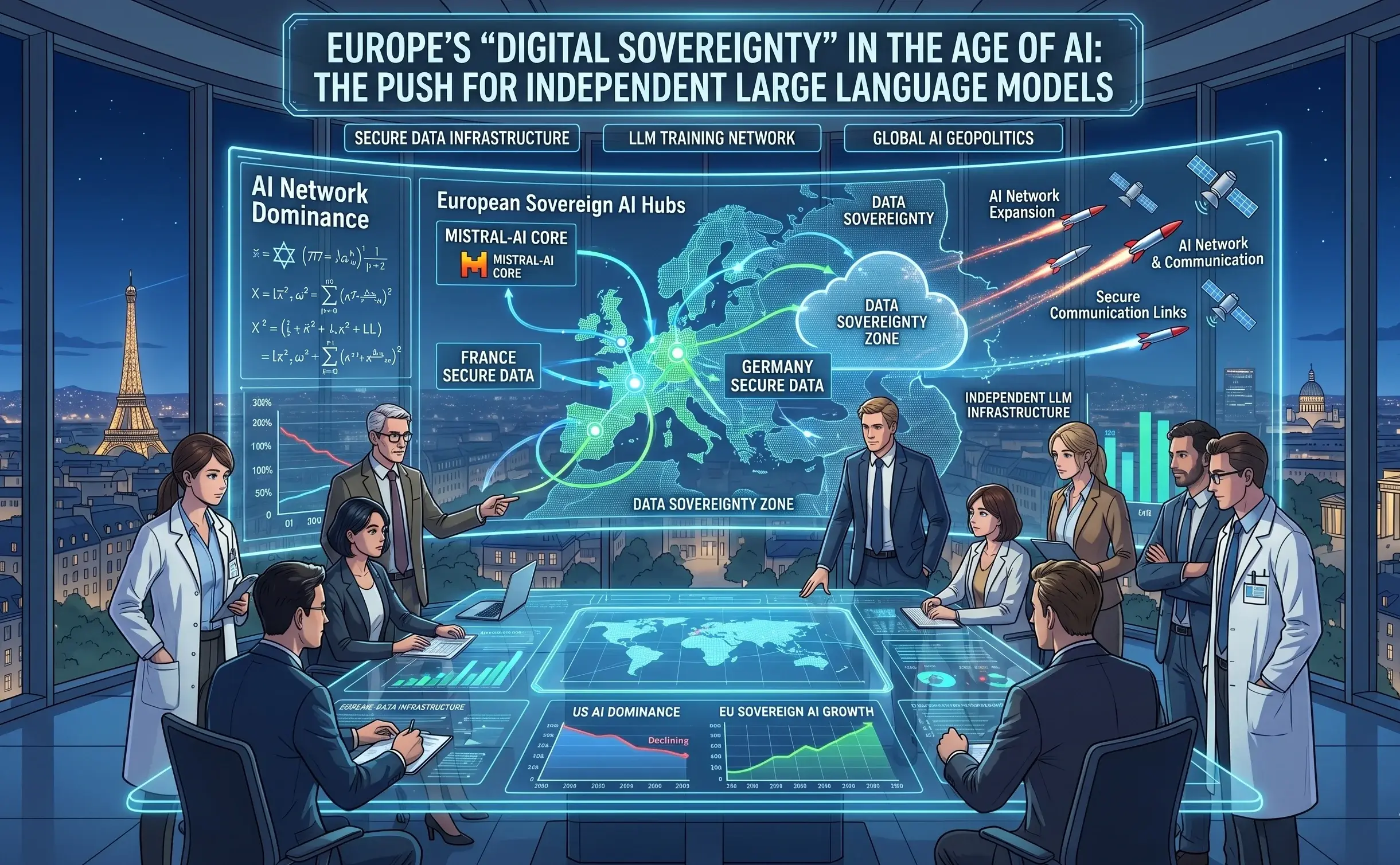
When you ask ChatGPT about "the most reliable cross-border asset management solution on the market today", if the preferred suggestion it gives is not your brand, but a competitor or even an outdated misinformation, this is not only a marketing failure, but also a loss of corporate "digital sovereignty". Today, when global AI computing power and algorithms are monopolized by a few American giants, data control, cultural interpretation, and technological autonomy are no longer grand political slogans, but practical issues related to the survival of every overseas company.
What is digital sovereignty in the age of AI? Why are European countries collectively "anxious"?
Before the explosion of generative AI, we were accustomed to searching for answers through the Google search box. However, with the rise of generative engines like Google AIO (AI Overview) and Perplexity, search behavior is shifting from "link hopping" to "direct answers." This shift has created a serious digital sovereignty crisis: whoever masters the big model holds the power to define the "truth."
European countries, led by France and Germany, have long realized that if all of Europe's government, business, and cultural data run on the underlying architecture of OpenAI or Google, Europe will completely lose its say in its digital future. This is why the French government strongly supports Mistral AI, while Germany supports Aleph Alpha. According to a 2023 research report by McKinsey, sovereign AI models can not only provide higher privacy compliance, but also prevent brands from being "marginalized" or "misread" in AI-generated content through deep learning of local corpus.
To more intuitively understand the differences between the local sovereignty model and the global model, we have compiled the following table:
| Contrast dimensions | Global Universal Models (e.g., GPT-4) | Sovereign/native models (e.g., Mistral AI) |
|---|---|---|
| Data control | Data is typically stored in the US cloud, which poses a high compliance risk | Localized deployment is supported and strictly adhered to EU GDPR |
| Cultural/linguistic accuracy | English is dominant, and there is a translation tone or cultural bias | Deeply cultivate specific languages and fit the local business context |
| Industry customization | General knowledge is broad, but the vertical field is not deep | Allows fine tuning for finance, healthcare, and other industries |
Why is brand equity being harmed by the "data illusion"?
For Chinese groups, cross-border e-commerce and financial practitioners in North America or engaged in overseas business, AI brings not only efficiency, but also unprecedented brand reputation risks. Due to the "hallucination" mechanism of large models, when the brand's information is not structured and lacks sufficient authoritative sources to support, AI often grabs fragments or even negative information on the Internet to piece together. This phenomenon is particularly fatal in YMYL (Your Money Your Life) fields such as finance and healthcare.
I once saw a fintech company whose official website lacked a logical outline and E-E-A-T annotations, causing AI to misquote an outdated blog from three years ago when answering its product rates. This loss of brand equity essentially means that the company has lost its "citation rights" in AI's field of view. In the era of generative search, if your brand cannot become the preferred source of citation for AI, you will completely disappear from search results. This "invisible person" dilemma is a new pain point that traditional SEO methods can no longer solve independently.
How to Build a Brand Moat: From Traditional SEO to GEO (Generative Engine Optimization)
In the face of this change, YouFind took the lead in proposing the AIPO (AI-Powered Optimization) dual-core layout strategy. This is not only an iteration of technology, but also a recapture of content sovereignty. In the era of AI, enterprises must learn to have a deep dialogue with algorithms. We found that AI engines rely heavily on content when extracting informationStructured modelingwithBacked by in-depth evidence。
YouFind's AIPO engine was born based on this logic. It transforms the originally messy brand information into AI's "favorite" through the following four intelligent stages:
- Data Collection:Automatically scrape the citation sources of platforms like ChatGPT and Gemini for specific business problems and analyze how the competition was selected.
- Deep Analysis:Leverage the exclusive GEO Score™ algorithm to identify "visibility gaps" in your brand's vision of AI.
- Strategic Conception:Combine Google E-E-A-T guidelines to tailor your brand's content blueprint with professionalism and AI crawling preferences.
- Structured Modeling:Using Maximizer's patented technology, it injects structured data without changing the web page architecture, ensuring that the content is logical and directly connected to the AI extraction portal.
Practical results: How does AIPO bring real digital asset appreciation to enterprises?
Talking about sovereignty and technology loses its business meaning if it is separated from business transformation. According to YouFind's measured data, AIPO-optimized companies have an average of 3.5 times higher citation rates in Google AI summaries and a 22% increase in overseas inquiries. This proves that when brands establish a "Source Center" that aligns with AI preferences, traffic is no longer a vanity number, but a real order.
We need to understand that brand building in the age of AI is no longer just about advertising, but about letting AI learn and recognize your business context. When your experience, expertise, authoritativeness, and trustworthiness are encoded into the knowledge base of global AI models through AIPO technology, you have successfully built a competitive barrier that others cannot overcome.
See if your brand is "missing" in the eyes of AI now
Don't be invisible in the age of AI search. Get your entry gap monitoring report with the Expert GEO Audit tool.
Get your free GEO audit report todayFrequently asked questions about digital sovereignty and optimization in the age of AI
What is the main difference between AIPO and traditional SEO?
Traditional SEO focuses on keyword rankings and backlinks, with the goal of getting users to click through to the website; while AIPO (AI-Powered Optimization) focuses onGenerative Engine Optimization (GEO)。 At its core, it's about increasing the brand's citation weight in AI responses, ensuring that AI prioritizes using your ideas and data when generating answers. To put it simply, SEO is about position, while AIPO is about "caliber."
Is it compliant to use AIPO in highly regulated industries such as finance or healthcare?
Very compliant. In fact, AIPO's emphasis on the E-E-A-T guidelines is exactly what these industries need most. By providing accurate, truthful, and well-documented content, AIPO is able to reduce AI hallucinations and prevent the spread of misinformation, thereby enhancing the brand's image of authority while meeting compliance requirements. Our system processes content strictly with respect to regulatory guidelines across various industries.
Does implementing AIPO require overturning existing website reconstruction?
Not at all. This is one of the core advantages of the YouFind service. With ourMaximizer's exclusive patented systemWe can complete AI-friendly structured optimization without changing the underlying architecture of the web page or changing the code logic. This saves enterprises huge restructuring costs and time risks, allowing the layout of digital sovereignty to be implemented quickly.
In today's increasingly fierce global AI competition, both countries and enterprises can only remain invincible in the torrent if they master their own digital sovereignty. Deploying AIPO in advance is to book your brand a ticket to the search ecosystem in the next ten years.
Learn about AI writing articlesto start your brand's AIPO evolution journey.