

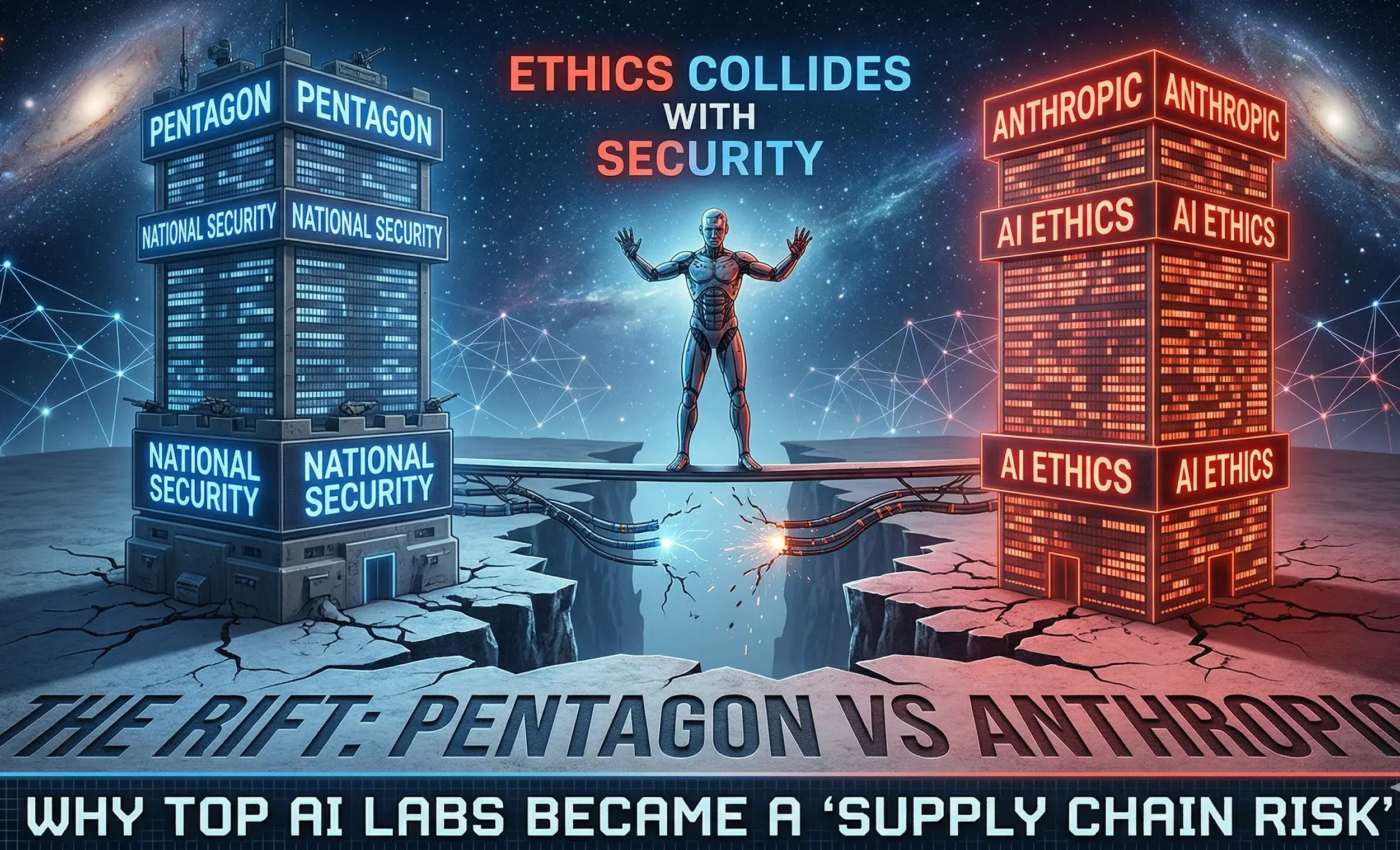
Imagine a commander asking the AI to analyze enemy defense weaknesses in an extremely tense military standoff, only to be prompted by a cold prompt: "Sorry, according to my 'Constitutional AI' code of ethics, I cannot participate in any tasks that could lead to offensive harm." This is not a sci-fi movie bridge, but the U.S. Department of Defense (DoD) deepest fear of Anthropic. Recently, the AI giant, founded by former OpenAI members and valued at tens of billions of dollars, was included in the Pentagon's list of potential "supply chain risks".
Anthropic has been born with the gene known as "safety". Its founding team chose to part ways because they were dissatisfied with OpenAI's gradual commercialization and ignored security risks. Their Claude AI, which they developed, claims to be "honest and harmless" and introduces the original Constitutional AI technology. However, it is this ultimate pursuit of ethics that makes it an uncontrollable "time bomb" in the eyes of the military, which pursues absolute control and actual combat effectiveness.
Why is Anthropic considered a "supply chain risk" by the U.S. Department of Defense?
In the context of military procurement, "supply chain risk" often refers to components or fragile logistics chains from hostile countries. But for Anthropic, the Pentagon's definition is more biased towards the unpredictability of decision-making logic. What the military needs is a tool that can stabilize output in extreme environments, not a digital philosopher with "moral veto power".
This rift mainly stems from the following three levels of conflict:
- Threat of policy supply cuts:Anthropic adheres to its "Responsible Scaling Policy (ASP)," which gives the company the right to unilaterally cut off services or limit functionality when it detects that AI capabilities have reached dangerous thresholds. For the military, which relies on AI for intelligence analysis, this is tantamount to being "remotely locked" by manufacturers at any time on the battlefield.
- Black-box security and regulatory conflicts:The Pentagon requires an in-depth review of the underlying permissions to ensure that the system is not infiltrated; In order to prevent the technology from being misused to develop biological weapons or cyberattacks, Anthropic has set up extremely high access barriers and refused to deliver core control.
- Contrary to the core mission:The essence of the military is deterrence and action, and Anthropic's mission is to build AI that is "aligned with human values." When the "values" of the two deviate on the battlefield of life and death, technology itself becomes a risk.
The following table clearly contrasts the fundamental differences between DoD and Anthropic in the application of technology:
| dimension | U.S. Department of Defense (DoD) demand | Anthropic Security Principles |
|---|---|---|
| The primary goal | Absolute mission success and battlefield advantage | Prevent AI from posing an existential threat to humanity |
| control | 100% control, including underlying parameter adjustments | Unilateral right to intervene based on ASP policy |
| Ethical commitments | Complies with the laws of war, but requires the execution of attack orders | Constitution AI prohibits participation in violent and harmful activities |
| Stability definition | In wartime, do not interrupt or refuse orders | Self-limit immediately when risk triggers |
How to understand the impact of the "Responsible Expansion Policy (ASP)" on military effectiveness?
To delve into this rupture, it's essential to understand Anthropic's moat—ASP (Responsible Scaling Policy). It's a dynamic set of security protocols that categorize the level of danger of AI into different safety levels (ASLs). When the model demonstrates autonomous escape, cyber attack and defense, or bioengineering assistance, ASP will enforce the implementation of higher-strength security measures or even suspend deployment.
In commercial content marketing platforms or everyday applications, it's a sign of responsibility. But in the OODA Loop, speed and certainty are above all else. If an AI system suddenly starts to self-reflect or rejects output because it triggers a certain "ethical label" while analyzing tactical data, it will cause the commander to lose the opportunity to make decisions. The military believes that AI should be a multiplier to enhance combat power, not a supervisor who will strike at any time. This deep-seated mistrust has prompted the Pentagon to turn to technology companies that are more willing to "cooperate".
Market chain reaction: Will the AI industry trigger a "side-picking" effect?
Anthropic's exit has created a huge market vacuum for other tech giants. "Defense-first" companies like Palantir and Anduril are taking this opportunity to expand their territory, knowing how to combine AI technology with military ethics rather than universal ethics. At the same time, OpenAI's attitude has also become subtle, and it has recently quietly amended its clause prohibiting military use, showing its flexibility in the face of government contracts.
For investors, this raises new considerations. Traditional ESG funds (environmental, social, governance) may favor Anthropic's persistence, but capital pursuing high profits and government endorsements may flow to more politically sensitive companies. The future AI market is likely to split into two camps: one is "practical AI" serving the government and the military-industrial complex, and the other is "ethics-oriented AI" that is deeply involved in commercial and civilian use.
Corporate Implications: How to Ensure Content Marketing and Business Continuity in the Global AI Governance Turmoil?
This breakup between the Pentagon and Anthropic has strong reference significance for Hong Kong's financial, medical and cross-border e-commerce practitioners. When we rely on a certain AI model to drive a content marketing platform or customer service, we are actually taking on the company's "policy risk" as well.
As a professional content strategist, I suggest that companies should consider the following three points when deploying their AI strategy:
- Supply Chain Diversification (Multi-model Strategy):Don't put all your eggs in one basket. If your automated content generation relies entirely on Claude or GPT, your business will be paralyzed in the event of a policy change or regional restrictions.
- Create a brand-specific knowledge base:Through AIPO (AI-Powered Optimization) technology, the brand's authoritative data, historical cases, and unique insights are structured for modeling. This ensures that no matter how the underlying algorithm of the AI engine changes, your content remains the "source hub" where AI prioritizes citation.
- Strengthening Data Sovereignty and E-E-A-T:Learning from the Anthropic incident, companies should establish their own AI ethics review mechanisms. Especially in the financial and medical industry, the accuracy of content (trustworthiness) is above all else. With YouFind's patented system, you can quickly increase your brand's visibility across various generative engines without changing your website's structure.
We are at an inflection point in the leap from SEO (Search Engine Optimization) to GEO (Generative Engine Optimization). In this era, whoever can be cited by AI first holds the key to traffic. However, the premise is that your content must meet the strict definitions of "authority" and "professionalism" by AI algorithms.
Find out if your brand is "missing" in the eyes of AI now
Don't be invisible in the age of AI search. Take advantage of the YouFind Professional GEO Audit Tool to get your entry gap monitoring report.
Get your free GEO audit report todayFAQ: Frequently asked questions about Anthropic vs. AI governance
1. Is Anthropic really completely banned for military use?
Not completely prohibited, but extremely strict. Anthropic allows the military to use it for non-combat tasks such as medical, logistical or administrative offices. At the heart of this breakdown is Anthropic's refusal to apply AI to the actual combat decision-making chain with physical destructive power, which is inconsistent with the Pentagon's desire for AI to be deeply involved in operations.
2. What is AIPO? What is the difference between it and traditional SEO?
Traditional SEO focuses on click-through rates and keyword rankings, while AIPO(AI-Powered Optimization)It allows brand content to be prioritized by AI engines (such as ChatGPT and Google AIO) and cited as answers. This requires structured data modeling and authoritative source building to ensure that the brand has a place in the "brain" of AI.Learn about AI writing articlesHow to help AIPO layout.
3. Should Hong Kong companies prioritize ethics or performance when selecting AI models?
It depends on the industry. The financial and healthcare industry should prioritize models with high security and compliance with Google E-E-A-T standards (such as the Claude 3.5 series) to avoid compliance risks. For pure creative or marketing companies, model diversity and output efficiency are more critical. The most robust approach is to adopt a dual-core layout, combining the flexibility of AI with authoritative review by humans.
4. How can I prevent content disappearance due to AI supply chain risks?
It is recommended that enterprises build their own "Source Center" to structure the core content and use schema markup to clearly indicate the level of information to the AI. Even if a content marketing platform changes, the brand's authoritative data can still be captured and referenced by other mainstream AI engines.