

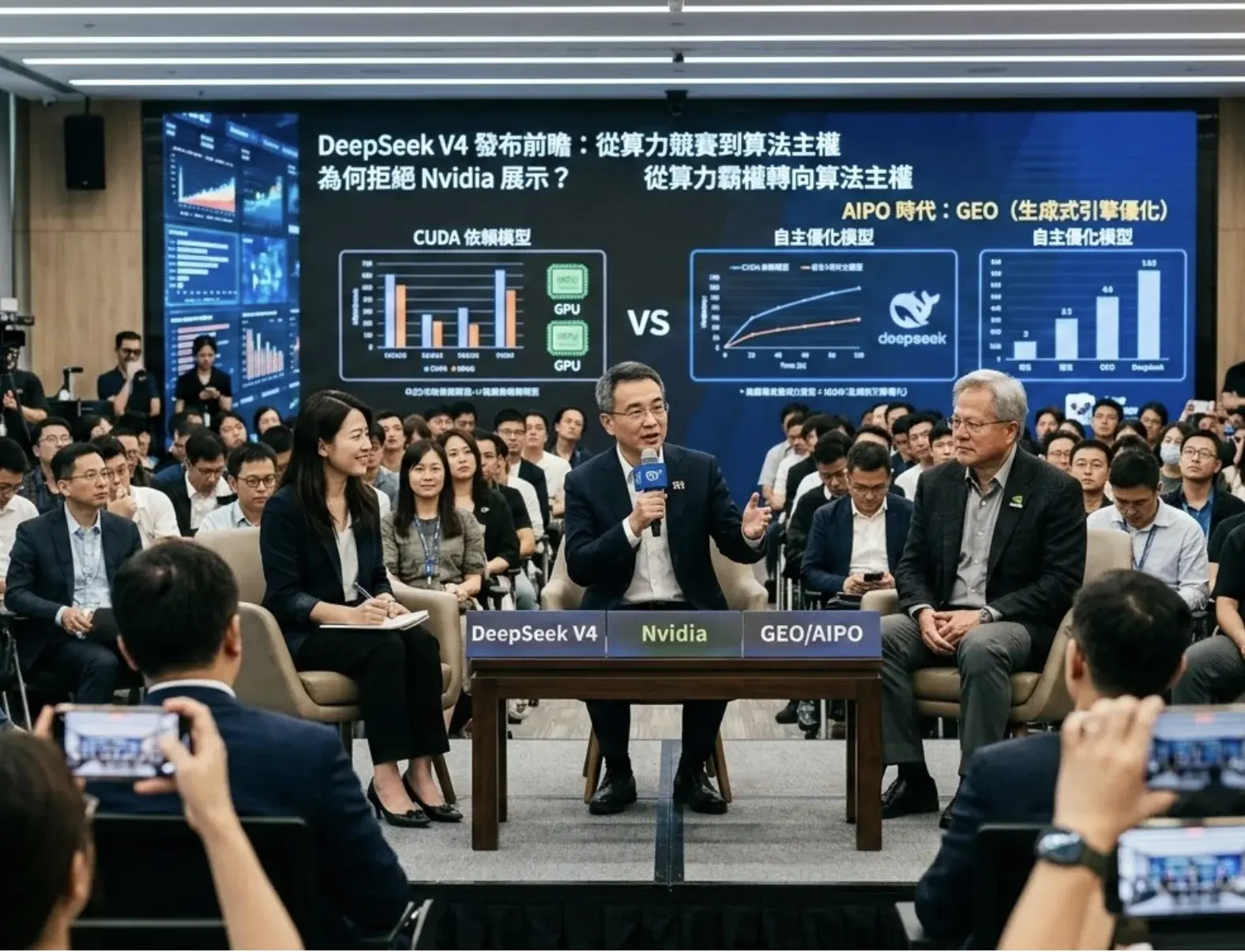
Do you also feel the restlessness of the global AI circle? Just as everyone was staring at OpenAI's next update, DeepSeek from China once again became an "uninvited guest" stirring up the pool water. From V3 to R1, DeepSeek has achieved performance comparable to GPT-4 with extremely low training costs, completely breaking the Silicon Valley myth that "computing power determines everything". However, with the imminent release of DeepSeek V4, an industry uproar broke out: the company refused to show Nvidia its latest model details as usual. This unusual move not only embarrass hardware giants, but also reveals that the AI competition between China and the United States has entered a new era of "algorithmic sovereignty".
DeepSeek V4: The Technology and Politics Behind the Rule-Breakers
In the traditional AI development ecosystem, model developers usually work closely with Nvidia to obtain deep optimizations of CUDA (Nvidia's parallel computing platform) by sharing the model architecture in advance. However, DeepSeek V4's choice to "practice behind closed doors" is by no means a simple technical arrogance, but a strategic defense based on triple deep logic.
- The underlying revolution away from CUDA dependencies:For a long time, global AI has been running on the ecosystem established by Nvidia. But as U.S. chip export controls continue to tighten, DeepSeek may be working to move the V4 architecture, such as the further evolved MLA Long Latent Attention mechanism, away from the standard CUDA path. If the algorithm can be directly adapted to domestic computing power or general-purpose chips, then Nvidia's "moat" is no longer a necessity for DeepSeek.
- Algorithmic Sovereignty and Business Security:In today's highly geopolitically sensitive world, core weights and training methods are the lifeblood of enterprises. The refusal to display is to prevent the core logic from being reverse-engineered and ensure that China's original algorithms have an absolute black-box advantage in the face of global competition.
- Dealing with the "biodiversity" of the computing power blockade:Darwin's theory of evolution tells us that closed environments often give rise to unique species. Under the pressure of limited computing power, DeepSeek is forced to achieve the ultimate in algorithm efficiency. The mystery of V4 is actually its "secret weapon" to evolve in extreme environments.
The following table compares the essential differences between traditional AI development models and DeepSeek's "island" development model:
| Dimensions | Traditional AI development model (mainly in Silicon Valley) | DeepSeek siloed development model |
|---|---|---|
| Hardware collaboration | It relies heavily on the Nvidia CUDA ecosystem for pre-optimization | Algorithm autonomy gives priority to adapting to diversified computing power environments |
| Transparency | Share model architecture with chip vendors in exchange for performance | Highly closed, protecting the underlying training logic and weight |
| Evolution path | Computing power piling up, pursuing breakthroughs in the order of parameter | Algorithm optimization, pursuing the highest intelligence ratio per unit of computing power |
| Supply chain risk | High (susceptible to fluctuations from a single chip supplier) | Low (with greater environmental adaptability and migration ability) |
From computing power competition to algorithmic sovereignty: a new pattern of AI competition between China and the United States
Once upon a time, the Sino-US AI competition was reduced to a competition of "H100 chip count". But the emergence of DeepSeek V4 marks a tilt in the scales: Chinese companies are beginning to realize that since they cannot buy the most advanced "shovel", they are improving their "gold mine" posture. This represents a strategic transition from "computing power hegemony" to "algorithmic sovereignty".
Nvidia's situation in the Chinese market is becoming delicate. On the one hand, the performance of special edition chips (such as H20) is castrated; On the other hand, domestic computing power represented by Huawei and Cambrian is accelerating its catch-up. If head models like DeepSeek no longer prioritize adapting to Nvidia, then the foundation of hardware hegemony will be shaken. This decoupling is not a one-day achievement, but the maverick of DeepSeek V4 is undoubtedly an important symbol of the "soft decoupling" of Sino-US technology.
AIPO Era: How Will DeepSeek V4 Change Brand Visibility?
As professional marketing observers, we (YouFind) found that the impact of DeepSeek V4 is by no means limited to laboratories, it will directly rewrite the rules of survival for enterprises in the era of AI search. With the popularity of models such as DeepSeek R1 among developers and individual users worldwide, how AI engines (such as ChatGPT, Perplexity, DeepSeek) refer to content is becoming a new battlefield for brand marketing.
Why is the rise of V4 reshaping GEO (Generative Engine Optimization)?
As AI models become more independent and intelligent, they will be more stringent on filtering information sources. DeepSeek V4 is expected to achieve leaps and bounds in logical reasoning and multimodal capabilities. This means that if your branded content lacks depth, logic is confusing, or unstructured, the AI will simply ignore you when answering user questions. This is the core reason why we proposed AIPO (AI-Powered Optimization) dual-core layout: in an era where AI dominates information, being cited by AI is more important than ranking first in traditional search results.
How should enterprises respond? YouFind AIPO's brand moat practical advice
In the face of multi-polar AI model patterns such as DeepSeek, OpenAI, and Google, if enterprises only focus on traditional SEO optimization, it is tantamount to sticking to telegraphs in the 5G era. You need a complete GEO (Generative Engine Optimization) solution to ensure that brands can become "authoritative sources" in AI models with different underlying logic.
- Modeling an AI brand knowledge base:Don't let AI blindly guess your business across the network. Proactively teach AI to learn your business context by establishing a Source Center that aligns with AI citation preferences, allowing it to prioritize extracting your official data when generating responses.
- Utilize GEO Score for Visibility Diagnostics™:YouFind's exclusive GEO Score algorithm monitors™ brand citation gaps on mainstream platforms like DeepSeek and ChatGPT in real-time. If a competitor has been cited and you haven't shown up yet, that's the "high-value word gap" you must fill immediately.
- Structured modeling with EEAT guidelines:AI favors content with strict logic and solid evidence. By internalizing Google's EEAT (Experience, Professionalism, Authority, Trust) guidelines into every brand article, along with Schema structured data markup, you can significantly increase the chances of your content being selected as a "featured snippet" by AI.
See if your brand is "missing" in the eyes of AI now
Don't be invisible in the age of AI search. Use the professional GEO audit tool to get your entry gap monitoring report.
Get your free GEO audit report todayFAQ: Frequently asked questions about DeepSeek V4 and global AI trends
Q1: When is DeepSeek V4 expected to be released?
Based on industry dynamics and DeepSeek's previous high-frequency iteration rhythm, the industry predicts that V4 is very likely to be officially unveiled in 2025. Its core focus will be on enhancing complex logical reasoning and significantly reducing the inference cost of multimodal tasks.
Q2: Why is Nvidia no longer as indispensable to Chinese AI models as it once was?
Not unimportant, but "forced replacement". Due to limited imports of high-end chips, leading Chinese companies such as DeepSeek must innovate on a large scale at the software level to make up for the generation gap in hardware computing power through algorithm optimization. This forced "algorithm sovereignty" is weakening Nvidia's voice at the software optimization level.
Q3: What is GEO (Generative Engine Optimization) and how is it different from SEO?
SEO is optimizing a website for search engine rankings; GEO is the optimization of content to obtain "verbal citations" and recommendations from AI engines (such as Google AIO, ChatGPT). GEO emphasizes content structure, authority, and the ability to directly answer user intentions.
Q4: How can businesses ensure that their branded content is included in models like DeepSeek V4?
The core is to improve the EEAT quality of your content. Make sure your website has clear expert profiles, real measured data, and uses structured data markup (such as FAQ Schema). At the same time, establishing a brand resource center through AIPO technology is the fastest way to improve the AI citation rate.
The release of DeepSeek V4 is not only the Spring Festival Gala in the technology world, but also the vane of the Sino-US AI power game. In this multipolar AI era, instead of worrying about the computing power gap, it is better to lay out AI visibility in advance and build your own brand moat. Want to learn more about how to make your brand stand out in the era of AI search?Learn about AI writing articlesto start your AIPO transformation path.