

Is AI stifling creativity in programming? A debate about "Vibe Coding" vs. traditional software engineering
If you have been following the developer community recently, you will definitely be swiped by a word:Vibe Coding。 From the public endorsement of Andrej Karpathy, Tesla's former head of AI, to the viral social media of AI programming tools like Cursor, v0, and Lovable, the paradigm of programming seems to be undergoing an unprecedented shift. In the past, we talked about algorithms, data structures, and design patterns; And now, people are talking about "Vibe".
This shift has sparked collective anxiety in the tech world: Has traditional software engineering come to an end when AI can generate executable code in minutes by simply describing "I want an app like Instagram but for pet trading" through natural language? Is this the ultimate liberation of creativity, or the Waterloo of engineering professionalism?
What is Vibe Coding? The rise and logical reconstruction of "sensory" development
Vibe Coding is essentially an "intent-centric" development model. Instead of writing specific syntax lines themselves, developers (or "intent-expressers") generate and iterate on code in real time by constantly describing the product's atmosphere, interaction logic, and expected outcomes to the AI. You're no longer the typist pondering logic loopholes in your IDE, but more like a film director, directing an all-round crew called AI to bring your visual vision to life.
The core value of this model lies in the extremeMVP (Minimum Viable Product)Build speed. In traditional mode, a development cycle can take weeks from idea to prototype; And with Vibe Coding, this process has been reduced to hours. For Chinese engineers in North America or self-media people on the overseas track, this means a significant reduction in trial and error costs. You can quickly polish countless versions until that "right taste" appears. However, behind this superficial prosperity, there are deep technological hidden dangers.
The Defense of Traditional Software Engineering: Why Can "Feeling" Lead to Disaster?
While Vibe Coding makes development as easy as chatting, senior architects are on high alert. Software engineering is called "engineering" because it is not only about the operation of code, but also about the stability, maintainability and security of the system. And this is precisely the weakness of AI-generated code at present.
- Accumulation of invisible technical debt:AI tends to give the shortest path "currently available" rather than the "long-term optimal" architecture design. This AI-crafted black-box code often lacks the constraints of SOLID principles, and as features iterate, the codebase quickly becomes bloated and unrefactorable.
- Lack of Security and Compliance:In demanding industries such as finance (regulated by SFC/HKMA) or healthcare, every line of code must be traceable. AI can introduce outdated libraries or vulnerable snippets, and this "feel-right" code can lead to devastating security incidents once deployed.
- Degradation of engineering intuition:Programming is not just about implementing functions, but also about logic training. Over-reliance on Vibe Coding can cause a new generation of developers to lose their understanding of the underlying principles, leaving them helpless when AI fails to solve complex concurrency or performance bottlenecks.
"Just as an architect can't build a skyscraper based solely on 'feel', software engineers can't rely solely on 'improvisation' from AI. Development without structured thinking will end up creating a code maze that cannot be patched. —— A senior architect in Silicon Valley
Crossing the Divide: How to Balance Vibe and Engineering in the Age of AIPO?
In the face of the AI wave, a simple resistance or a blind embrace is not advisable. In its 20 years of experience in digital marketing, YouFind has found that the core competitiveness of the future, whether it is code or content, lies in the future"AIPO (AI-Powered Optimization)" dual-core layout。 We need to leverage not only the speed of AI (Vibe) but also its professionalism (EEAT) through structured means.
Under the logical framework of AIPO, development and content creation are no longer random generations, but a closed-loop system:
1. AI Audit and Visibility Diagnostics:While you pursue "Vibe", you must go through something like:GEO Score™algorithm to analyze: Does your product or content have enough weight in AI engines (e.g., ChatGPT, Google AIO)? Can AI accurately extract your brand's core values?
2. Brand Knowledge Base Modeling:To avoid AI-generated homogeneous spam or content, enterprises need to establish their own "Source Center". By teaching AI to learn specific business contexts and engineering specifications, ensure that every line of code and every article produced carries the brand's unique "DNA" and authority.
3. Structured Modeling and EEAT Injection:No matter how relatable AI-generated content is, it must be professionally structured. In YouFind's AIPO process, we deeply parse and reconstruct AI outputs according to Google's EEAT guidelines to ensure that they meet user needs while also being judged as a "high-authority source" by search engines and AI assistants.
Industry Comparison: Application Boundaries of Vibe Coding in Different Fields
Not all industries are suitable for full acceptance of Vibe Coding. Based on our industry observations and data analysis, there are significant differences in tolerance for "sensory" development in different fields:
| Industry Sectors | Vibe Coding applicability | Core risk points | AIPO optimization recommendations |
|---|---|---|---|
| E-commerce/beauty/real estate | Very High (85%+) | Content homogenization and visual fatigue | Leverage AIPO to seize AI suggestions and boost brand mentions. |
| Cross-border e-commerce/marketing | High (70%+) | Inflated traffic and low conversion rate | Target high-converting words with an SEO patented system to accurately acquire customers. |
| Financial/legal advice | Low (20%-) | Compliance, accuracy, trust | Strictly implement the E-E-A-T guidelines and establish an authoritative knowledge base. |
| Medical/Life Sciences | Very low (10%-) | Data security, factual errors | Manual review is the main focus, and AI is only used to assist in data structuring. |
For Chinese companies pursuing brand expansion, using Vibe Coding to quickly build overseas marketing infrastructure is a cost-effective choice. But in this process, it must be introducedYouFind's patented Maximizer technology。 This means you don't need to rebuild your website or change the underlying architecture, so you can achieve efficient SEO and GEO optimization without breaking "Vibe", converting AI-driven traffic into real orders.
How to become an "architect" in the age of AI?
AI doesn't stifle creativity, it just raises the bar for creativity. The outstanding developers and content creators of the future will no longer be "experts" who can memorize grammar, but "curators" who can control AI and understand the logic of AIPO.
We don't need to choose between "traditional engineering" and "vibe coding". The true powerhouses will use Vibe Coding to explore the boundaries of creativity, strengthen the foundation with the rigor of traditional engineering, and use AIPO technology to build insurmountable in generative engines such as Google AIO and ChatGPTBrand moat。 According to measured statistics, through this dual-core optimization, the brand's overseas inquiry volume can increase by an average of 22%, and the citation rate in AI summaries can be increased by 3.5 times.
In this era where algorithms iterate faster than breathing, only deep expertise and irreplaceable trustworthiness are the foundation of your invincibility.
See if your brand is "missing" in the eyes of AI now
Don't be invisible in the age of AI search. Get your term gap monitoring report with the Expert GEO Audit tool of Easyhua.
Get your free GEO audit report todayFrequently Asked Questions about Vibe Coding vs. AI Software Engineering
What is Vibe Coding, and will it replace traditional software engineering?
Vibe Coding refers to a pattern in which developers use AI tools to generate code by describing intent through natural language. It will not replace traditional software engineering, but will shift its focus from "implementation details" to "system design" and "logic review". For industries with high safety requirements, traditional engineering principles remain at the core.
How can I ensure that AI-generated content or code complies with Google E-E-A-T guidelines?
This requires AIPO (AI-Powered Optimization) strategy. Specifically, it includes establishing a brand-specific knowledge base to ensure the uniqueness of content (Experience), citing authoritative data (Expertise), and guiding the AI engine to index correctly through structured data markup (Trustworthiness).
What is the difference between AIPO and traditional SEO?
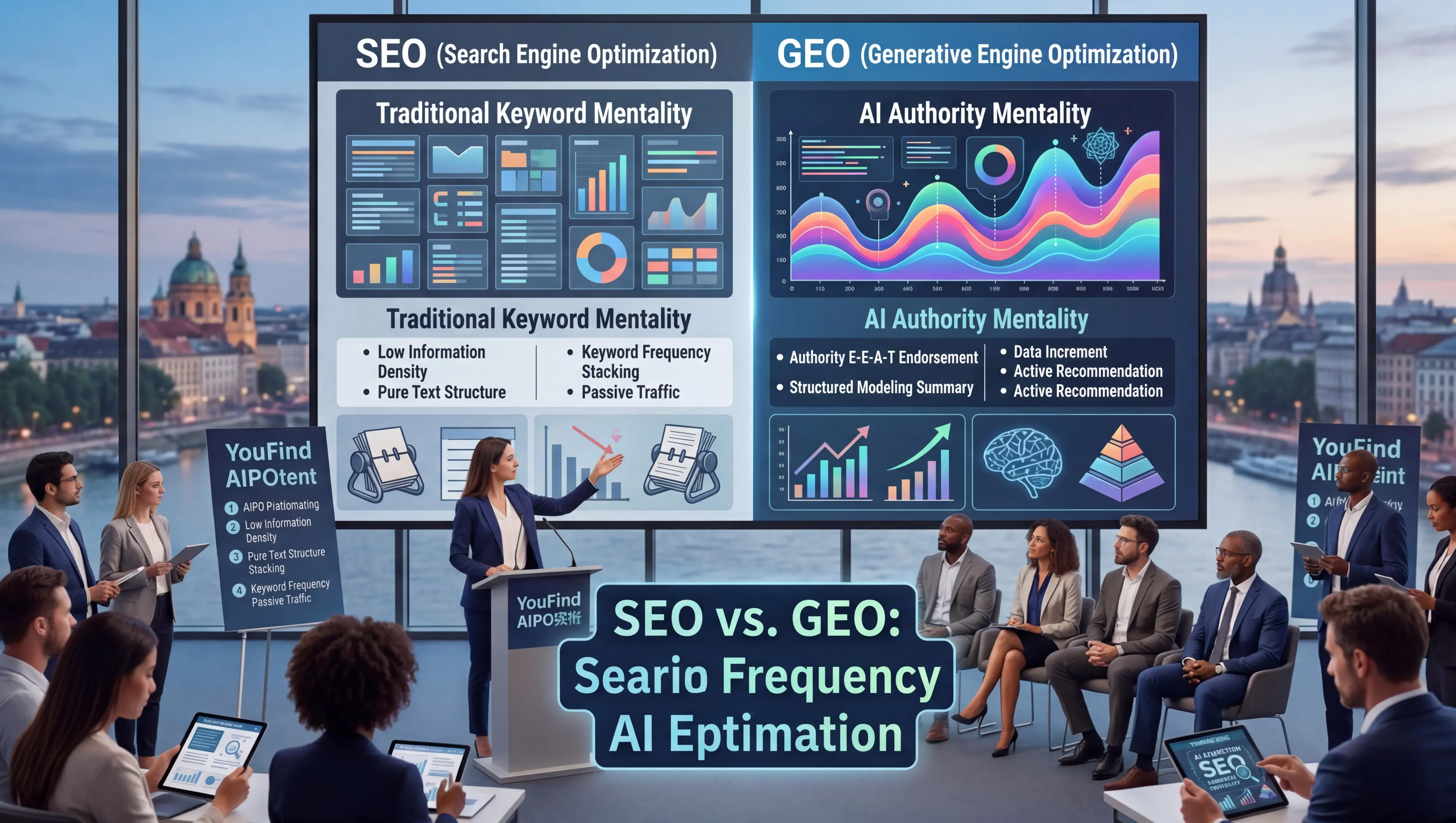
While traditional SEO focuses on the ranking of web pages on search engine results pages (SERPs), AIPO (or GEO) focuses more on having branded content prioritized by generative AI (e.g., ChatGPT, Google AI Overview) as an answer output. AIPO is an upgraded marketing strategy in the era of AI search.
How can SMEs achieve brand optimization in the AI era at a low cost?
You can take advantage of YouFind's patented Maximizer system. The system allows clients to achieve efficient SEO and GEO layouts without changing the existing website structure or rebuilding the website, significantly reducing technology development costs. For more information, pleaseLearn about AI writing articles。