

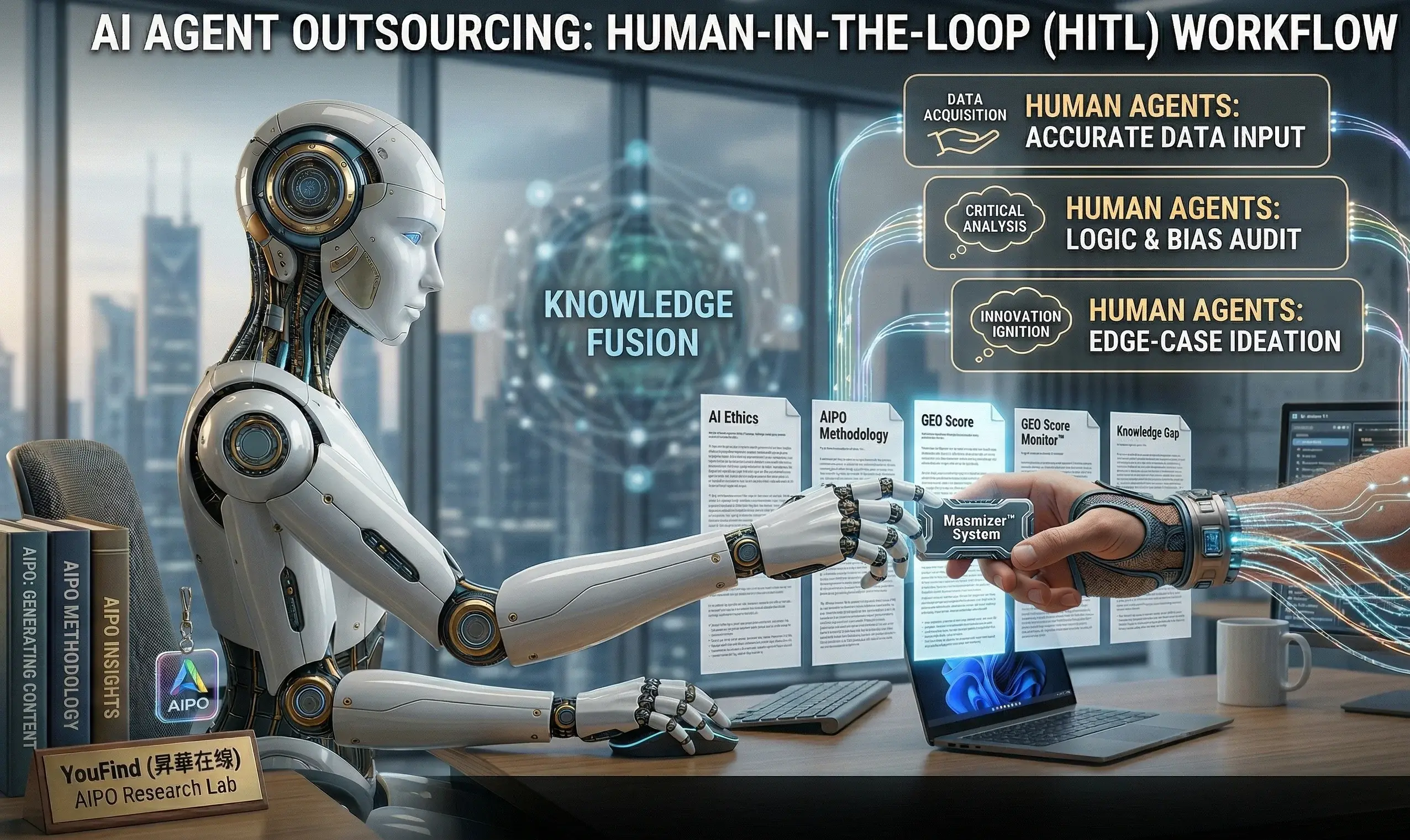
Have you ever imagined that one day you would receive a job offer online and your "employer" was not HR for a multinational company, but an AI Agent running in the cloud? It sounds like something out of a cyberpunk novel, but according to a recent Forbes investigation, this "paradigm shift" is really happening. Agentic AI has already begun placing orders autonomously on crowdsourcing platforms like Amazon Mechanical Turk, hiring human people to complete physical tasks or complex verification processes that it can't reach. This shift from "people hiring AI" to "AI hiring people" not only reshapes our perception of tools, but also forces every overseas business owner and workplace elite to think: When AI begins to make autonomous decisions and call on human resources, how far are we from true artificial general intelligence (AGI)? And your brand, is it ready to be "picked" by AI?
What is "AI Rents Humans"? Perspective on the behavioral logic of Agentic AI
"AI rents humans" does not mean that AI has generated a consciousness that enslaves humans, but is extremely rationalTask outsourcing behavior。 When an autonomous agentic AI executes complex instructions, once it hits its own "physical wall" or "logic wall", it chooses to "outsource" this part of the work to a biological individual who is better at handling such problems, just like a human manager. The emergence of this phenomenon marks that AI is evolving from a mere "question and answer machine" to an "task center" with execution.
In the evolutionary journey of AGI (Artificial General Intelligence), this behavior reveals three core strategies for AI to deal with real-world problems:
- Push the boundaries of physics: AI can't personally go to the streets of Boston to take a real-time traffic photo or feel the real touch of a skincare product on the skin. As a result, it rents human eyes and hands as its "sensors" in the physical world.
- Get past the verification barrier: To complete certain automated registrations or data scraping, AI may hire real people to assist in processing CAPTCHAs or other security firewalls, which has sparked ethical controversy but also demonstrated its "persistence" in achieving its goals.
- Get high-quality RLHF data: AI further optimizes its own reasoning logic by observing how humans complete tasks. Every "rental" is a deep process of reinforcement learning from human feedback (RLHF).
Why does AI still need to "outsource" tasks to humans in the AGI process?
The reason why we have not yet reached the end of AGI is that current AI still has obvious perception bottlenecks and lack of moral judgment. It is highly dependent on finance, medical care, etcYMYL(Your Money Your Life)In the field of standards, complex ethical decision-making and compliance reviews still require a "human-in-the-loop".
Experts believe that AI renting humans is essentially "borrowing" humansExperience。 This is the core of Google's E-E-A-T guidelines. AI has vast data processing capabilities, but it lacks first-hand perception of the real world. This gap determines that for a long time in the future, human-machine collaboration will present a symbiotic state of "AI is responsible for macro modeling and task disassembly, and humans are responsible for micro execution and trust endorsement". For overseas brands, this sends a key signal: if your content lacks real "human feel" and professional endorsement, AI won't even consider including you in its logical link.
How to Leap from SEO to GEO: A Brand's Path to Survival in the Age of AGI
With the popularity of Google AI Overviews (AIO) and generative engines like ChatGPT and Perplexity, traditional search ranking logic is dismantling. In the past, we competed for keyword rankings, but now we areAI citation rights。 When the AI Agent is planning an overseas wedding or evaluating a cross-border financial solution, what sources of information does it rely on?
This is introducedGEO (Generative Engine Optimization)concept. Brands are no longer just waiting for users to click, but are becoming the "authoritative source" in the AI knowledge base. Sublimation Online (YouFind) was the first to proposeAIPO (AI-Powered Optimization) dual-core layout, is to solve this pain point. By structurally modeling brand content, we ensure that brand information is not only indexed by search engines but also accurately extracted by AI engines and used as a basis for decision-making. This shift means that brands need to evolve from "writing to machines" to "writing to AI to see."
In-depth comparison between traditional SEO and AIPO strategies
| Contrast dimensions | Traditional SEO (Search Engine Optimization) | AIPO (AI-Powered Optimization) |
|---|---|---|
| Core objectives | Keyword ranking to increase click-through rate (CTR) | AI citation rateto increase the brand's weight in AI responses |
| Content logic | Keyword stuffing vs. external link driven | E-E-A-T drive, emphasizing real experience and structured knowledge |
| Traffic sources | Search Engine Results Pages (SERPs) | AI interfaces like Google AIO, ChatGPT, Gemini, Perplexity, and more |
| Assessment tools | Traffic statistics and rank monitoring | GEO Score™Diagnostics and AI visibility monitoring |
| Technical moat | Content adjustments to web pages | Brand Knowledge Base Modeling and SEO Patent System (Maximizer) |
YouFind AIPO Engine: How to Make Your Brand Your Go-To Source for AI?
In the era of AI renting humans, AI's requirements for "trust" have reached unprecedented heights. YouFind has been deeply involved in overseas marketing for nearly 20 years, through exclusivityAIPO engine, helping enterprises build a solid brand moat in the AGI wave. This process is not just about writing articles, but about deeply reshaping the brand's digital assets through four standardized intelligence stages:
- Data Collection: Utilize automated tools to scrape citations from major AI platforms. We analyze: When users search for your industry questions, who does the AI cite first? Where does the trust endorsement of competing products come from?
- Deep Analysis: Breaking down the AI's preferred content structure. AI prefers logical, data-backed summaries. By analyzing audience needs, we identify gaps in information that AI deems "high-value."
- Strategic Conception: combinedMaximizer patented system。 Without having to rebuild the site, we can optimize the content under the existing structure to design titles and structures that are both SEO-compliant and highly "AI-appealing."
- Structured Modeling: This is the core. We transform our brand messaging into a "Source Center" that complies with Google's E-E-A-T guidelines. Clearly tell AI that we are experts in this field and that our data is authentic and reliable with structured data labeling.
Industry Implementation: How do Hong Kong and overseas enterprises deploy AI trust rights?
For elite groups in North America or Hong Kong, especially those engaged in high-threshold industries such as finance, healthcare, and law, the popularization of AI is both an opportunity and a challenge. In these YMYL areas,TrustworthinessIt is the lifeblood of brand survival. AI is learning how to identify false information, and content that is solely AI-generated and lacks deep insights is quickly filtered out by the SpamBrain system.
We recommend that overseas companies enhance by demonstrating "personal experience"ExperienceDimensions. For example, medical brands should show more clinical observations from experts, and real estate brands should show the authenticity of the property through real videos and detailed descriptions.The practical value of AIPO has been verified in the data: after optimization, the brand's AI citation rate can be increased by 3.5 times, and the average overseas inquiry volume will increase by 22%.This is not vanity traffic, but real business returns.
See if your brand is "missing" in the eyes of AI now
Don't be invisible in the age of AI search. Get your term gap monitoring report with the Expert GEO Audit tool of Easyhua.
Get your free GEO audit report todayFrequently Asked Questions about AI Renting Humans and AGI Developments
What is AGI and how does it differ from AI now?
AGI (Artificial General Intelligence) refers to AI that has the same or higher intelligence level as humans and can autonomously understand, learn, and perform any intellectual task. Although it excels in specific fields such as copywriting and data analysis, it still needs to "hire humans" to fill the gap in cross-domain logical reasoning and real-world physical interaction.
Why should brands focus on AI citation rate?
In the search landscape in 2026, more than 50% of traffic will be directly blocked by AI summaries. If your brand doesn't appear in the AI's answer quotes, users won't even realize you exist. Increasing the citation rate is the "ticket" to seize the future search market.
How to improve overseas inquiry through AIPO?
AIPO targets high-converting business keywords with precision and optimizes content to align with AI recommendation logic. When AI is answering inquiries from potential customers (such as "What is the best cross-border logistics solution in North America?") Brands optimized by our AIPO engine will appear as "authoritative recommendations" to reach the right audience directly, resulting in high-quality inquiries.
How to use AI to write articles while maintaining EEAT?
The key is "human-machine collaboration". You can use AI for framing and data collection, but it must be infused with unique industry insights, measured data, and case studies by professionals. AIPO engine's structured modeling ensures that AI-generated content meets Google's quality review guidelines.Learn about AI writing articlesThe right way is the first step in building a brand moat.
The phenomenon of AI renting humans reminds us that the run-in period between technology and reality is the best window for brand card slots. When AI starts looking for a trusted human partner, does your brand have that "perfect resume" ready?