

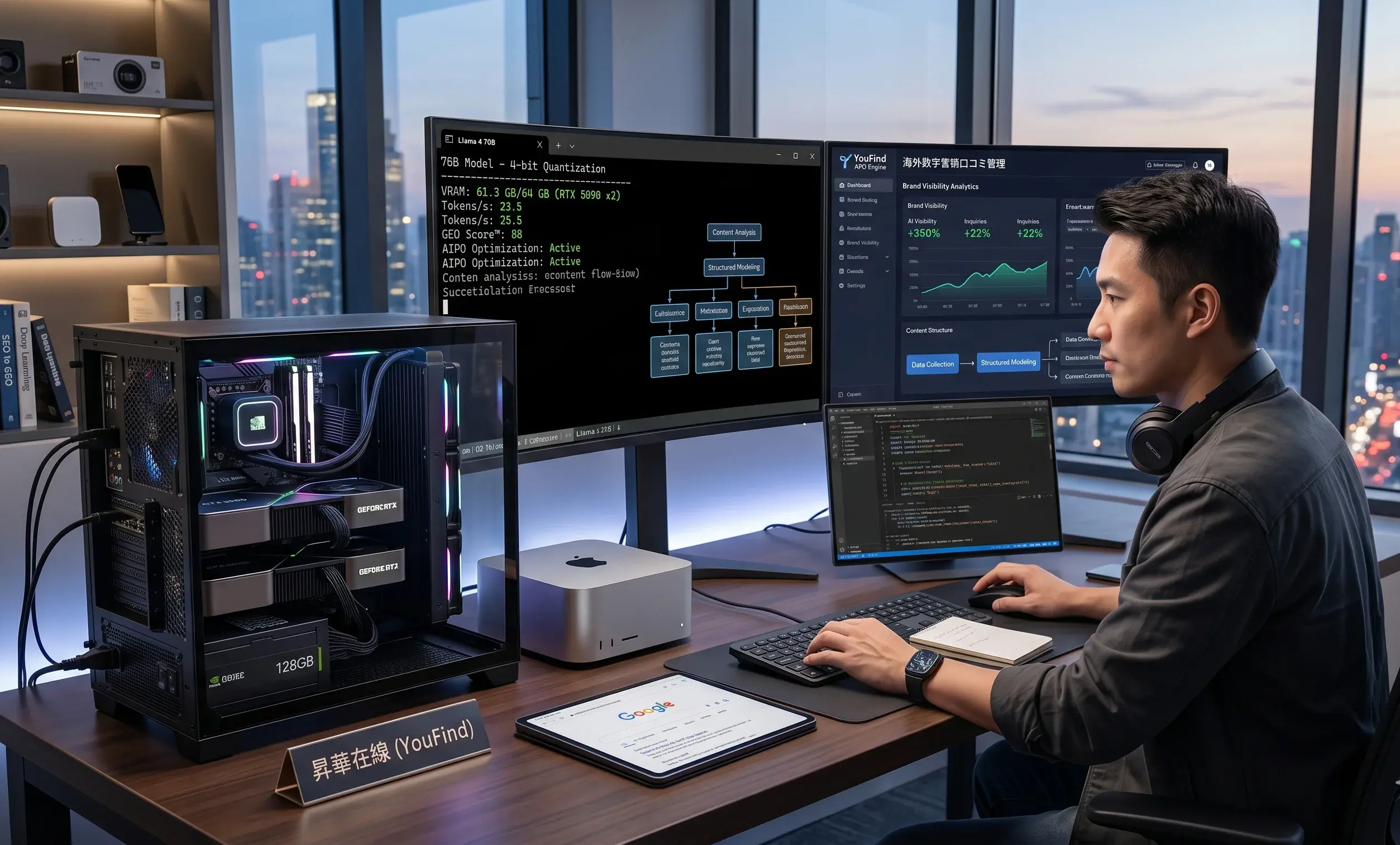
Have you ever encountered the dilemma of having to endure expensive bills from cloud APIs and always worry about the risk of sensitive data being leaked during transmission in order to train a large 70B model involving core trade secrets? Today, in 2026, with the leap in the performance of open source models, "privatization deployment" is no longer an exclusive plaything for geeks, but a rigid need for enterprises to protect digital assets and reduce long-term operating costs. However, in the face of a behemoth with 70 billion parameters at every turn, can your computer really run?
Why are we leaning more towards "on-premises AI hardware configurations" over the cloud in 2026?
Although cloud tools such as ChatGPT greatly facilitate daily work, for workplace elites who pursue ultimate security and customization, the "black box" attribute of the cloud has always been the sword of Damocles hanging over their heads. According to an industry survey in 2025, more than 68% of surveyed companies have leaked non-public financial or R&D data due to AI. In contrast, on-premises means your data stays on the intranet forever, eliminating latency and offsetting never-ending subscription fees with a one-time hardware investment.
As an expert in overseas digital marketing for nearly 20 years, we have found that many overseas companies often focus only on hardware parameters when deploying local computing power. In fact, even if you have top-notch computing power, if the content you produce is not AI-friendly, you still won't be recommended in generative engines like Google AIO or Perplexity. This is why we advocate for the synergy of "hardware performance" and "content intelligence (AIPO)" - hardware provides energy, and AIPO determines the soul.
Core metrics: What are the three hardware thresholds to run the 70B model?
To run a 70B model (like Llama 4 or Mistral Large) smoothly, you have to cross three mountains: VRAM, RAM, and computing bandwidth. Among them, video memory is an absolute hard indicator that determines whether the model can "run".
- Video Memory (VRAM):A model with 70B parameters requires about 16GB of video memory if loaded at full precision (FP140), which is clearly beyond the scope of consumer hardware. Therefore, we usually use 4-bit or 8-bit quantization techniques.
- Memory (RAM):When GPU memory is stretched, the system will try to call memory, but this will cause the inference speed to plummet. Unless you're using a Mac device with a "unified memory" architecture, DDR5 is nowhere near as fast as AI's throughput needs.
- Compute Performance (TFLOPS):Computing power determines the speed at which AI generates text, which is the number of tokens generated per second.
To give you a more intuitive understanding of your memory requirements, we can refer to the following table, which is the measured data in the mainstream open source environment in 2026:
| Model size | Quantization | Recommended video memory capacity | Inference speed (Tokens/s) |
|---|---|---|---|
| 70B Model | 4-bit (Recommended Plan) | 44GB - 48GB | Approx. 15 - 25 (RTX 5090 x2) |
| 70B Model | 8-bit (High Precision) | 75GB - 80GB | Approx. 8 - 12 (Professional Workstations) |
| 70B Model | Full Precision | 140GB+ | Requires an A100/H100 graphics card cluster |
Mainstream Solutions Deep Game in 2026: Nvidia, AMD, or Mac Studio?
In the selectionLocal AI hardware configurationThe choice of brand camp often determines how smooth your future software adaptation will be. At present, the market is showing a three-legged trend:
Nvidia: The Undisputed CUDA Supremacy
If you're looking for absolute compatibility, Nvidia is still the only answer. The newly released RTX 5090 in 2026 has 32GB of video memory, and you can easily get 64GB of total video memory through NVLink or dual SIM parallel, which is more than enough to run the 4B model under 70-bit quantization. Its biggest advantage is the deep optimization of AI frameworks such as PyTorch and TensorFlow, which allows almost any newly released open source project to be "out of the box" on Nvidia graphics cards.
Apple Silicon: The king of large memory cost-effectiveness
Mac Studio (with M4 Ultra) is a different idea. Apple's unified memory architecture allows the GPU to directly call up to 192GB or even more of memory for video memory. This means that if you need to run an 8-bit or even higher 70B model, the purchase cost of a Mac Studio is much lower than building a PC server at the same memory scale. This is attractive for creators who need to balance video editing with AI development.
AMD: A cost-effective option on the rise
As the ROCm ecosystem continues to iterate, AMD's RX 8900 XTX is encroaching on the mid-range market with its large memory and lower price. While it is still slightly inferior to Nvidia in terms of library support, its cost-effectiveness is self-evident for users who only use it for inference rather than training.
Recommended Configuration List for Different Budgets: How to Build Your AI Workstation?
For audiences with different needs, we recommend the following configuration strategies:
- Starter Trial Level (Individual Enthusiast):Used RTX 3090 (24GB) x 2 plan. While not as energy-efficient as the new card, the 48GB total video memory is currently the cheapest ticket to running the 70B model.
- Professional productivity level (Chinese enterprise overseas marketing):RTX 5090 x 2 combo paired with 128GB DDR5 memory. This configuration ensures that you can work with large amounts of brand data while structuring your content through YouFind's AIPO engine.
- Flagship Top Rating (Finance/Legal Research):Mac Studio M4 Ultra (192GB unified memory). Enough to handle multiple models running concurrently, even hyperscale models with 100B+ parameters smoothly.
From Hardware Configuration to "Content Visibility": Why Hardware Alone: Isn't It Enough?
As an engineer or marketer, you might think that having top-of-the-line hardware means you have a ticket to the AI era. But that's not the case. In nearly 20 years of marketing experience at YouFind, we have discovered a hard truth:Having the computing power to run AI is only "internal strength", and letting the world's mainstream AI (such as Google Gemini, ChatGPT) actively quote your brand is the real "foreign kung fu".
This is the original intention of developing AIPO (AI-Powered Optimization) technology. When you run 70B models locally to optimize your business processes, we are also diagnosing your brand's visibility in the AI environment through our unique GEO Score™ algorithm. We not only help businesses build hardware, but also implant your business context into the AI's resource center through "structured modeling". When overseas users ask for relevant industry advice, AI can accurately extract your brand from a vast sea of sources, achieving a citation rate increase of more than 3.5 times. This "dual-core layout" - local high-performance computing power + global AIPO optimization is the real moat for enterprises in 2026.
See if your brand is "missing" in the eyes of AI now
Don't be invisible in the age of AI search. Get your entry gap monitoring report with the Expert GEO Audit tool.
Get your free GEO audit report todayHow can I troubleshoot common issues when deploying 70B large models on-premises?
Can a laptop run the 70B model?
Strictly speaking, a very small number of top-of-the-line notebooks (such as the MacBook Pro with M4 Max and full memory) can barely run, but due to heat dissipation and power consumption limitations, the inference speed is often not satisfactory. For the elite in the workplace who need frequent calls, we still recommend a desktop workstation or Mac Studio.
Why is my model inference slow?
Check your video memory usage. If the video memory is filled, the system automatically calls up the RAM, which creates a serious bottleneck. In addition, the memory frequency is as critical as PCIe bandwidth. Ensure your motherboard supports PCIe 5.0, which can significantly optimize the efficiency of multi-card communication.
How to enhance the competitiveness of brands going overseas through local AI?
Leverage the local 70B model to dig deep into the structure of your competitive content, combined with YouFind's AIPO technology, to generate authoritative summaries that comply with Google's E-E-A-T guidelines. This not only saves a lot of manual editing costs but also ensures that your content is highly weighted in the age of AI. You can go furtherLearn about AI writing articlesThe underlying logic of the local computing power is transformed into real order growth.
In 2026, computing power has become a new type of "infrastructure". Whether you are a technical expert in North America or an entrepreneur committed to Chinese brands going overseas, make a reasonable configurationNative AI hardwareCombined with a forward-looking AIPO strategy, you will be able to gain a head start in the fierce global competition.