

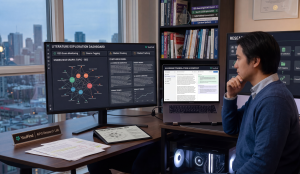
Today, in 2026, the wave of generative AI has already swept from the cloud to everyone's desktop. If you're a Chinese-American engineer in North America, an international student, or a cross-border e-commerce practitioner on the cusp of going overseas, you must have felt this urgency: relying solely on ChatGPT or Claude's web page is no longer enough. To ensure that trade secrets are not leaked, to meet compliance requirements when handling financial models or medical data, or even just to create online articles in the middle of the night without being interrupted by network latency, deploying "local AI hardware" has become the standard for the workplace elite in 2026.
We are no longer faced with the question of "whether to run the local model", but the question of "what to run". Should you choose the M3 Max MacBook Pro with 128GB of unified memory that can hold the whole world, or build an RTX 4090 PC with the pinnacle of CUDA computing power but stretched thin in the face of video memory? This article will take you to break down this most core productivity tool showdown in 2026.
Why do businesses and professionals need "local AI" in 2026?
If you're still hesitant to invest hesitantly in high-performance hardware, take a look at current industry trends. According to the latest industry research, more than 60% of financial and healthcare organizations have begun restricting employees from uploading sensitive data to public AI clouds [Source: Gartner 2025 AI Security Report]. Data privacy (Data Sovereignty) is no longer a legal term, but a sword of Damocles hanging over the head of every overseas enterprise.
In North America, for engineers and lawyers working with privacy-sensitive data, running a large model at the local level of 70B (like the successor to Llama 3) means that all your prompts and customer profiles never leave your hard drive. At the same time, the cost of a long-term subscription to cloud computing power tends to buy two high-end MacBook Pros within three years. asYouFind (Sublimation Online)The concept that has always been adhered to when promoting enterprises to go overseas: hardware is the base, and data is the moat. Owning local computing power is the first step for enterprises to build a privatized brand fortress in the AI era.
Core Showdown: Unified Memory (Mac) vs Video Memory Specialization (PC)
These are two completely different sets of underlying philosophies. Nvidia is going the "lightning-fast lightning" route, while Apple is taking the "inclusive" route. For running large models, the core bottleneck is often not CPU speed, but the size of video memory (VRAM). If your video memory can't hold the parameters of the model, the model won't run at all, or it will be as slow as a slide.
The following table clearly shows the comparison of core parameters of mainstream AI hardware when running local large models in 2026:
| Dimensions | Apple MacBook Pro (M3 Max) | Assembling a PC (Single RTX 4090) |
|---|---|---|
| Core architecture | Unified Memory | Dedicated VRAM (discrete video memory) |
| Memory/video memory limit | Up to 128GB | Fixed 24GB |
| Maximum model support | Runs the 70B model with full accuracy | Only highly quantized 70B models can be run |
| Reasoning framework support | MLX (Apple optimized), llama.cpp | CUDA (industry standard), TensorRT |
| Power consumption and noise | 30W - 100W / Extremely quiet | 450W - 1000W+ / Obvious fan sound |
How to measure inference speed vs. token efficiency?
In real-world testing, if you're running a smaller model (like 7B or 14B parameters), the RTX 4090 performs horrifyingly. It can spit out words at a speed of more than 100 tokens per second, basically as soon as you finish typing, the answer will instantly pop up all over the screen. For self-media people and online creators, this sense of instant feedback greatly improves the creative flow. But in 2026, we will need to deal with long text analysis and complex logical reasoning, and that's when large models above 70B will come in handy.
The RTX 4090's 24GB of memory will look very cramped when faced with a 70B-level model, and you have to use a quantized version of 4-bit or even lower, which will lose the model's "IQ". The M3 Max with 128GB of RAM can only output 10-15 tokens per second (equivalent to normal human reading speed), but it can fully load the model with extreme precision. For financial analysts and engineers,"Accuracy" is far more important than "speed".
Energy efficiency ratio and office scene: a game of silence and wildness
For professionals working in regions like North America or Hong Kong, where land is scarce and electricity costs are high, energy efficiency is an unavoidable topic. Building an RTX 4090 PC requires a huge chassis, a complex cooling system, and at least 1000W of power supply, which means your office will be like a small heating station. If you work in a medical office, law firm, or shared office, the noise and heat are unbearable.
In contrast, the MacBook Pro M3 Max shows a dimensionality reduction blow in industrial design. You can run Llama 3 without power while having a coffee at Starbucks. This ability to work from the go gives you unparalleled elegance when presenting AI-powered marketing strategies or tech demos to your clients. That's exactly what it isYouFindThe concept of efficiency promoted: tools should not be the limitation of the scenario.
Software Ecology: The rise of MLX challenges CUDA's supremacy
For a long time, Nvidia's CUDA has been almost synonymous with AI. Almost all open source models will support CUDA in the first second of release. If you are a deep learning researcher or need to train models frequently (Fine-tuning), the PC camp is still your best choice. The maturity of its ecosystem means that any bug you encounter will be answered on Stack Overflow.
However, Apple's MLX framework has seen explosive growth between 2025-2026. MLX is a machine learning framework designed specifically for Apple Silicon that allows Macs to directly invoke the bandwidth benefits of unified memory when inference. Now, mainstream open-source projects like Stable Diffusion, Llama 3, and even the latest DeepSeek are optimized to run amazingly efficiently on the Mac. For most "apped" users—those who use AI to code, copy, and analyze—the barrier to software for Mac is getting lower.
Configuration recommendations for different budgets and industries
In 2026, there is no best hardware, only the configuration that best suits your business scenario. Based on our measured experience, the recommendations are as follows:
- Option A (Medical/Legal/Financial Elite):PreferredMacBook Pro M3 Max (128GB RAM)。
You're dealing with extremely long contracts, medical records, or financial reports, and privacy is strict. Mac's unified memory allows you to load high-precision long-text models locally, and the data does not leave the local device, making it perfectly compliant.
- Scenario B (Technical Developer/Creative Videographer):AssemblyRTX 4090 or even dual-socket RTX 4090 workstations。
If you need to perform large-scale image generation (such as Stable Diffusion XL) or small-scale model fine-tuning, CUDA's computing power advantage is irreplaceable. Although 24GB of video memory is a bottleneck for a single card, most of the problems can be solved through dual SIM splicing.
- Plan C (cost-effective/self-media): Mac Studio M2 Ultra or used multi-graphics PC。
If you don't need to work on the go, the Mac Studio offers more consistent sustained output, while multiple used RTX 3090 (24GB) servers are the cheapest option to run large models out there.
The leap from hardware purchase to AIPO's brand strategy
Having powerful on-premises AI hardware is just the beginning of this efficiency revolution. For overseas business owners and cross-border e-commerce practitioners, the real challenge is: how to make your brand visible to more people in the AI era? This is itYouFind (Sublimation Online)proposedAIPO(AI-Powered Optimization)Core logic. The hardware provides the computing power to produce your content, and AIPO ensures that it is prioritized by generative engines like Google AIO, ChatGPT, Perplexity, and more.
In the era of AI search, it's not enough for brands to only do traditional SEO. You need to take advantage of likeYouFindExclusive patentedMaximizer systemto structure and model content to comply with Google E-E-A-T guidelines without changing the web page's architecture. Our data proves that with AIPO optimization, brands can increase their citation rate in AI summaries by 3.5 times, with an average increase of 22% in overseas inquiries. Hardware is your sword, and AIPO is your navigator, guiding you to accurately acquire customers during the AI traffic dividend period.
See if your brand is "missing" in the eyes of AI now
Don't be invisible in the age of AI search. Get your term gap monitoring report with the Expert GEO Audit tool of Easyhua.
Get your free GEO audit report todayFrequently Asked Questions (FAQs)
What are the core parameters of local AI hardware?
In 2026,The size of the video memory (or unified memory).is the first element. Computing power determines the generation speed, but the memory size determines whether you can run the model. For large models of the 70B level, it is recommended to have at least 64GB of free memory.
Can a regular computer with 16GB of RAM still run AI?
Yes, but the experience is poor. 16GB of RAM only runs the minimalist quantized version of the 7B or 8B model. These models, while fast, are prone to "hallucinations" or gibberish when dealing with complex logic and long texts. For professional use, 32GB is recommended to start.
How can I improve my content's citation rate in Google AI Overview?
This needs to be doneGEO (Generative Engine Optimization)。 In addition to ensuring the accuracy of your content, it's crucial to use structured data (Schema) and in-depth analysis that adheres to E-E-A-T guidelines. You canLearn about AI writing articlesHow to achieve this with the AIPO engine.
Buy the M3 Max now or wait for the M4 series?
If your current business is already limited by computing power, it's wise to buy the M3 Max now because it offers productivity gains that far outweigh the costs of waiting. Although the M4 is strong, the performance improvement of Apple Silicon has entered a plateau, and the capacity of unified memory is the metric you should pay the most attention to.
Will it be complicated to assemble a PC to run AI?
Compared to Mac out-of-the-box, PCs need to configure CUDA environments, Python versions, and various drivers, which does have certain technical thresholds. But if you're an engineer or a developer who likes to toss around, the freedom and extreme speed that a PC brings are very cost-effective.
Regardless of the hardware you choose, the competition in 2026 is essentially a race of "AI collaborative power." Choose the right tools with a professional AIPO content strategy to stay ahead in the ever-changing global market. Want to know how to leverage AI to produce high-quality, branded content? WelcomeLearn about AI writing articlesLearn more about cutting-edge technologies.