

In the current digital marketing landscape, artificial intelligence (AI) is no longer a distant future concept but a real force that profoundly influences content production and distribution. Many marketing teams are facing a core dilemma: on the one hand, with the help of AI tools, the efficiency of content generation has been improved unprecedentedly; On the other hand, they are also worried that the content produced may be empty, or even damage the brand's long-term trust due to quality issues, and its visibility in search engines will not increase but decrease.
Taking industries that rely heavily on professional reputation, such as finance and insurance, for example, when potential customers ask questions to large language models such as Gemini, if they are always quoted from competitors' perspectives and data, it means that brands are at a disadvantage in the "content distribution" battle in the AI era. The crux of the matter is that we need to shift our thinking: the future of content marketing battlegrounds, yes"Writing for AI to read with people"。 Instead of passive anxiety, it is better to take the initiative and regard AI as the most important "content distribution partner". To achieve this goal, it is necessary to systematically produce high-quality content assets that AI can accurately understand, trust, and are willing to reference.
This article aims to provide a set of specific, immediately actionable team workshop guidelines. Through the period2 hoursYour team will get three core outputs:
-
A common set of "AI-friendly content" languages: Build a bridge between marketing, content, and technical teams.
-
Three practical exercises that can be applied immediately: Generate specifically optimized content modules to directly improve content quality.
-
A blueprint for a sustainable "AIO content engine": Transform one-time insights into systematic processes that operate sustainably.
1. Build consensus: Understand how AI "reads" your content - the "three-layer summary" framework
Before optimizing content, teams need to unify their understanding of the AI operating logic. Traditional E-E-A-T principles (experience, expertise, authority, and trustworthiness) are still the cornerstone of content value, but in the age of AI, these characteristics must be conveyed through clearer and structured "signals" to be effectively captured.
To this end, we have introduced the core tool -"Three-tier summary" framework。 This framework is like a "reading guide" for AI and readers, ensuring that your core values can be accurately captured in different search scenarios:
-
Level 1: A one-sentence summary
-
Definitions: Condense the core value proposition of the full text and accurately embed the target keywords. Its function is equivalent to a perfect "elevator presentation", which must persuade the AI and readers to click and read in a very short time.
-
Example"This guide provides a 2-hour team workshop process that systematically teaches you how to create a content strategy that earns both AI recommendations and user trust."
-
-
Level 2: Three-sentence summary
-
Definitions: Expand on the core argument, usually covering 2-3 main subtopics of the article. This level provides the AI with a clear content skeleton, allowing it to generate bullet points or medium-length summary responses.
-
Example"First, we will establish a common language with the 'three-tier summary' at its core; secondly, through three practical exercises, lead the team to master specific skills for content optimization; Finally, we will systematize the output and build a sustainable content engine."
-
-
The third level: complete explanation
-
Definitions: That is, the detailed body of the article. Specific steps, case studies, data support, and authoritative citations should be provided here to enrich the argument and establish a deep sense of professional authority for the brand.
-
The effectiveness of this framework lies in its precise correspondence to AI's information processing mode: a one-sentence summary is used to answer simple questions; The three-sentence summary can be included in the knowledge panel or highlighted summary; The full explanation provides material for in-depth inquiries. The following table summarizes the shift in thinking patterns:
| Traditional content thinking | AI-optimized (AIO) content thinking |
|---|---|
| Created for end-users of "one-time reading" | Structured design for AI systems that "repeatedly grab and cite" |
| emphasizes literary rhetoric and creative layout | Emphasize logical clarity, information density, and structured presentation |
| Evidence citation tends to be vague and generalized (e.g. "industry general opinion") | Evidence citations must be clear, traceable, and come from authoritative sources |
| Title design is mainly oriented towards click-through rate | Titles and summaries must accurately reflect the core of the content to reduce the risk of AI misjudgment |
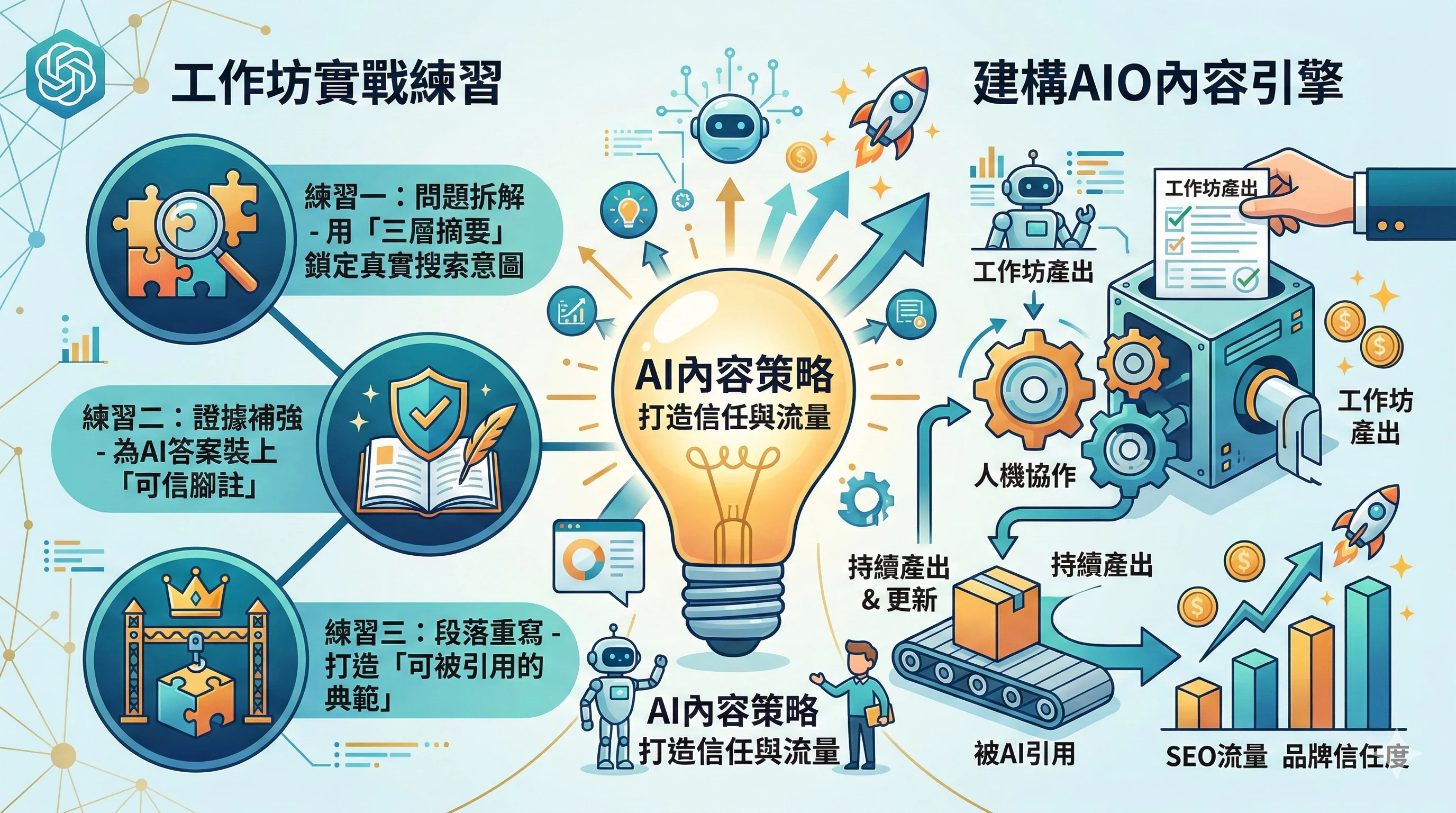
2. Practical exercise: Three steps to reinvent the content
This session is recommended that the team be divided into groups and prepare tools such as whiteboards and sticky notes. Each exercise is set with clear inputs, steps, and outputs, ensuring that learning outcomes are specific and quantifiable.
Exercise 1: Problem Breakdown - Use the "three-level summary" to lock in real search intent
Many content traffic is poor because of answering a "wrong" or too empty question. This exercise aims to train teams to translate core keywords into specific questions that AI and users are genuinely concerned about.
-
Input: A core keyword that is highly relevant to the business, such as "Savings insurance」。
-
step:
-
Brainstorming: 5 minutes for a time limit, in small groups, using the 5W1H method (Who, What, When, Where, Why, How) to think about all related questions. For example: "Who is suitable for buying?" "What is the difference between it and time deposits?" "When is the most advantageous time to insure it?" "How to compare the expected returns of different products?".
-
Intent classification: Post all questions to the whiteboard by search intent:informational(want to know),Transactional(want to buy),Navigation type(Find a specific brand). This move will reveal the full user journey implied behind a keyword.
-
Frame application: Select a high-value question (e.g., "How to calculate the expected rate of return of savings insurance?") ), try to draft a "three-layer abstract" for it. A one-sentence summary gives the core answer range; A three-sentence summary lists the key factors that affect returns; For a complete explanation, it is necessary to plan to quote authoritative information such as regulatory announcements or dividend realization rate reports published by insurance companies.
-
-
Export: A visual "Problem Intent Analysis Canvas" that serves as a strategic map for subsequent content planning.
Exercise 2: Evidence reinforcement - Attach "credible footnotes" to AI's point of view
AI can efficiently produce the first draft with correct views, but it often lacks the "flesh and blood" to support the argument. This exercise aims to solve the problem of empty content and insufficient persuasiveness, and directly strengthen the "authority" and "credibility" in E-E-A-T.
-
Input: A short article generated by an AI tool with correct views but lack citations, such as "Comparison of term life insurance and whole life insurance."
-
step:
-
Mark assertions: The panelists circled all the statements in the text that needed to be supported by evidence, such as: "The premium of term life insurance is relatively low" and "Whole life insurance provides protection up to the age of 100".
-
Look for evidence: Guide the team to find reliable data sources by priority. For the financial and insurance industry, the priorities are:Government regulators(as announced by the Financial Supervisory Commission),Industry associations(such as the statistical report of the Federation of Insurers),A well-known professional service organization(such as research by the Big Four accounting firms),A peer-reviewed academic journal。
-
Consolidate citations: Learn how to embed evidence elegantly in your text. For example, use the sentence "According to the Financial Supervisory Commission's 2023 Life Insurance Market Statistical Report...", and attach hyperlinks to keywords instead of directly pasting lengthy URLs.
-
-
Export: An optimized text that has been revised and full of authoritative citations, and a summarized "list of authoritative sources of evidence".
Exercise 3: Paragraph Rewriting - Creating a "Citable Model"
This is a comprehensive output exercise. Take your company's existing but underperforming content and use the skills you've learned to reshape it into "model paragraphs" that are easy for AI to recognize and are willing to cite.
-
Input: a core paragraph in an existing article.
-
step:
-
Refine the core: Write a one-sentence summary for the paragraph to clarify its core argument.
-
Optimize the structure: Adopt "Claim → Evidence → Explanation → Summary" logical structure to be rewritten. For example, it first proposes that "XYZ savings insurance plan is suitable for long-term financial goal planning", then cites the cash value statement in the product description as evidence, then explains how the data meets the needs of children's education or retirement, and finally reiterates the advantages of long-term planning.
-
Reinforce signal words: Deliberately use logical conjunctions such as "first", "more importantly", "for example", and "in summary" to provide clear paragraph structure signals for AI.
-
Add internal links: Link to more in-depth articles on the site (e.g., "Learn more about the bonus distribution mechanism") in relevant places to not only enhance the user experience, but also demonstrate the depth of the website's knowledge system to the AI.
-
-
Export: A rewritten "model paragraph" with a "model paragraph checklist" co-created by the team as a benchmark for future content quality control.
3. Systematic operation: from workshops to normalized "AIO content engine"
A successful workshop can ignite a team spark, but it's only by establishing a systematic process that a fleeting passion can be transformed into a lasting competitive advantage.
Step 1: Map "Content Opportunities"
Systematically organize the "Problem Intent Analysis Canvas" from Exercise 1 and the topics of Exercise 3 optimization into a shared digital board (such as Notion, Trello, or Excel). This Content Opportunity Map should include the following dimensions:
-
Content topics: Derived from real problems from users.
-
Current status: Mark "Existing content/To be optimized/To be created".
-
Target formatSuch as blog posts, white papers, FAQ pages, etc.
-
Person in charge: Clear division of labor.
-
AIO priority: Evaluate which topics are most likely to be cited by AI to drive high-value traffic.
Step 2: Establish standard operating procedures (SOPs) and update cadences for "human-machine collaboration"
To ensure that the team continues to use the AIO methodology, it is essential to establish a clear review process and maintenance mechanism.
-
Design SOP flow charts: Establish a standardized content production process, such as: "AI-generated first draft"→ "Content owner uses the 'three-tier summary' framework to restructure"→ "Optimize evidence and logic with reference to the 'model paragraph checklist'"→ "Legal/domain experts conduct compliance and fact reviews"→ "Publish and monitor performance".
-
Clarify the division of roles:
-
Marketing strategist: Define the content direction and core message.
-
Content optimizer: Focus on using AIO techniques to improve content quality.
-
Domain expert/legal: Perform a final audit to establish a firewall of trust.
-
-
Set the update cadence: Content publishing is not the end. It is recommended to review the "Content Opportunity Map" quarterly and use the "three-tier summary" framework to regularly optimize and update old articles that have organic traffic but have not received featured summaries to maintain the freshness and competitiveness of the content.
Conclusion: Let AI be your most professional content distribution partner
Looking back at the essence of this "paper workshop", the core is to complete a mindset transformation: we are no longer just "content producers", but upgraded to "architects of knowledge assets that can be distributed and referenced". AI is not a replacement for human opponents, but a powerful collaborator who needs clear guidance. The "three-tiered summary" framework provides a common language for collaboration, and three practical exercises internalize theory into the team's muscle memory.
The value of this approach goes far beyond improving short-term search rankings, it is essentially a pairTeam collaboration efficiencyWithThe quality of the company's digital assetsstrategic investment. When your content can be continuously cited by AI, it can gradually establish an unshakable position of authority in the user's mind and information channels.
Action starts in the moment.We recommend that you gather your core team next week and start with a 60-minute lite version of "Exercise 1: Problem Breakdown". You'll be amazed at your team's new insights into what users really want, and that's where all great content strategies come from.
Appendix: AI Marketing and Content Trust FAQs
Q1: Will I be punished by search engines like Google for using AI-generated content extensively?
A: Google's core rule is to crack down on low-quality, spammy content created "for search engines, not users." AI itself is just a tool, the problem is how to use it. There are indeed risks in directly publishing unaudited AI outputs that lack unique insights and authoritative evidence. The "human-machine collaboration" and in-depth optimization advocated in this article are aimed at creating high-quality content with depth and trust that AI tools cannot accomplish independently.
Q2: Does the "three-tier summary" framework work for all types of content, such as product pages or white papers?
A: It can be applied flexibly. For example, a one-sentence summary of the product page can be a core value proposition, a three-sentence summary summarizes the three major product advantages, and a complete explanation is a detailed specification and use case. The white paper can apply this framework to the executive summary and repeat a similar structure in each section of the body. This method is particularly useful for content that requires clear explanation of complex concepts.
Q3: What are the most common misconceptions about AI marketing for highly regulated industries like finance and insurance?
A: The two major pitfalls are "over-commitment" and "lack of compliance". AI models may absorb imprecise information from the internet during training, resulting in copy with absolute language (such as "guaranteed highest returns") or ignoring necessary risk warnings. This makes itManual professional audits and compliance checks have become crucial, must not be omitted due to the pursuit of efficiency.
Q4: How can I effectively measure the return on investment (ROI) of an AIO strategy?
A: In addition to traditional traffic and conversion rates, you can pay attention to the following indicators:1) Featured snippet acquisition rate; 2) The number of times a brand is mentioned or cited in AI responses (e.g., Gemini, Copilot).(can be measured through brand monitoring tools); 3) Average time on page and bounce rate(High-quality, well-structured content can effectively retain users); 4) Organic ranking improvement for core keywords。
Q5: How should a small team initiate an AIO strategy with limited resources?
A: It is recommended to start with the Minimum Viable Scenario (MVP):Choose a core service or product page that matters most, concentrating their firepower, using the "three-tier summary" framework to rewrite their introductory paragraphs and find authoritative evidence for each functional proposition to reinforce. Maximize a single page, verify results, and then gradually replicate and expand success experiences to other pages and content types.