

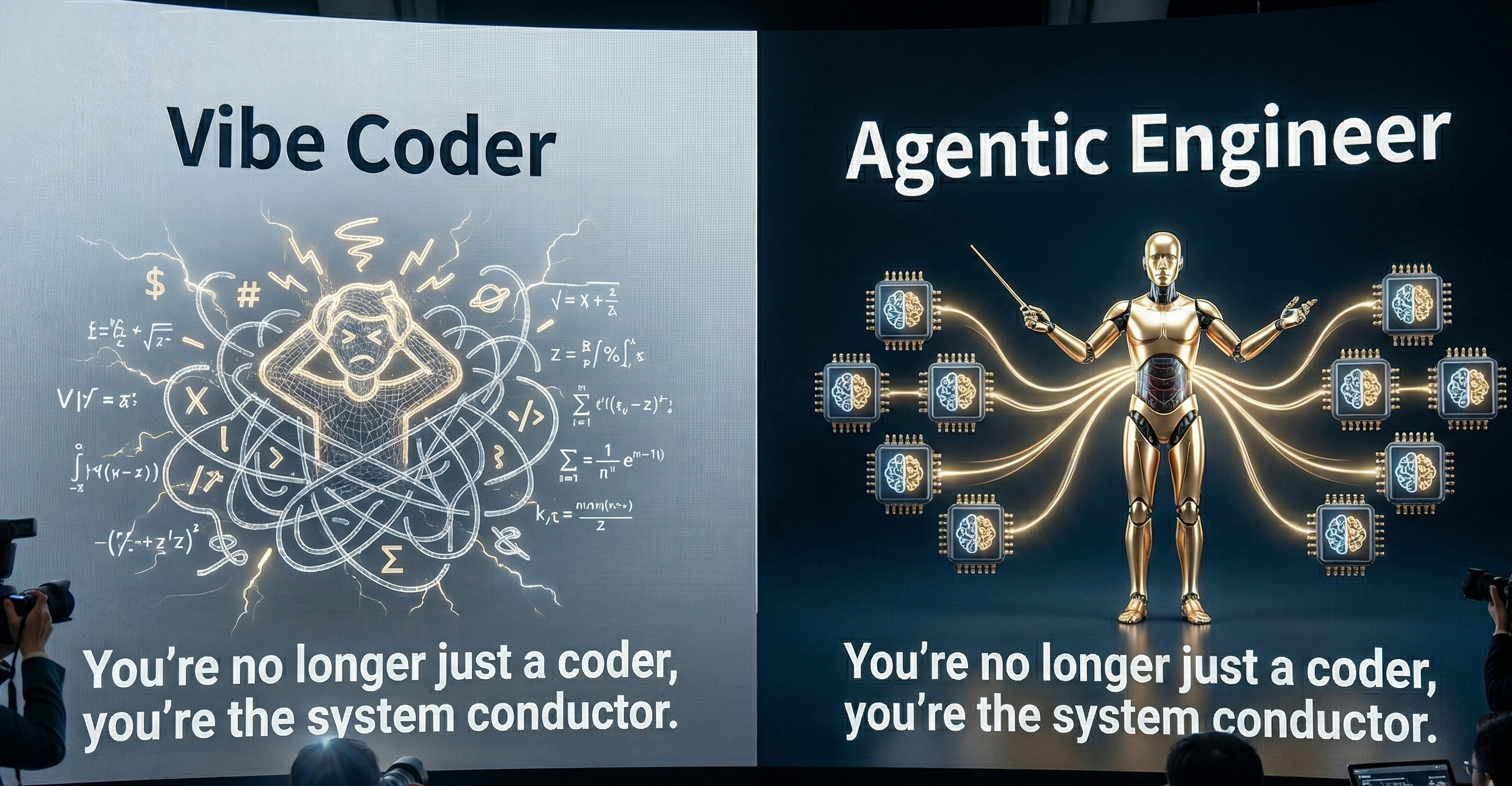
Article Description: Dive into the core trends of the GLM-5 launch event, analyze the paradigm shift from Vibe Coding to Agentic Engineering, and uncover how enterprises can leverage YouFind AIPO technology to seize citation dividends in the era of AI agents.
Have you ever had the experience of repeatedly debugging a prompt to ChatGPT or Claude, like "trying your luck" with a black box, until at a certain moment the output looks "Vibe is right" and you breathe a sigh of relief? This development model, which relies on intuition and lacks structured logic, is nicknamed by the industryVibe Coding(Atmosphere Programming).
However, at the recent GLM-5 launch of Zhipu AI, a more industrial aesthetic and rigorous vocabulary -Agentic Engineering(Agency project) officially went to the front of the stage. This is not only a change in technical terminology, but also a watershed in the transition from "metaphysical attempts" to "systems engineering" in AI application development. For Chinese engineers, cross-border e-commerce and overseas business owners in the highly competitive environment of North America, understanding the underlying logic of this transformation is crucial for your brand to survive in the era of AI search (GEO).
Why can't Vibe Coding support enterprise-grade application ambitions?
Vibe Coding can be fun for personal prototyping or creative writing, but its drawbacks come to light when the scene switches to specialized areas such as actuarial science, medical consulting, or legal compliance. Relying on AI powered by Simple Prompting is essentially making probabilistic predictions. This "trial-and-error" development faces three insurmountable obstacles:
- Uncontrollable Risk of Hallucinations:Without structured constraints, AI can easily "deviate" in long text processing, outputting false facts that seem professional but are actually wrong.
- Stability that is difficult to quantify:The same instruction, outputting 100 points today and possibly only 60 tomorrow, is a nightmare for enterprise-grade SLAs (service level agreements).
- Low iteration efficiency:When business logic becomes complex, simply increasing the length of the prompt will only make the model more confusing, and developers will fall into an infinite cycle of "changing A and breaking B".
For financial or real estate companies that are deeply involved in Hong Kong and overseas markets, any misquotation caused by "atmosphere" may turn into a serious compliance incident or brand public relations crisis. Therefore, the evolution towards Agentic Engineering is imperative.
In-Depth Understanding: What is Agentic Engineering?
If Vibe Coding is "chatting" with AI, then Agentic Engineering is "building a production line" for AI. Instead of seeking to have the AI give a perfect answer the first time, it builds an inclusionPlanning、MemorywithTool Useautonomous agent workflows.
The three core pillars of Agentic Engineering
In the Agentic paradigm, AI acts as a "project manager" rather than a "typist."
- Multi-step reasoning and reflection:The agent breaks down complex tasks into subtasks and self-examines them after each step is executed. If it finds that the results are not logical, it will actively correct the path.
- Dynamic Tooling:It knows when to call the search interface, when to query the private database (RAG), and when to run a piece of Python code to validate the calculations.
- Long-term contextual management:Remember brand preferences and historical decisions across sessions, ensuring a high degree of consistency in output.
This pattern is a direct response to "professionalism" and "trustworthiness" in Google's EEAT guidelines. Through engineering, we have taken AI's capabilities from "generating content" to "performing tasks".
Industry shock: How can industries adapt to the shift from "dialogue" to "workflow"?
Agentic Engineering is reshaping the depth of interaction across different verticals. To visualize this evolution, we've compiled the following table to compare the pain points of traditional SEO thinking with the breakthrough brought about by the Agentic model:
| Industry Sectors | Traditional SEO/AI pain points (Vibe mode) | Agentic Engineering Solutions | Increased business value |
|---|---|---|---|
| Cross-border finance/wealth management | The content is superficial and can't handle real-time exchange rates and complex compliance terms. | Build an agent with compliance check logic to call financial APIs to verify data in real time. | Improve customer acquisition accuracy and reduce legal compliance risks. |
| Healthcare/Consultation | It is easy to produce medical hallucinations, the source of citations is unknown, and there is a lack of authority. | Multidimensional validation workflow: References medical database > cross-matched > structured outputs. | Build a high level of brand trust and comply with YMYL strict regulations. |
| Cross-border e-commerce/retail | Product descriptions are the same, which cannot solve users' long-tail price comparison needs. | Independently perform competitive product analysis and inventory matching, and generate dynamic shopping guide plans. | Conversion rate is improved, reducing the cost of manual customer service intervention. |
| Real Estate/Professional Services | Static pages struggle to answer complex tax or loan calculation questions. | Integrate the Financial Model Calculation Agent to provide a personalized home purchase planning path. | Shorten the user decision-making cycle and improve the quality of inquiry. |
This paradigm shift means that the future search portal is no longer just a link returned, but AI Agent directly calls the most authoritative resources to answer questions. So, how can brands ensure that they are the "most authoritative resource"?
AIPO Dual-Core Layout: How to Get Prioritized in the AI Agent Era?
In the era of Agentic Engineering, the way AI agents find information has fundamentally changed. They prefer to reference content sources that are structured, logical, and EEAT-compliant. YouFind (YouFind) was the first to proposeAIPO(AI-Powered Optimization)The engine is born for this.
We found that to take a central seat in the responses of ChatGPT, Perplexity, or Google AIO, brands must build their own "AI moat."
GEO Score™: Diagnosing Your "AI Visibility"
Exclusive through YouFindGEO Score™algorithms, we can monitor the brand's citation rate across major AI engines in real time. It's not just about looking at rankings, it's about analyzing whether there are "citation gaps" when AI deals with industry-specific issues. If a competitor has already occupied an AI recommendation position for a high-value keyword, our system will automatically alert and develop a counterattack strategy.
The four-step logic of content intelligence
Through a standardized process, the AIPO engine transforms fragmented enterprise information into a "textbook-grade" corpus that AI agents like to quote:
- Data collection:Trace the crawl path of the AI agent and lock high-authority sources.
- In-depth analysis:Dismantle the structure of competing content and extract summary anchors that are easily recognized by AI.
- Strategy Ideation:Combine SEO norms with AI algorithm preferences to design titles that both incentivize clicks.
- Structured Modeling:This is the core. We structure the content (Schema Markup) to ensure that it is not only understandable by humans but also recognized by AI agents as authoritative.
The most worry-free thing for business owners is that with YouFind's exclusive patented Maximizer system, customers can achieve these efficient optimizations without having to redevelop their websites without changing the web architecture.
From Writing Prompts to Designing Systems: Skills Transformation for Developers and Business Owners
In the Vibe Coding era, the skill point was in "vocabulary"; In the era of Agentic Engineering, the skill point is "system architecture". For workplace elites and self-media people, the core competitiveness in the future will beStructured Modelingability. Instead of "how do I ask AI", you need to think about "how can I feed my professional experience and authoritativeness to AI and make it my exclusive agent".
According to YouFind's practical case, brands optimized by AIPO have seen an average increase of 3.5 times in the citation rate in Google AI summaries, and the number of overseas inquiries has increased by 22%. This proves that AI search optimization is not in the future tense but in progress.
See if your brand is "missing" in the eyes of AI now
Don't be invisible in the age of AI search. Get your term gap monitoring report with the Expert GEO Audit tool of Easyhua.
Get your free GEO audit report todayFrequently Asked Questions (FAQs) on AI Development Paradigm Shift
What is Vibe Coding and why is it gradually becoming obsolete in 2026?
Vibe coding refers to an AI development method that lacks rigorous logic and relies primarily on repeatedly adjusting prompts to try to achieve satisfactory results. With the evolution of multimodal large models such as GLM-5, enterprises need higher stability and predictable task execution capabilities, so this "feeling-based" model is being replaced by systematic agentic engineering.
How does Agentic Engineering improve brand performance in Google AIO?
Agentic Engineering emphasizes the rigor of workflows. When branded content is structured to follow this logic, AI engines like Google can more easily identify the expertise and authoritativeness of the content, prioritizing the brand's data as a source of answers when generating AI summaries.
Does implementing AIPO optimization require significant technical costs?
No, you don't. With YouFind's patented Maximizer system, businesses can quickly optimize layouts that align with AI search preferences without changing the existing website architecture or redeveloping the website, saving significant time and R&D costs.
How to start laying out the brand moat in the AI era?
The first step is to perform a visibility diagnosis. By analyzing your brand's current GEO Score™, you can identify content gaps in the AI search environment, and then build a brand knowledge base (Source Center) through structured modeling, allowing AI Agents to learn and get used to referencing your brand information.
In the face of the AI wave, embracing change is more important than immersing oneself in hard work. Whether you're a business owner looking to break through or a developer seeking to be at the forefront of technology, switching from Vibe Coding to Agentic Engineering is a surefire way. In this process, YouFind will serve as your technical endorsement to help you occupy the information high ground in the era of generative AI.
Want to learn how to leverage advanced technology to boost your content's impact?Learn about AI writing articlesto start your AIPO transformation journey.