

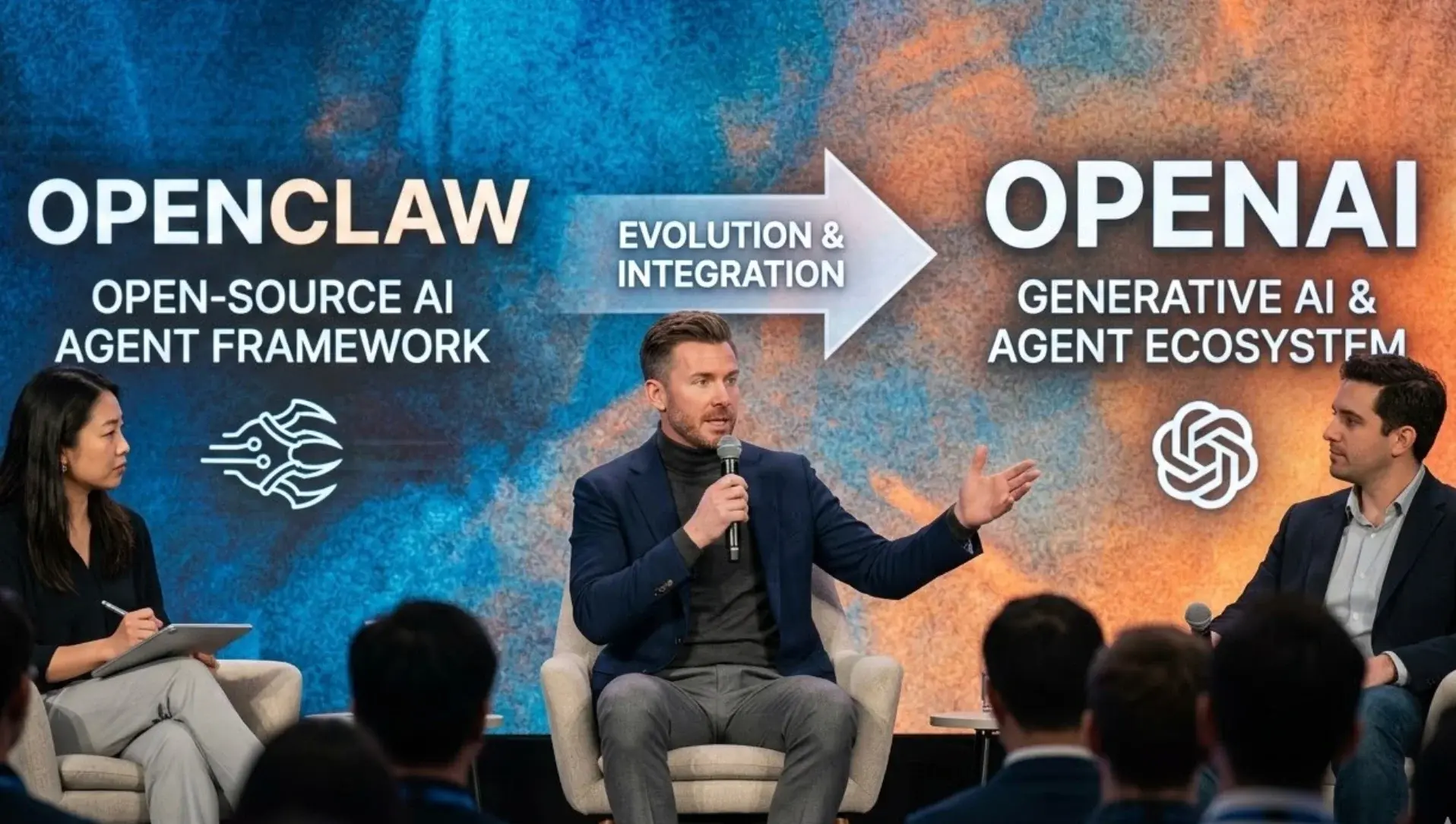
A recent shock in the AI circle has kept many developers and overseas companies awake at night: the founder of OpenClaw, a top open source AI agent framework, has officially announced that he has joined OpenAI. This is not just an ordinary talent flow, it is more like a signal that the field of AI agents is accelerating from the "open source era" to the "integration era of giant integration".
For Chinese engineers, cross-border e-commerce sellers, or self-media people far away in North America, this raises a core anxiety: If good open source tools like OpenClaw are eventually absorbed by closed-source giants, will there be a future for the automated workflows we build on these frameworks? More importantly, when AI engines (such as Google AIO, ChatGPT) begin to dominate information distribution, will your branded content be prioritized by AI as a "standard answer", or will it be drowned in massive model training data and completely lose visibility?
Why did the founder of OpenClaw choose OpenAI? Deep considerations behind the technical logic
OpenClaw has become popular in a short period of time because it greatly simplifies the automation of complex tasks. However, the essence of AI Agent is the collaboration between "brain (large model)" and "hands and feet (tool call)". As OpenAI continues to enhance its inference models, such as the o1 series, the logical planning capabilities of the models themselves have begun to cover vulnerabilities that previously required forced patching by external frameworks. The founder's addition is likely to deeply implant OpenClaw's sophisticated automated workflow logic into OpenAI's native ecosystem, such as creating more powerful GPTs upgrades or more actionable system-level agents.
This reflects an irreversible trend: computing resources and model capabilities are moving towards "great unification". For enterprises, this means that while the barrier to technology is lowering, the barriers to "being discovered by AI" and "trusted by AI" are significantly increasing. Relying solely on open source frameworks is no longer enough to build barriers, the real moat lies in whether your brand data has high-quality attributes extracted by AI.
Deep Predictions: The Future of OpenClaw and AI Agent Frameworks
After the entry of giants, the development path of AI Agent will undergo qualitative changes. We can clearly see the impact of this evolution on technology selection through the following table:
| Dimensions | The State of Open Source Frameworks (e.g., OpenClaw) | Future Integration Trends (OpenAI/Cloud Native) |
|---|---|---|
| Depth of integration | You need to manually configure the API and prompts | Models are natively supported with millisecond responses |
| Data security | Localized deployment with strong privacy controls | Trending towards compliance cloud, brand asset library modeling |
| Distribute weights | Depends on search ranking (SEO) | Depends on AI Citation Weight (GEO) |
| Maintenance costs | High, you need to keep up with the model version update | low, automated via standard interfaces |
We predict that OpenClaw's core technology will most likely evolve into OpenAI's official Agent standard in the future. This means that the future content competition will no longer be a pile of keywords, but a competition of structured knowledge. If your brand messaging doesn't exist in the way AI prefers, you won't be able to get traffic in the age of AI search, whether you're using OpenClaw or another tool.
From SEO to GEO: How to Protect Brand Equity in the AI Engine Game?
In the traditional search era, we are talking about SEO (Search Engine Optimization), with the goal of being on the first page of Google. But in the era of OpenClaw-powered Agents or Google AIOs, users no longer clicked on links and went directly to AI-generated summaries. That's where you need GEO (Generative Engine Optimization).
With nearly 20 years of experience in overseas digital marketing, YouFind keenly captures this paradigm shift. Our first AIPO (AI-Powered Optimization) engine** is designed to solve the pain points of "invisible" brands in the AI era. AIPO is not meant to replace SEO, but to maintain traditional search rankings through a "dual-core layout" that not only maintains traditional search rankings, but also makes your brand the "preferred source" for AI models through exclusive technology.
AIPO Core Logic:When generating responses, AI engines like ChatGPT or Gemini prioritize authoritative content that is logical, well-evidenced, and aligns with E-E-A-T guidelines. YouFind's AIPO engine uses technical means to ensure that your branded content holds the highest weight in the AI crawling path.
Practical Guide: Leverage the AIPO engine to make AI prioritize "recommending" your brand
How to get AI to answer "Which overseas marketing company is the most professional?" Or How do I choose an AI Agent framework? "I saw you at first sight? The YouFind AIPO engine achieves a deep fit between content and algorithms through four standardized intelligence stages:
- Data Collection:We use technical means to automatically crawl the citation sources of mainstream AI platforms, accurately track the traffic path of the competition, and identify which websites are currently considered high-authority sources by AI.
- Deep Analysis:Utilize the exclusive **GEO Score™** algorithm to analyze the real needs of your audience and break down the structural gaps of your content. We identify high-value key areas that are frequently triggered by AI but haven't been covered by your brand yet (GEO word gaps).
- Strategic Conception:Combine the preferences of AI algorithms to generate headline strategies that combine brand benefits and click-through incentives, ensuring that the content is not only readable by AI but also attracts users to click.
- Structured Modeling:This is the most critical step. We rigorously import Google E-E-A-T (Experience, Expertise, Authority, Trust) guidelines and logically structure content (e.g., FAQ Schema), making it the preferred material for AI extraction of summaries.
In this way, we not only optimize the web page but also build a dynamic "brand knowledge base" for brands in the AI era, teaching AI how to correctly and positively understand and cite your business.
Hong Kong Industry Applications: AI moat for finance, healthcare, and high-regulation industries
For financial, healthcare, or educational institutions in Hong Kong, the rise of AI is both an opportunity and a huge challenge. These industries are strictly regulated by the SFC, the Insurance Regulatory Authority, etc., and the accuracy and authority of the information cannot be compromised. If AI cites the wrong information in response to financial advice or medical options, the blow to brand reputation can be devastating.
In the financial sector, YouFind helps clients use AIPO layout to ensure that AI prioritizes the opinions of licensed experts published by brands when generating investment analysis, rather than online rumors from unknown sources. In the medical beauty industry, we emphasize experience in E-E-A-T, which improves brand citation rates in AI summaries through structured processing of measured cases and professional qualifications. Actual data shows that after AIPO optimization, the brand's overseas inquiry volume can increase by **22%** on average, and the citation rate in Google AI snippets can be increased by **3.5 times**.
In addition, YouFind's exclusive patented system of Maximizer allows businesses to optimize efficiently without changing the web architecture without rebuilding their websites. This "lightweight" intervention method saves huge development costs and time for financial and real estate groups with huge historical web pages. No matter how OpenClaw evolves, with the "right to interpret" and "right to be cited" of the underlying data, enterprises can be invincible in the AI search ecosystem.
See if your brand is "missing" in the eyes of AI now
Don't be invisible in the age of AI search. Get your entry gap monitoring report with the Expert GEO Audit tool.
Get your free GEO audit report todayFrequently Asked Questions (FAQs)
1. After the founder of OpenClaw joined OpenAI, can the original open source code still be used?
Currently, OpenClaw's open-source codebase is still accessible and usable. However, in the long run, the diversion of core maintainers may lead to a slowdown in open source version updates. Businesses are advised to focus on its compatibility with OpenAI's official APIs while continuing to use open-source frameworks or consider moving to a more neutral multi-model agent platform.
2. What is AIPO? What is the essential difference between it and traditional SEO?
At its core, traditional SEO is about ranking, which is getting pages to appear at the top of search results. At the heart of AIPO (AI-Powered Optimization) is "being cited". In the era of generative AI, AI integrates multiple sources and gives a straightforward answer. AIPO's goal is for AI to cite your brand data as a core fact in this answer. It emphasizes content structuring, authority, and adaptation to AI scraping logic.
3. Is it too late for enterprises to deploy GEO (Generative Engine Optimization) now?
Now is the golden period for layout. Currently, most companies are still stuck in the traditional SEO stage, and the "word gap" in the AI search field is huge. The sooner you establish a brand knowledge base and conduct structured modeling through YouFind AIPO, the more you can occupy the trust position of AI models in advance, building insurmountable barriers to digital competition.
The wave of AI technology is rushing forward, and the changes in OpenClaw are just a microcosm of the mainstream of AI agents. In this process, only an evolving marketing strategy can continue to increase the value of brand equity in the face of technological changes. If you want to learn more practical tips on how to improve content quality with AI, welcomeLearn about AI writing articles, join us to explore a new paradigm of growth in the age of AI.