

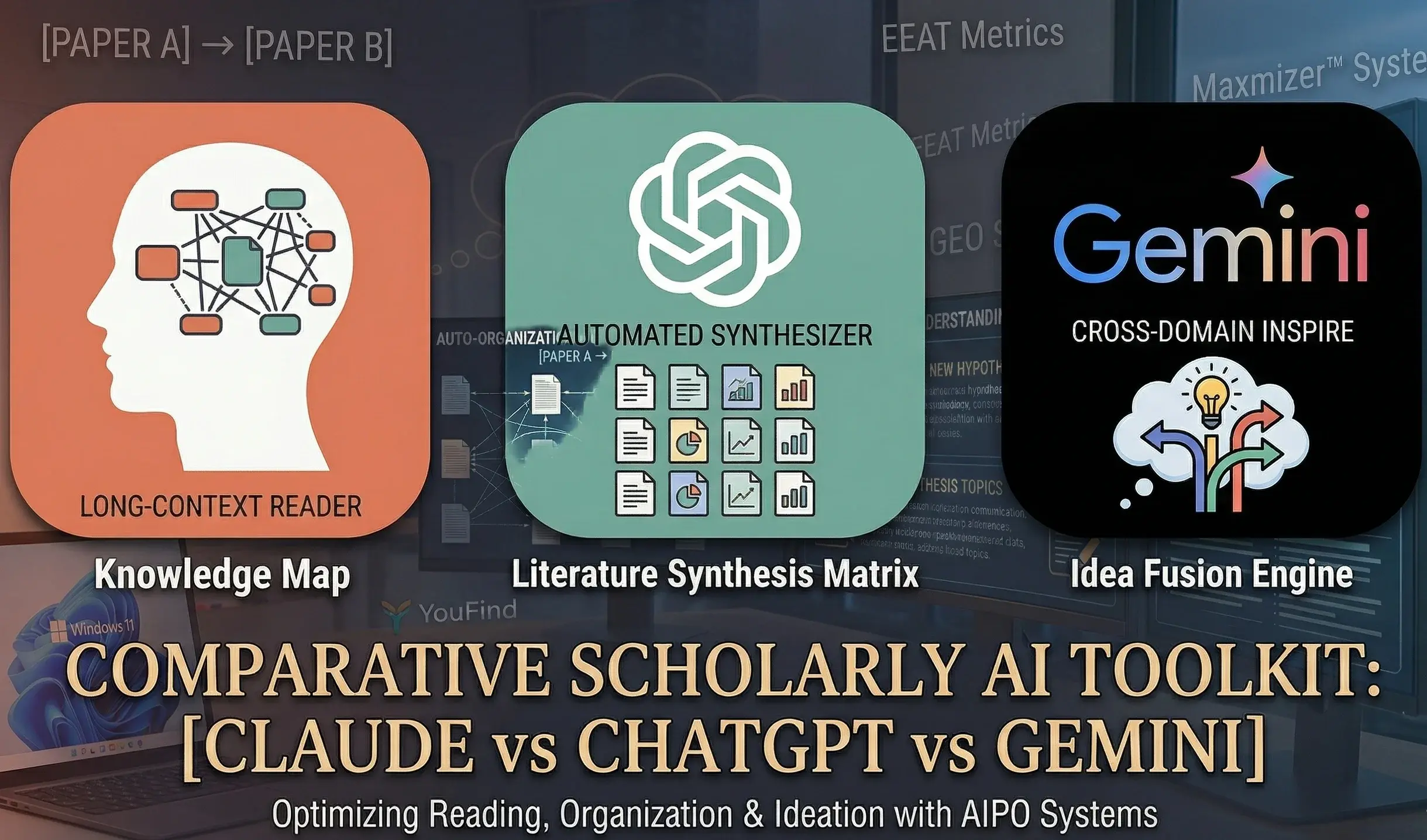
In the entrepreneurial wave of 2026, if you are still struggling with "which AI writes code faster" or "which AI chats more like a human", then you may be behind the starting line. For today's entrepreneurs, overseas e-commerce companies, and workplace elites, AI selection is no longer a simple tool selection, but a matter of concern"Brand Right to Survive"strategic layout. When your potential customers no longer flip through ten pages of Google search results but directly ask ChatGPT or Gemini "Which cross-border marketing service is the most reliable," does your brand appear on the AI's recommendation list?
According to data, the rise of generative search engines (GEOs) has led to a structural shift in the click-through rate of traditional websites. If your content cannot be flagged as an "authoritative source" by AI engines, your business will become an invisible person in the digital world in an era where AI Overview (AIO) dominates the screen. That's why we not only discuss technology selection but also introduce the core logic of AIPO (AI-Powered Optimization): how to make AI prioritize citing your data and opinions.
2026 AI Selection Maze for Entrepreneurs: ChatGPT, Claude, or Gemini?
Entering 2026, the ecosystem of generative AI has matured, but it is also more complex. OpenAI, Anthropic and Google are three-legged, each building a deep technical moat. For startups, deviations in selection not only mean wasted development costs, but may also lead to the brand losing its voice in the specific AI ecosystem. We found that leading entrepreneurs are shifting from pure SEO to AIPO, as AI citation rate has become a new lifeline for startups, which directly determines the bottom line of customer acquisition cost (CAC).
In its practice of helping thousands of companies go overseas, YouFind has observed that different industries rely on AI engines in completely different paths. When choosing a core engine, you must consider: Is its API stable? Does it meet financial or medical regulations for compliance? Most importantly, does its citation mechanism benefit your brand communication?
In-depth review of the three major AI giants: What indicators should entrepreneurs look at?
To make the right decision, we need to tear off the marketing labels of these large models and hit the underlying logic of their business. The following is an in-depth analysis of mainstream models in 2026:
1. OpenAI (ChatGPT/GPT-5): A leader in ecological niches and agents
If you plan to build complex AI Agents or require strong plugin scalability, OpenAI is still the first choice. GPT-5 (and subsequent optimized versions) demonstrates amazing intuition in multimodal collaborative processing, whether it's voice interaction or real-time execution of complex code, the developer ecosystem maturity of its API is still unmatched. However, the pain points for entrepreneurs are the volatility of their cost structure and the extremely high marginal cost of privacy compliance when dealing with highly sensitive financial or medical data.
2. Anthropic (Claude 4): Long text processing and "Constitution AI" trust
For entrepreneurs who are deeply involved in the legal, consulting, or insurance industries, the "security" provided by Claude 4 is irreplaceable. Its unique Constitutional AI framework can greatly reduce the public relations risk of AI hallucinations or outputs. Its long Context Window makes it easy to work with entire industry specifications or hundreds of contracts. Especially in highly regulated markets like Hong Kong, Claude's adherence to data ethics has made it a preferred choice for financial institutions.
3. Google (Gemini 2.0): A native multimodal and search ecosystem moat
If you are pursuing "traffic" and "visibility", Gemini is an unavoidable giant. Gemini's native integration with Google Search and Workspace means it directly controls the content distribution rights of Google AI Overviews (AIO). When users conduct commercial searches, Gemini's citation mechanism prioritizes sites that meet E-E-A-T guidelines and are well-structured. For overseas marketing, this means the convergence of SEO and GEO - optimizing Gemini's citation rate is to optimize your future order volume.
2026 Decision Framework: Selection based on business model
Selection should not go with the flow, but should be based on your business genes. We've integrated the core consideration dimensions into the following matrix to help you quickly locate:
| Types of entrepreneurship | Core engine recommendation | Key reasons for selection | AIPO strategic focus |
|---|---|---|---|
| Content/Media/Overseas E-commerce | Google Gemini | Powerful search traffic conversion and AIO citation weight | Structured data modeling and E-E-A-T authoritative endorsement |
| SaaS/tool development | OpenAI (ChatGPT) | The API ecosystem is the richest, and the Agent development components are mature | Brand knowledge base embedding and plugin market layout |
| Financial/legal/professional consulting | Anthropic (Claude) | Extremely high security, long text analysis and data privacy | Structured orientation for in-depth professional content |
For entrepreneurs who pursue ultimate growth, we recommend adopting a "dual-core layout". For example, ChatGPT is used to optimize internal R&D and product interactions, while Gemini and YouFind's AIPO technology is used to ensure the brand's authoritative position in external search engines.
AIPO Strategy: How to Ensure Your Brand Is AI-Referenced, No Matter Which One You Choose?
After selecting the engine, the real battle has just begun. In the AI era, content is no longer written for people to see, but to be "fed" to AI. YouFind's leading AIPO (AI-Powered Optimization) solution is aimed at solving the problem of brands' "absence" in AI answers.
Through our exclusive GEO Score™ diagnostic system, we can accurately analyze your brand's mention rate and visibility in mainstream AI engines. It's not just about rankings, it's about the "trigger mechanism" - why does the AI quote your competitors instead of you when answering relevant questions?
Through YouFind's patented system Maximizer, enterprises can structure the underlying architecture of a web page without the need to rebuild the website. We follow Google's E-E-A-T guidelines to transform brand equity into an AI-easily extractable source of truth, ensuring that within milliseconds of AI generating answers, your brand is the "standard answer" that is chosen.
AIPO practical advice for different industries
For different audiences and industries, AIPO's focus has its own focus:
- Finance, Beauty, and Medical:These belong to the field of YMYL (Your Money Your Life), where AI is extremely strict in its source review. You need to establish a strong "Trust (T)" dimension through AIPO, ensuring that all professional data has traceable authoritative sources.
- Real Estate, Education and Going Overseas:Emphasis on "experience (E)". Through the structured processing of real cases and measured data, AI can refer to your real customer feedback and business results when recommending services.
- Self-media and cultural network creators:Use AIPO for "content intelligence" to analyze the high-authority source path of the AI platform and reverse optimize the headline strategy, making your work a frequent visitor to AI summarization.
Actual data shows that AIPO-optimized brands have increased their overseas inquiries by an average of 22%, and the citation rate in Google AI summaries has increased by as much as 3.5 times.
See if your brand is "missing" in the eyes of AI now
Don't be invisible in the age of AI search. Use the professional GEO audit tool to get your entry gap monitoring report.
Get your free GEO audit report todayFrequently Asked Questions (FAQs) on AI Startup Selection and Layout
The following are common questions we have about the AI environment in 2026 in the process of serving customers:
Q1: Now that I've used AI to write code and content, do I still need to consider traditional SEO?
Traditional SEO has not disappeared but has evolved into a part of GEO. AI engine sources still rely on high-quality web content. If you give up SEO entirely, AI will lose its ability to scrape your brand's authoritative data. The correct approach is to use AIPO to let SEO serve the extraction logic of AI.
Q2: What are the budget allocation recommendations for AIPO vs. traditional SEO?
For startups looking to quickly capture the market in 2026, it is recommended to devote 40% of the budget to basic SEO optimization and 60% to AIPO and GEO layout. Because the traffic brought by AI search usually has a higher conversion tendency, it can directly bring real inquiries and orders.
Q3: How can Chinese companies go overseas to solve the problem of limited access to AI engines and citation bias in different regions?
This is the advantage of YouFind (Sublimation Online) for nearly 20 years. We deploy monitoring nodes globally to track brand performance in AI engines in different regions (such as North America and Southeast Asia) in real time, and eliminate regional citation bias through a global AIPO strategy.
In today's rapidly changing technology, choosing the right engine is just the beginning, and continuous optimization and layout are the foundation. Don't let your brand be silent in the age of AI.
If you want to learn more about how to make AI the "spokesperson" of your brand, please click the link below to explore more technical details.
Next suggestion: Learn about AI writing articles