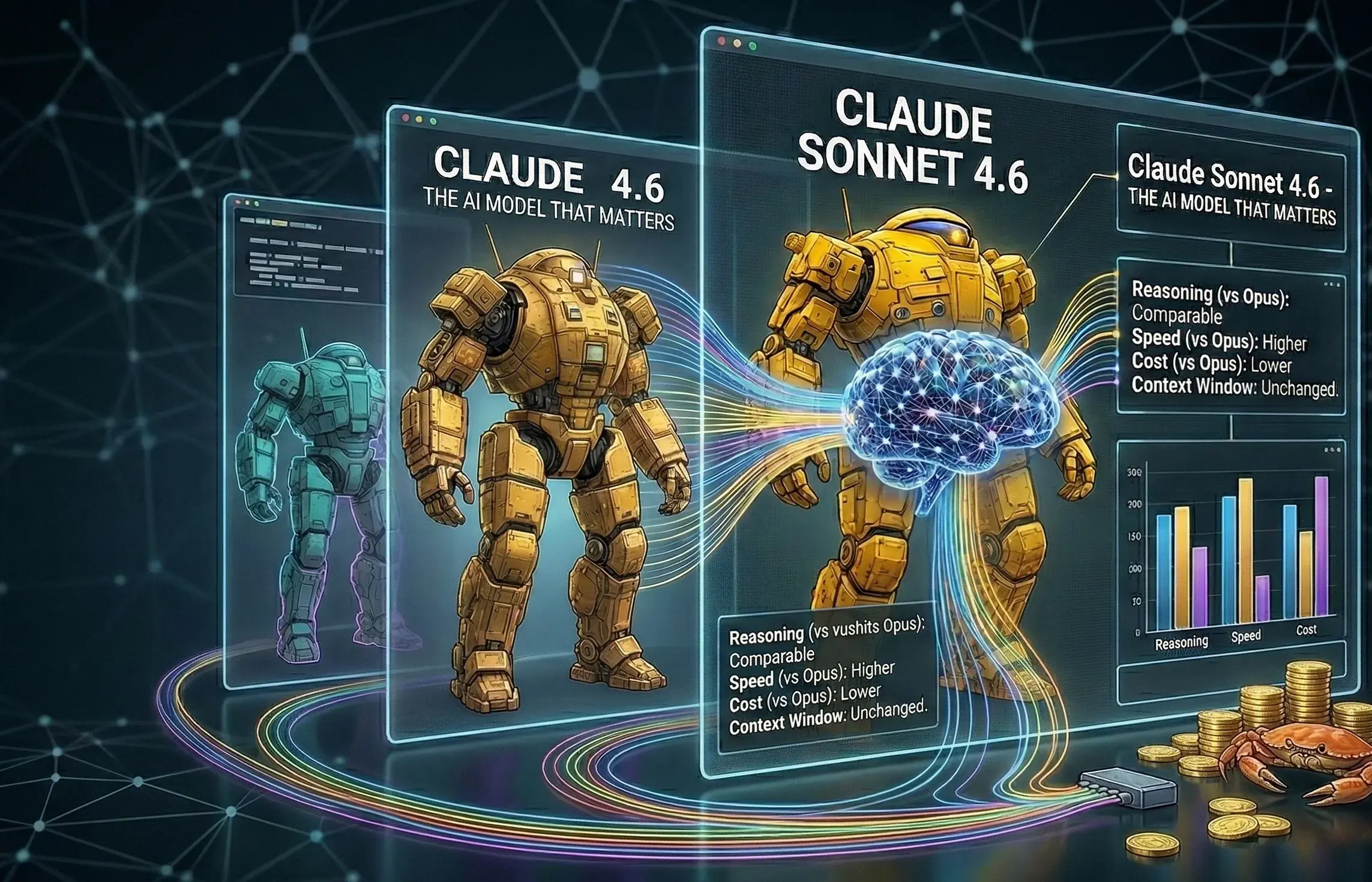
In the 2026 AI arms race, enterprise decision-makers face a cruel paradox: pursuing extreme performance "flagship models" often comes with expensive API costs and significant response latency, while pursuing speed "lightweight models" struggle to handle complex business logic. Anthropic's克勞德十四行詩 4.6was born exactly to break this stalemate. It not only chases the flagship-class Opus closely in multiple benchmarks but also, with extremely competitive inference cost, has become the "all-around hexagonal warrior" in the eyes of North American Chinese engineers, overseas marketers, and self-media creators.
Claude Sonnet 4.6 Performance Real-World Test: Does It Really Surpass the Flagship in Coding and Business Scenarios?
As a strategy expert with 15 years of experience in digital marketing, I've seen too many models with "astonishing parameters" but "weak landing." However, Claude Sonnet 4.6's real-world performance is indeed amazing. When handling complex Python script refactoring and JavaScript framework migration, its code generation accuracy improved by about 25% over the previous generation [Source: Anthropic Technical Report 2026]. More importantly, its understanding of code annotation logic has become more "human-like," no longer rigidly stacking functions.
At the business analysis level, Sonnet 4.6 shows extremely strong visual parsing capability. When we threw it a financial audit PDF up to 80 pages with massive nested tables and trend charts, it extracted core risk points nearly twice as fast as traditional models. This "lightning response" is crucial for financial trading or instant customer service scenarios needing real-time decisions. It's no longer just a chatbot but a digital employee capable of deeply understanding industry context.
What Is the Financial Underlying Logic of Claude Sonnet 4.6 Becoming the Enterprise "Daily Workhorse"?
For shrewd enterprises going global and cross-border e-commerce practitioners, performance without discussing cost is just hype. Sonnet 4.6's core competitiveness is its extremely high "intelligence density." The table below compares the comprehensive performance of current mainstream large models in enterprise daily high-frequency call scenarios:
| 評估維度 | 克勞德十四行詩 4.6 | 克勞德作品4.6 | GPT-4o |
|---|---|---|---|
| API Cost (per million Tokens) | ~$3.00 (low) | ~$15.00 (high) | ~$5.00 (medium) |
| Inference Latency | Extremely low (< 1s) | Medium (2-3s) | Low (1-2s) |
| Logical Reasoning Capability | 92% (close to flagship) | 98% (highest) | 94% (excellent) |
| Visual Parsing Precision | 太好了 | Top-tier | 太好了 |
The data shows Sonnet 4.6 provides over 90% of Opus's logical capabilities at less than one-fifth the price. For teams needing to process tens of thousands of inquiries daily or generate massive SEO content, this cost structure optimization directly determines project ROI (return on investment).
Why Can't Pure SEO Protect Your Brand Moat in the AI Era?
When we discuss Claude Sonnet 4.6's strength, we must realize a reality: your customers are reducing their use of traditional Google search and turning to ask AI directly. If AI doesn't mention your brand when answering "Who is the best cross-border marketing service provider in North America?" — even if you rank first in Google search, you're losing over 40% of potential traffic. This is why你找到first proposed theAIPO(AI 驅動優化)concept.
Traditional SEO is about optimizing webpages to cater to crawlers, while AIPO usesGEO(生成引擎優化)strategy to put brand assets into AI's "core knowledge base." YouFind's proprietary AIPO engine, through four intelligent phases —data collection, deep analysis, strategic conception, and structured modeling— ensures your brand content matches Google E-E-A-T principles, getting preferentially cited as an authoritative source by Google AIO, ChatGPT, or Perplexity. This "dual-core deployment" not only seizes the search first page but also pre-builds a brand firewall in AI recommendation slots.
How to Conduct AI Deployment and Compliance Optimization for High-Value Industries Such as Finance and Healthcare?
In Hong Kong and North American markets, YMYL (Your Money or Your Life) industries such as finance, healthcare, and real estate have nearly draconian requirements for content professionalism and compliance. Combining Claude Sonnet 4.6's powerful text-processing capabilities with YouFind'sMaximizer patented SEO system, enterprises can efficiently optimize existing content without altering any web architecture or rebuilding the site.
For example, in medical aesthetics, we don't just require accurate content — we require it to have a "sense of experience." Through AIPO technology, we can identify competitors' "GEO keyword gaps" on AI platforms and targetedly patch the brand's absence in AI answers. Real-world data shows brands optimized through AIPO see their overseas inquiry volume rise an average of 22%, with citation rates in Google AI summaries soaring 3.5x. This precise "dimension-reducing strike" lets brands always dominate in AI-driven search ecosystems.
Using the Maximizer Patented System: Achieving SEO and AIPO Dual-Leap at Low Cost
When facing AI transformation, many enterprises most worry about high costs and long cycles brought by technology restructuring. YouFind's Maximizer system thoroughly solves this pain point. It allows enterprises to retain the existing website front end while directly performing SEO optimization and structured data marking (such as FAQ Schema) through backend patented technology.
When combining this technology with Claude Sonnet 4.6's intelligent generation capabilities, a perfect closed loop forms: use AI to efficiently produce high-quality content matching E-E-A-T principles, then quickly distribute and AIPO-tune through the Maximizer system. This not only saves over 50% of development costs but also gives brands the flexibility to adjust marketing strategy in real time in rapidly changing markets.In the generative AI era, speed and accuracy are equally important — and this is exactly the core value we provide to enterprises going global.
Frequently Asked Questions About Claude Sonnet 4.6 and AIPO Deployment
1. What Are the Core Differences Between Claude Sonnet 4.6 and Opus?
Opus is still the flagship choice for handling super-large-scale, super-high-complexity tasks, but Sonnet 4.6 performs equivalently to Opus in 90% of business and programming tasks, with lower API costs and faster response — making it the first choice for enterprises as a "daily productivity tool."
2. What Is AIPO? How Is It Fundamentally Different From Traditional SEO?
Traditional SEO focuses on keyword Ranking, while AIPO (AI-Powered Optimization) focuses on Citations. It aims to make brand content recognized as authoritative sources by generative AI (such as ChatGPT, Google AIO) and mentioned in AI-generated answers. You can了解 AI 文章寫作for more about content intelligent manufacturing logic.
3. How to Boost Brand Mention Rates in AI Tools Through YouFind?
We use the proprietary GEO Score™ algorithm to first conduct AI visibility diagnostics for your brand. Then through "structured modeling" and "brand knowledge base modeling," we teach AI to learn your business context, building a Source Center matching AI citation preferences, thereby greatly boosting citation probability.
4. What Technical Conditions Do Hong Kong or Overseas Enterprises Need to Implement AIPO?
Through YouFind's Maximizer patented system, enterprises don't need to rebuild the site or have deep technical background. We provide one-stop diagnosis, optimization, and monitoring services, helping enterprises achieve significant AI citation rate growth within 3-6 months.