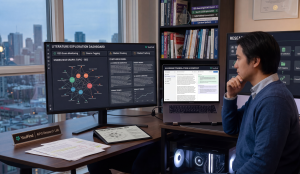
In 2026, the wave of generative AI has long surged from the cloud to everyone's desktop. If you're a North American Chinese engineer, international student, or cross-border e-commerce practitioner at the cutting edge of overseas expansion, you must feel this urgency: relying solely on the web versions of ChatGPT or Claude is no longer enough. To ensure business secrets don't leak, to comply with regulations when handling financial models or medical data, or even just to avoid being interrupted by network latency when creating online novels late at night, deploying "local AI hardware" has become standard for 2026 workplace elites.
What we face is no longer the question of "whether to run local models" but "what to use." Should you choose the M3 Max MacBook Pro with 128GB unified memory that can hold an entire world, or build an RTX 4090 PC with peak CUDA compute power but limited VRAM? This article will help you deconstruct this most core productivity tool duel of 2026.
Why Do Enterprises and Professionals Need "Local AI" in 2026?
If you're still hesitating whether to invest heavily in high-performance hardware, look at current industry trends. According to the latest industry research, over 60% of financial and medical institutions have started restricting employees from uploading sensitive data to public AI clouds [Source: Gartner 2025 AI Security Report]. Data Sovereignty is no longer a legal term but a Sword of Damocles hanging over every enterprise going overseas.
In North America, for engineers and lawyers handling privacy-sensitive data, running local 70B-level large models (such as enhanced versions of Llama 3) means all your prompts and customer data will never leave your hard drive. Meanwhile, the cost of long-term cloud compute subscriptions can buy two high-spec MacBook Pros within three years. As YouFind consistently emphasizes when helping enterprises go global: hardware is the foundation, data is the moat. Owning local compute is the first step for enterprises building private brand fortresses in the AI era.
Core Showdown: Unified Memory (Mac) vs. VRAM Specialization (PC)
These are two completely different underlying philosophies. Nvidia takes the "ultra-fast lightning" path, while Apple takes the "all-encompassing ocean" path. For running large models, the most core bottleneck is often not CPU speed but VRAM size. If your VRAM can't hold the model's parameters, the model simply can't run, or it'll be as slow as a slideshow.
The table below clearly shows the core parameter comparison of mainstream 2026 AI hardware running local large models:
| Dimension | Apple MacBook Pro (M3 Max) | Custom PC (Single RTX 4090) |
|---|---|---|
| Core Architecture | Unified Memory | Dedicated VRAM |
| Memory/VRAM Limit | Up to 128GB | Fixed 24GB |
| Maximum Model Support | Can run 70B models at full precision | Can only run highly quantized 70B models |
| Inference Framework Support | MLX (Apple optimized), llama.cpp | CUDA (industry standard), TensorRT |
| Power and Noise | 30W - 100W / extremely quiet | 450W - 1000W+ / noticeable fan noise |
How to Measure Inference Speed and Token Efficiency?
In actual testing, if you're running smaller models (such as 7B or 14B parameters), the RTX 4090's performance is terrifying. It can spit out tokens at over 100 per second — basically as soon as you finish typing, the answer instantly fills the screen. For content creators and online novelists, this immediate feedback greatly boosts the creative flow. But in 2026, we more often need to handle long-text analysis and complex logical reasoning, when 70B+ large models come in handy.
When facing 70B-level models, the RTX 4090's 24GB VRAM appears very cramped — you must use 4-bit or even lower quantization, which loses model "intelligence." The M3 Max with 128GB memory, while only outputting 10-15 tokens per second (equivalent to normal human reading speed), can fully load models at extremely high precision. For financial analysts and engineers, "accuracy" matters far more than "speed."
Energy Efficiency and Office Scenarios: The Game Between Silence and Wildness
For professionals working in expensive, high-electricity-cost areas like North America or Hong Kong, energy efficiency is an unavoidable topic. Building an RTX 4090 PC requires a huge case, complex cooling system, and at least 1000W power supply, meaning your office will be like a small heat-generating station. If you work in medical clinics, law firms, or co-working offices, this noise and heat are unbearable.
In comparison, the MacBook Pro M3 Max shows industrial design dimensional reduction. You can run Llama 3 unplugged at Starbucks while drinking coffee. This mobile office capability gives you unrivaled elegance when demonstrating AI-driven marketing plans or technical demos to clients. This is exactly the efficiency philosophy YouFind advocates: tools should not become limitations of the scenario.
Software Ecosystem: MLX's Rise Challenges CUDA's Dominance
For a long time, Nvidia's CUDA has been almost synonymous with AI. Almost all open-source models support CUDA from the moment of release. If you're a deep learning researcher or need to frequently train models (Fine-tuning), the PC camp is still your only choice. The maturity of its ecosystem means you can find answers on Stack Overflow for any bug.
However, Apple's MLX framework saw explosive growth in 2025-2026. MLX is a machine learning framework specifically designed for Apple Silicon, allowing Macs to directly use unified memory bandwidth advantages during inference. Now, mainstream open-source projects like Stable Diffusion, Llama 3, and the latest DeepSeek run with astonishingly optimized efficiency on Macs. For most "application-type" users — those using AI to write code, copy, or do analysis — Mac's software threshold is becoming lower and lower.
Configuration Recommendations for Different Budgets and Industries
In 2026, there's no best hardware — only the configuration most suitable for your business scenario. According to our real-world testing experience, we recommend:
- Plan A (Healthcare/Legal/Financial Elites): First choice MacBook Pro M3 Max (128GB memory).
You need to handle extremely long contracts, medical records, or financial reports, with strict privacy requirements. Mac's unified memory lets you locally load high-precision long-text models, with data never leaving the local device — perfectly compliant.
- Plan B (Tech Developers/Creative Video Creators): Build an RTX 4090 or even dual RTX 4090 workstation.
If you need large-scale image generation (such as Stable Diffusion XL) or small-scale model fine-tuning, CUDA's compute advantage is irreplaceable. While 24GB VRAM is a single-card bottleneck, dual-card configurations can solve most problems.
- Plan C (Cost-Effective/Content Creators): Mac Studio M2 Ultra or used multi-GPU PC.
If you don't need mobile office, Mac Studio provides more stable continuous output, while servers built from multiple used RTX 3090s (24GB) are currently the cheapest solution for running large models.
From Hardware Purchase to AIPO Brand Strategy
Owning powerful local AI hardware is just the start of this efficiency revolution. For overseas expansion business owners and cross-border e-commerce practitioners, the real challenge is: how to make your brand seen by more people in the AI era? This is the core logic of AIPO (AI-Powered Optimization) proposed by YouFind. Hardware provides compute for content production, while AIPO ensures these contents are preferentially cited by generative engines like Google AIO, ChatGPT, and Perplexity.
In the AI search era, doing only traditional SEO is far from enough. You need to use systems like YouFind's proprietary Maximizer system to structurally model content without altering web architecture, making it meet Google E-E-A-T principles. Our data proves that through AIPO optimization, brands' citation rate in AI summaries can be boosted 3.5x, with overseas inquiry volume rising an average of 22%. Hardware is your sharp sword, and AIPO is your navigator, guiding you to precisely acquire customers in the AI traffic dividend period.
Check Right Now Whether Your Brand Is “Missing” in the Eyes of AI
Don't become invisible in the era of AI search. Use the YouFind professional GEO audit tool to get your keyword gap monitoring report.
Get Your Free GEO Audit Report NowFrequently Asked Questions (FAQ)
What Is the Most Core Parameter of Local AI Hardware?
In 2026, VRAM (or unified memory) size is the primary factor. Compute determines generation speed, but memory size determines whether you can run the model. For 70B-level large models, we recommend at least 64GB or more available memory.
Can a Regular Computer With 16GB Memory Still Run AI?
Yes, but the experience is poor. 16GB memory can only run highly quantized versions of 7B or 8B models. Although these models are fast, they tend to produce "hallucinations" or nonsense when handling complex logic and long text. For professional use, we recommend starting from 32GB.
How to Boost My Content's Citation Rate in Google AI Overview?
This requires GEO (Generative Engine Optimization). Besides ensuring content accuracy, using structured data (Schema) and in-depth analysis meeting E-E-A-T principles is crucial. You can Learn About AI Article Writing and how to achieve this through the AIPO engine.
Should You Buy M3 Max Now or Wait for the M4 Series?
If your current business is constrained by compute, immediately buying M3 Max is wise — the productivity boost it brings far exceeds the cost of waiting. While M4 will be powerful, Apple Silicon performance gains have entered a stable period. Unified memory capacity is the metric you should care about most.
Is It Complicated to Build a PC for Running AI?
Compared to Mac's out-of-the-box readiness, PCs require configuring CUDA environment, Python versions, and various drivers — there's a real technical threshold. But if you're an engineer or developer who enjoys tinkering, the freedom and ultra-fast speed PCs bring are extremely cost-effective.
No matter which hardware you choose, 2026 competition is essentially "AI collaboration capability" competition. Choose the right tools combined with professional AIPO content strategies to stay ahead in the rapidly changing global market. Want to know how to use AI to produce high-quality brand content? Welcome to Learn About AI Article Writing for more cutting-edge technology.