

Last Monday morning, shortly after I arrived at the office, a colleague forwarded me a screenshot of a customer’s WeChat message. The customer asked directly: “Do you provide GEO services? I found you through AI search.”
I read that sentence several times.
Not because the term “GEO” felt new. As someone who has worked in search engine optimization for twenty years, I have seen many new concepts rise and fade. What made me pause was the second half of the sentence: “I found you through AI search.”
For many years, when we asked customers, “How did you find us?”, the answers were usually straightforward: “I found you on Baidu,” “I found you on Google,” “A friend recommended you,” or “I visited your website.” But in recent months, the answers have started to change. Customers now say things like, “I asked ChatGPT,” “DeepSeek recommended you,” “I saw you on Doubao,” or “You appeared in Google AI Mode.”
This is not an isolated case.
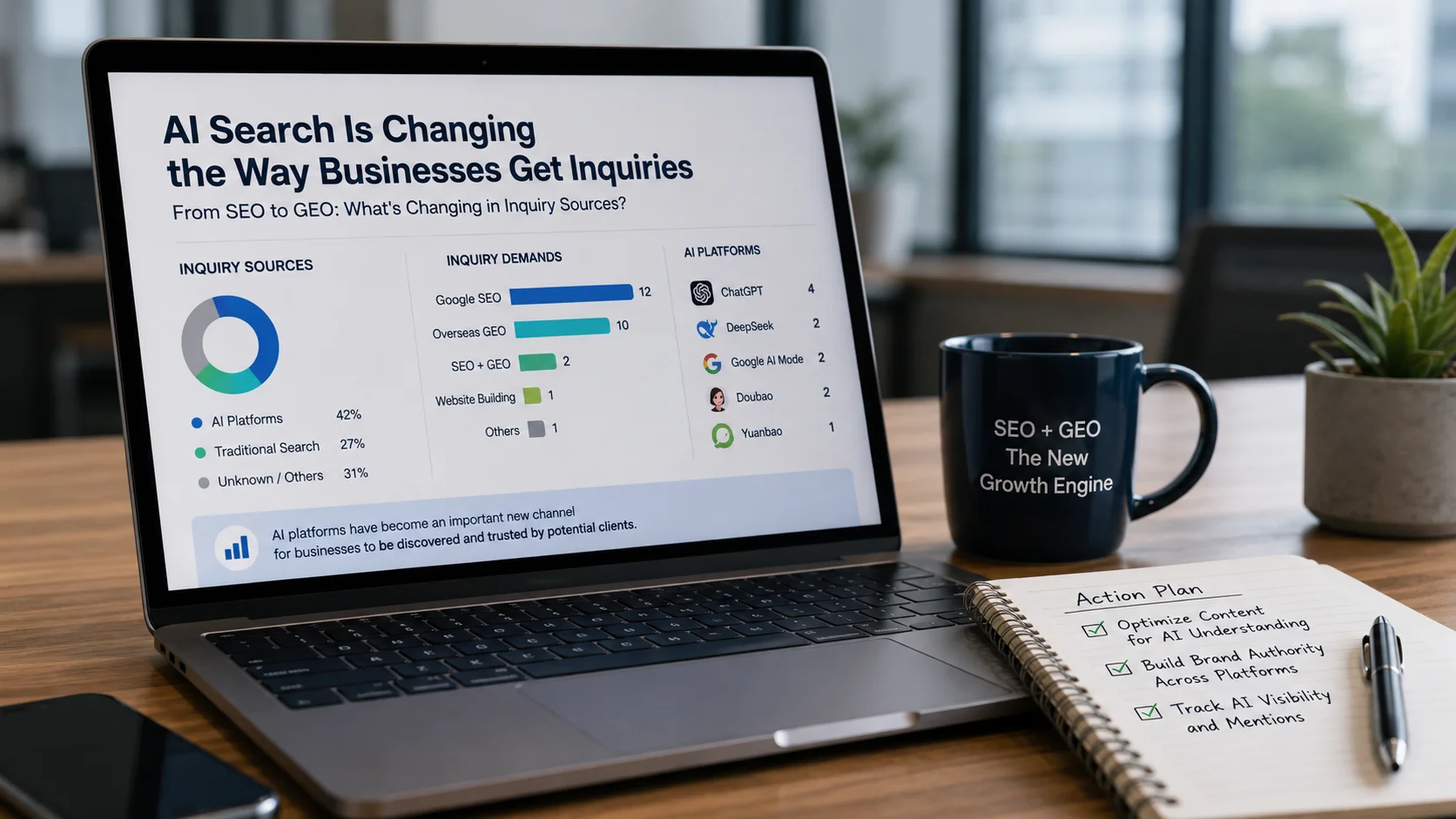
We recently reviewed one week of real inquiry data. Among 26 inquiries, 11 came from AI-related sources, accounting for more than 40%. Traditional search sources contributed 7 inquiries. Another 8 customers either could not remember the exact source or did not reply when asked. On the demand side, Google SEO remained a major topic, appearing 12 times, while overseas GEO-related needs appeared 10 times, almost catching up with SEO.
After twenty years in SEO, I used to believe that phrases like “the search入口 is changing” were often just marketing slogans. But this time, my view is clear: the入口 for business customer acquisition is truly changing. SEO is not disappearing. Instead, the path through which customers discover companies is expanding from “search results pages” into “AI-generated answers.”
Counterintuitive Truth 1: AI Search Does Not Make SEO Obsolete. It Makes SEO Fundamentals More Important.
When many people hear about GEO, their first reaction is: “Does this mean we no longer need SEO?”
My answer is direct: no. In fact, the opposite is true. SEO fundamentals are becoming even more important.
In the past, SEO solved one core problem: helping companies become visible on search engine results pages. GEO now solves a new problem: helping companies be mentioned, cited, trusted, and recommended in AI answers, AI summaries, and AI-driven recommendations. But AI does not understand a company out of thin air. It still needs to learn who you are, what you do, and whether you are trustworthy from websites, content, authoritative pages, third-party mentions, brand entity signals, and structured information.
In other words, GEO is not a replacement for SEO. It is a new layer of competition built on top of SEO.
This was very clear in our inquiry data. During that week, “Google SEO” appeared 12 times in customer需求, while “overseas GEO” appeared 10 times. Many customers were not asking about GEO alone. They were asking about “SEO + GEO” or “website building + SEO + GEO.” This shows that customers are not abandoning SEO. They are starting to see SEO and GEO as part of the same customer acquisition system.
I once spoke with a customer who began by asking: “Can you help us get recommended by ChatGPT?” I then asked, “Is your website content complete? Does your English website have industry pages? Do you have case study pages? Can Google consistently recognize your brand name?” The customer paused for a while and said, “We have not built those systematically yet.”
That is exactly the problem. Companies want to appear in AI answers, but AI first needs to understand them. And in many cases, the foundation of AI understanding still comes from what may seem like “old-school” SEO work: website structure, topic coverage, brand consistency, authority signals, and external citations.
So I prefer to tell customers this: do not abandon SEO just because GEO is becoming popular. What you really need to do is upgrade SEO from a “keyword ranking project” into a “brand information system that AI can understand.”
Counterintuitive Truth 2: AI-Driven Inquiries May Not Always Be Larger in Volume, But They Are Often More Problem-Aware
The second major change is how customers ask questions.
In the past, customers from search engines often asked questions like: “How much does SEO cost?” “How long does Google SEO take to work?” or “How do you charge for website optimization?” These questions are important, but many of these customers were still in an early comparison stage.
Customers who come through AI platforms are often different. They have usually been “educated” by AI before contacting us. They ask more specific questions: “How does GEO work?” “How can we appear in ChatGPT recommendations?” “Why doesn’t DeepSeek mention our brand?” or “How will Google AI Mode affect B2B customer acquisition?”
Behind these questions is a more specific pain point: customers are no longer just thinking about traffic. They are worried about losing visibility in a new search environment.
Among the 11 AI-source inquiries we saw that week, the sources included ChatGPT, DeepSeek, Doubao, Yuanbao, Google AI Mode, and other platforms. To me, this is not just about “AI sources having a high share.” More importantly, it shows that AI platforms are no longer merely tools for information lookup. They are becoming入口 for supplier discovery, service understanding, and pre-decision research.
One customer’s comment left a deep impression on me. He did not simply say, “I want to do SEO.” Instead, he asked: “Will customers start asking AI to recommend suppliers? If AI does not recommend us, does that mean we do not exist?”
That sentence sounds harsh, but it is very real.
In the traditional search era, a company’s biggest anxiety was: “Are we ranking on the first page?” In the AI search era, the anxiety becomes: “When AI answers this question, are we included?”
These two questions may look similar, but they are fundamentally different. Search ranking is list competition. AI answers are recommendation competition. In list competition, customers may see ten results. In recommendation competition, AI may mention only three companies, or even summarize only one preferred direction.
That is why the value of AI-source inquiries is not only in the number of leads. Their deeper value is that they remind us that customers are beginning to form initial judgments through AI. If a company does not enter the AI answer ecosystem, it may be excluded from the shortlist before the customer ever contacts sales.
Counterintuitive Truth 3: Unknown Sources Are Not Useless Data. They Show That Customer Journeys Are Becoming More Complex.
When many people analyze marketing data, they feel frustrated when they see “unknown source.” They treat it as dirty data, incomplete data, or something to ignore.
I used to think that way too. But I no longer see it that way.
Our inquiry source data is recorded by the colleague who handles incoming inquiries. After receiving a customer inquiry, they ask the customer: “How did you find us?” This naturally has limitations. Customers may not remember clearly, or they may not reply. Some customers may first see a company in AI, then search the brand name on Google, then visit the website, and finally contact the company through a form or WeChat. When you ask them the source, they may only remember that they “saw it online.”
This is the new reality of business customer acquisition: the customer journey is no longer driven by a single入口. It is built through multiple touchpoints.
Among the 26 inquiries in that week, 8 had unknown sources, close to one-third of the total. On the surface, this looks like a data gap. But from a customer behavior perspective, it may also reflect a deeper reality: the path from “discovering you” to “contacting you” now passes through more platforms than before.
In the past, we liked to attribute sources clearly: Baidu, Google, WeChat Official Account, referral. Today, it is not always that simple. A customer may first ask DeepSeek, “Which companies in China provide GEO services?”, then search “AIPO GEO” on Google, then visit the website, and finally contact the team on WeChat. By the time we ask the customer what made them reach out, they may not be able to identify one single source.
This raises the bar for marketing teams.
We cannot only look at the last click. We cannot only ask, “Where did the customer come from?” We also need to understand: on which platforms was the customer educated? Through which content did they build trust? In which AI answers did they first see the brand? And through which search results did they verify the company’s credibility?
So unknown sources are not meaningless. They remind us that single-channel attribution is losing accuracy, and companies need to upgrade from “traffic source tracking” to “customer cognition path management.”
The Opposing View: Is GEO Overhyped? Is It Too Early to Invest?
I know some people will disagree.
The first opposing view is: “AI platforms are still unstable. They may recommend you today and ignore you tomorrow. It is too early to do GEO.”
This concern is reasonable. AI answers are indeed less stable than traditional search results. Different models, different times, and different prompts may produce different answers. But this does not mean companies should wait. Early SEO was also unstable. Algorithms changed constantly, and rankings fluctuated all the time. Yet the companies that built content assets and brand authority early were often the ones that benefited most later.
GEO is similar. The goal today is not to guarantee 100% visibility for one specific prompt. The real goal is to make it easier for AI to include your company in the trusted candidate set when it understands an industry, a brand, or a category of service providers. This takes time. It is not something a company can fix quickly after customers have already started using AI to choose suppliers.
The second opposing view is: “AI platforms cannot generate large numbers of inquiries directly, so it is better to keep investing in ads.”
I do not oppose advertising. Advertising solves short-term exposure and controllable traffic. But AI search influences the starting point of customer cognition. Before clicking an ad, requesting a quote, or contacting a supplier, a customer may already have asked AI: “Which companies are reliable in this industry?” “How should I choose this type of service?” or “Which company is suitable for overseas GEO?”
If AI does not mention you at this stage, your later advertising costs may become higher, because you will need to spend more money to rebuild the trust gap.
The third opposing view is: “GEO has no standard method, and it is difficult to measure.”
This statement is half right and half wrong.
It is right because GEO cannot be measured only by rankings, indexed pages, and traffic in the same way traditional SEO often is. It is wrong because difficulty in measurement does not mean it should not be done. We can measure AI platform mention rate, brand answer coverage, visibility for core questions, recommendation context, citation sources, AI-source inquiries, and changes in SEO + GEO combined demand.
The fact that AI-source inquiries exceeded traditional search-source inquiries in our weekly data is itself an early signal. It is not perfect, but it is enough to remind companies that customer behavior is changing faster than many marketing budgets.
What Should You Do Next? One Key Action for Each Role
If you are a founder, I suggest you do one thing first: personally ask AI ten questions related to your business and see whether your company appears in the answers.
Do not only search for your brand name. Ask the questions your customers would actually ask. For example: “Which GEO service providers are suitable for export businesses?” “How can Chinese companies gain visibility in Google AI Mode?” or “How should B2B companies combine SEO and GEO?” If your company does not appear in these answers at all, or if AI misunderstands what you do, that is not a small technical problem. It is a future customer acquisition problem.
If you are an SEO manager, I suggest you stop treating GEO as another “keyword ranking task.” Your next step should be to organize your brand entity information: who the company is, what services it provides, who it serves, what cases it has, where its authority signals come from, whether its content topics are clear, and whether third-party platforms describe the brand consistently. AI does not need keyword stuffing. It needs stable, credible, and verifiable brand knowledge.
If you are a content editor-in-chief, I suggest you adjust your topic planning immediately. In the past, many content strategies revolved around keywords such as “Google SEO pricing” or “how to do SEO.” Now you need to add another type of content: content based on questions customers would ask AI. For example: “What is the difference between SEO and GEO?” “Why can’t my company be found in ChatGPT?” or “How will Google AI Mode affect B2B customer acquisition?” This content is not only written for human readers. It is also written to help AI understand and cite you.
Final Thought
I increasingly believe that the future dividing line in business customer acquisition is not whether a company “uses AI.” It is whether AI knows you, understands you, and is willing to include you in its answer when customers ask the questions that matter.
SEO and GEO have simply entered a more difficult and more valuable stage: from competing for positions on search results pages to competing for trust inside AI-generated answers.
Want to instantly boost your website's AI search visibility? Try our automated AIPO Audit now and unlock key GEO optimization insights!