

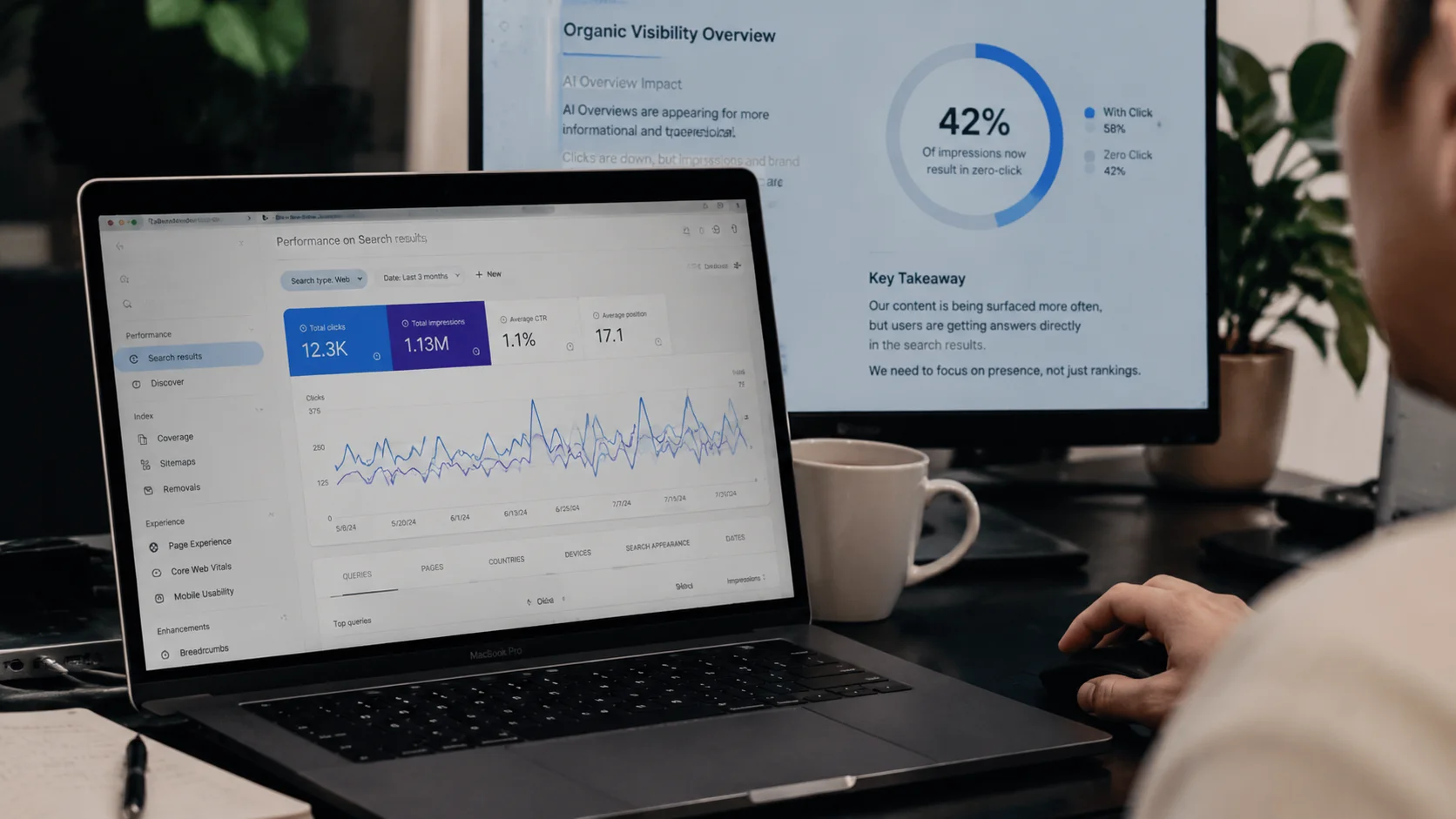
Recently, while reviewing data for a group of cross-border independent sites, I noticed a typical pattern recurring: impressions remained stable, but clicks began to fluctuate.
It's not a cliff-edge drop.
It's more like “the same spot, but fewer people are walking in.”
A colleague in operations dropped a screenshot in the group chat with a casual remark: “Why are impressions stable, but clicks dropping?”
For a moment, no one immediately responded.
A few seconds later, someone reopened the report.
This isn't an issue with a single site.
It feels more like an overall shift in the search distribution structure, especially after Google AI Overviews began covering more informational queries.
Starting my SEO career in 2005 at a Hong Kong digital marketing agency, I've witnessed the transition across three generations of search engines: Yahoo → Google → AI. This phase of “normal metrics but a change in feel” isn't unfamiliar.
This time, however, the change is happening at a higher level.
Not rankings, but the answer structure.
To put it simply:
Attention is still there, but the path has changed.
A Cross-Border Team's Real Puzzle: Why is CTR Becoming Distorted?
That day, I was speaking with a team running sites for the US and European markets. They laid out their past three months of data on the screen.
Someone said: “Our keyword rankings haven't dropped.”
Another person added: “But our CTR has dropped significantly.”
The meeting room went quiet for a few seconds.
Someone leaned back in their chair, staring at the screen without speaking.
Then someone restated the problem:
“Is our content not good anymore?”
I didn't answer directly.
Because the more critical point isn't content quality; it's the distribution structure.
It's not that traffic disappeared; it's that traffic got re-layered.
Analogy: The Eve of the 2015 Mobile-First Index
Looking back before the 2015 Mobile-first index rollout, you'd find a similar structure.
Back then, sites were well-made, but inconsistent mobile experiences led to a redefinition of the “display logic.”
The ranking logic didn't collapse.
But a weight shift occurred.
This time, the change is one layer deeper.
AI Overviews isn't just a display change; it rewrites “display + distribution” together.
Users don't just see a list of links; they enter the answer layer directly.
Simply put:
The interface change is just the surface.
The structural change is the core.
First Counter-Intuition: Zero-Click is Not a Loss
Zero-click search was often understood as “traffic being eaten up.”
But with the arrival of AI Overviews, this understanding becomes invalid.
Because the consumption behavior for informational queries has moved up to the search results layer.
Users aren't leaving Google.
They just aren't entering the website.
Exposure still exists; clicking is no longer the only exit.
Attention is still concentrated; the path has just been compressed.
Second Counter-Intuition: SEO Rankings No Longer Equal Visibility
In traditional SEO, rankings almost equaled visibility.
But in the AI citation mechanism, this relationship is decoupled.
Content ranked #1 but not cited might not enter the answer layer at all.
Meanwhile, content ranked #3 but cited becomes the core source of “being seen.”
This is a shift from ranking to presence.
Some teams have started calling this process PO (Presence Optimization).
It's not about optimizing rankings, but optimizing “whether you enter the answer structure.”
| Dimension | SEO Click Era | AI Citation Era |
|---|---|---|
| Core Value | Ranking | Being Cited |
| Traffic Path | Search → Click → Website | Search → Answer Layer → Possible Click |
| Optimization Goal | Ranking | Presence |
| Success Metric | CTR | Citation / Inclusion |
The Core Change
Competition in search no longer happens within the ranking list, but rather in whether you can enter the AI's answer structure.
When I shared this with a growth lead, he paused, and then said:
“If that's the case, we might need to review the content structure we've built over the past three years.”
He didn't continue speaking; he just put his pen down.
I've seen this kind of pause many times over the past few years.
Third Counter-Intuition: Presence May Rise, But Clicks May Drop
In cases where AI Overviews covers more queries, a seemingly contradictory structure emerges:
Impressions go up, but clicks go down.
The brand is seen more often, but fewer people visit the site.
This isn't a decline.
It's a “decoupling of exposure and clicks.”
The definition of effective traffic begins to change.
It shifts from “traffic volume” to “entering the user's cognitive chain.”
AIPO Perspective: Where is PO Capability Lacking?
In the AIPO methodology, this layer of change corresponds to PO (Presence Optimization) capability.
The problem for many cross-border independent sites isn't content volume, but structure.
- Do they have a semantic structure that AI can parse?
- Can they form citable information units?
- Do they cover real user intent instead of just keyword stacking?
Simply put:
It's not about whether you write content, but whether your content can be “extracted.”
Three Action Directions for Cross-Border Independent Sites
First, adopt a FAQ-style content structure.
Break information into independently answerable units, rather than long narratives.
Second, restructure semantic density.
Reorganize pages around product + intent, rather than around keyword density.
Third, prioritize citation opportunities over just chasing rankings.
The citation logic of Google AI Overviews, Perplexity, and Gemini is essentially closer to “structural matching.”
Role-Based Recommendations
If you are an SEO Manager, I recommend you first re-analyze your page structure, not just add more content.
If you are a Growth Lead, you need to shift your KPI from CTR to “whether you enter the AI answer layer.”
If you are a Founder, you need to re-evaluate whether your growth still relies on the click model.
Related Questions
Q1: Will Google AI Overviews Make SEO Traffic Disappear?
It won't disappear entirely, but the structure will change, and the click-through rate for informational queries will decrease.
Q2: What Does Zero-Click Search Mean?
It means users complete their information acquisition at the search layer, but the brand can still gain exposure.
Q3: Are SEO Rankings Still Important?
Yes, they are important, but they no longer equal visibility; being cited by AI becomes more critical.
Q4: How Should Cross-Border Independent Sites Respond?
Shift from keyword optimization to building structured semantic content.
Q5: What is PO (Presence Optimization)?
It's the ability to get your content into the AI's answer structure, rather than just improving rankings.
Q6: Is Content SEO Still Necessary?
Yes, it is necessary, but it needs to adapt to a structure that AI can parse and cite.
If you run cross-border independent sites, you can start with a content structure diagnosis to determine which pages meet the conditions for entering the AI answer layer.