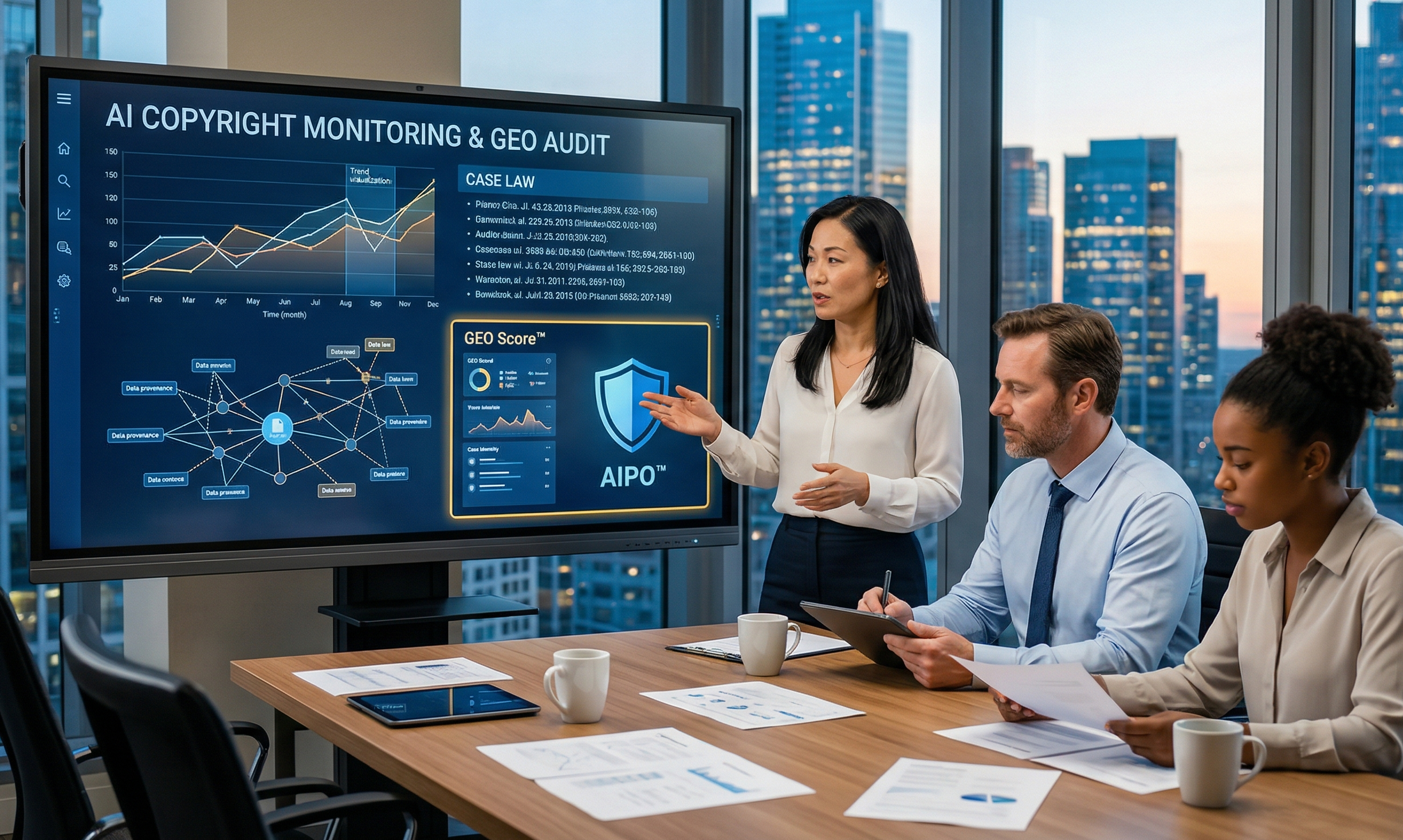
Have you ever worried that the industry white papers your company painstakingly created originally are being silently "devoured" by some large model and transformed into competitors' answers? Or, after using AI to generate a set of beautiful marketing posters, you found you couldn't register a trademark and even received a lawyer's letter?
By 2026, copyright lawsuits against generative AI globally have accumulated to 87 cases. This is no longer a patent war between Silicon Valley tech giants but a survival challenge every creator, enterprise going global, and cross-border e-commerce practitioner must face directly. In the AI era, the way to protect yourself is no longer just applying for patents — it's also learning how to establish your own "authoritative boundary" within AI's underlying logic.
Why Did 2026 AI Copyright Lawsuits Shift From "Feeding Data" to "Generating Content"?
Looking back at the past two years, AI legal disputes have undergone an obvious paradigm shift. Early lawsuits (such as Getty Images suing Stability AI) mainly focused on the legality of "training data," with the dispute being whether AI companies had "laundered" all of humanity's intellectual property without permission. However, entering 2026, the focal point of court debate has shifted to the "output end."
The current dispute core is: when AI-generated content is "highly similar" to original works, who bears responsibility? If AI-output code is completely identical to an open-source project, does the engineer using that code constitute infringement?
| Dimension | Phase 1: Training Data Disputes (2023-2024) | Phase 2: Generated Content Infringement (2025-2026) |
|---|---|---|
| Core Dispute | Boundaries of Fair Use | Substantial similarity and commercial substitutability |
| Representative Case | The New York Times vs. OpenAI | Individual artist vs. AI image library similarity case |
| Legal Impact | Affects model training cost and licensing agreements | Directly impacts enterprise AI content compliance risk |
| Protection Focus | Preventing data from being scraped without compensation | Ensuring AI-generated works have protectable "human creative components" |
Under Hong Kong and North American legal systems, works generated purely by AI without substantial human intervention often struggle to obtain copyright protection. This means if you completely rely on AI for creation, your brand assets may be in a "legal vacuum" where anyone can freely appropriate them. This is exactly the biggest hidden concern enterprises going global currently face.
The "Disaster Zones" of Copyright in Different Industries in the AI Era
Not all industries face the same impact. According to our observations in overseas markets, highly regulated and visually dependent industries show the most significant anxiety:
- Finance and Healthcare: These industries have extremely high requirements for data authority and accuracy. When AI cites unauthorized fake data or misidentifies non-official analysis as "authoritative conclusions," it not only involves copyright but serious compliance and reputation risks.
- Real Estate and Beauty: Advertising materials are these industries' lifeline. Using AI-generated model faces or renovation effect images, if lacking clear authorization chains, easily triggers copyright review mechanisms causing account bans when placed on North American Meta or Google ads.
- Self-Media and Online Content Creators: Creators most worry about their writing styles being precisely imitated by AI (Style Mimicry), causing original content's weight in search engines to be diluted by AI imitations.
How to Protect Yourself? Four-Dimensional Defense Strategy for 2026 Creators
Facing the increasingly complex legal environment, passively waiting for legal completion is unrealistic. Experts recommend enterprises and creators build "active defense" systems:
- Strengthen "Human Intervention" Proof: During creation, please retain Prompt modification records, initial sketches, and traces of manual adjustments. During copyright registration, these are key evidence proving the work contains "human originality."
- Import AI Identification Markers (Digital Watermarking): Use technologies such as Google SynthID to embed watermarks in generated content that are invisible to the eye but machine-recognizable. This effectively traces content sources, preventing malicious laundering by others.
- Establish Brand-Specific Knowledge Base: Reduce dependence on general public-domain models. Structure your brand's existing patents, cases, and professional knowledge to train enterprise-specific contextual models.
- Use Models With Authorization Chains: Prioritize model providers that declare their training data has obtained legal authorization, reducing infringement risk at the source.
Crossing SEO: Building a Brand Copyright Moat With the AIPO Engine
In the AI era, traditional SEO (Search Engine Optimization) is no longer enough to address challenges. What you need is GEO (Generative Engine Optimization). The industry-leading **AIPO (AI-Powered Optimization)** dual-core deployment launched by YouFind is designed precisely to help enterprises find balance between legal risk and traffic growth.
When users ask in ChatGPT or Google AIO: "Who is the most authoritative supplier in this field?" — AIPO's core task is to ensure AI cites your brand, with accurate citation content. This is not only for traffic but also to attach an "authority" label to AI's training logic, forming de facto copyright protection.
How Does AIPO Protect and Boost Your Brand Assets?
Through the proprietary GEO Score™ algorithm, we conduct deep diagnosis for brands. This not only sees your rankings but also the "authority gaps" in AI's eyes.
- Structured Modeling: We strictly follow Google E-E-A-T principles, transforming your professional Experience and Authoritativeness into structured summaries AI can easily extract. This makes your content AI's "preferred source" rather than material AI casually rewrites.
- Monitoring Alert System: The AIPO engine can track brand mention frequency on various AI platforms in real time. Once illegal citations or misleading uses of your brand assets by competitors or third-party platforms are detected, the system immediately alerts, helping you quickly take legal action.
- Precise Targeting of GEO Keyword Gaps: By analyzing AI engines' trigger mechanisms, we help you occupy high-value keywords competitors haven't covered, ensuring you preempt AI recommendation slots.
Data shows brands optimized through AIPO see their citation rate in Google AI summaries boosted by an average of 3.5x, with overseas inquiry volume achieving significant growth of 22%. This proves a fact: when you become an AI-recognized authoritative source, copyright disputes naturally transform into brand dividends.
Check Right Now Whether Your Brand Is “Missing” in the Eyes of AI
Don't become invisible in the era of AI search. Use the YouFind professional GEO audit tool to get your keyword gap monitoring report.
Get Your Free GEO Audit Report NowFrequently Asked Questions About AI Copyright and AIPO (FAQ)
Q1: Who Legally Owns AI-Generated Works Currently?
Current legal trends (especially the US Copyright Office's rulings) tend to consider works completely generated by AI as not having copyright. But if humans have significant "creative guidance" during creation (such as complex prompt adjustments, post-image editing), the parts of the work attributable to human labor can obtain protection. This is also why we emphasize keeping creation records.
Q2: If My Website Content Is Crawled by AI for Model Training, Can I Defend My Rights?
This depends on the AI company's data acquisition path and your website's Robots.txt protocol. The current AIPO strategy is: rather than fighting it, guide it. Through technical means, we optimize content structure, requiring AI to mark sources (Citation) when citing your data, thus transforming "data scraping" into "brand traffic generation."
Q3: What's the Difference Between AIPO and Traditional SEO?
SEO focuses on getting your webpage to rank in front of search results; AIPO (GEO) focuses on getting your brand to appear in AI's "answers." In the AI era, users tend more to read answers AI directly gives. AIPO ensures your brand is the unique authoritative source of that answer.
Although AI copyright's deep waters are full of unknowns, enterprises that grasp technology and rules can always turn danger into safety. Rather than worrying about being replaced or infringed by AI, take initiative in deployment — let AI become the strongest "amplifier" for your brand's globalization.
Ready for the AIPO era? Learn About AI Article Writing and begin building your brand moat.