

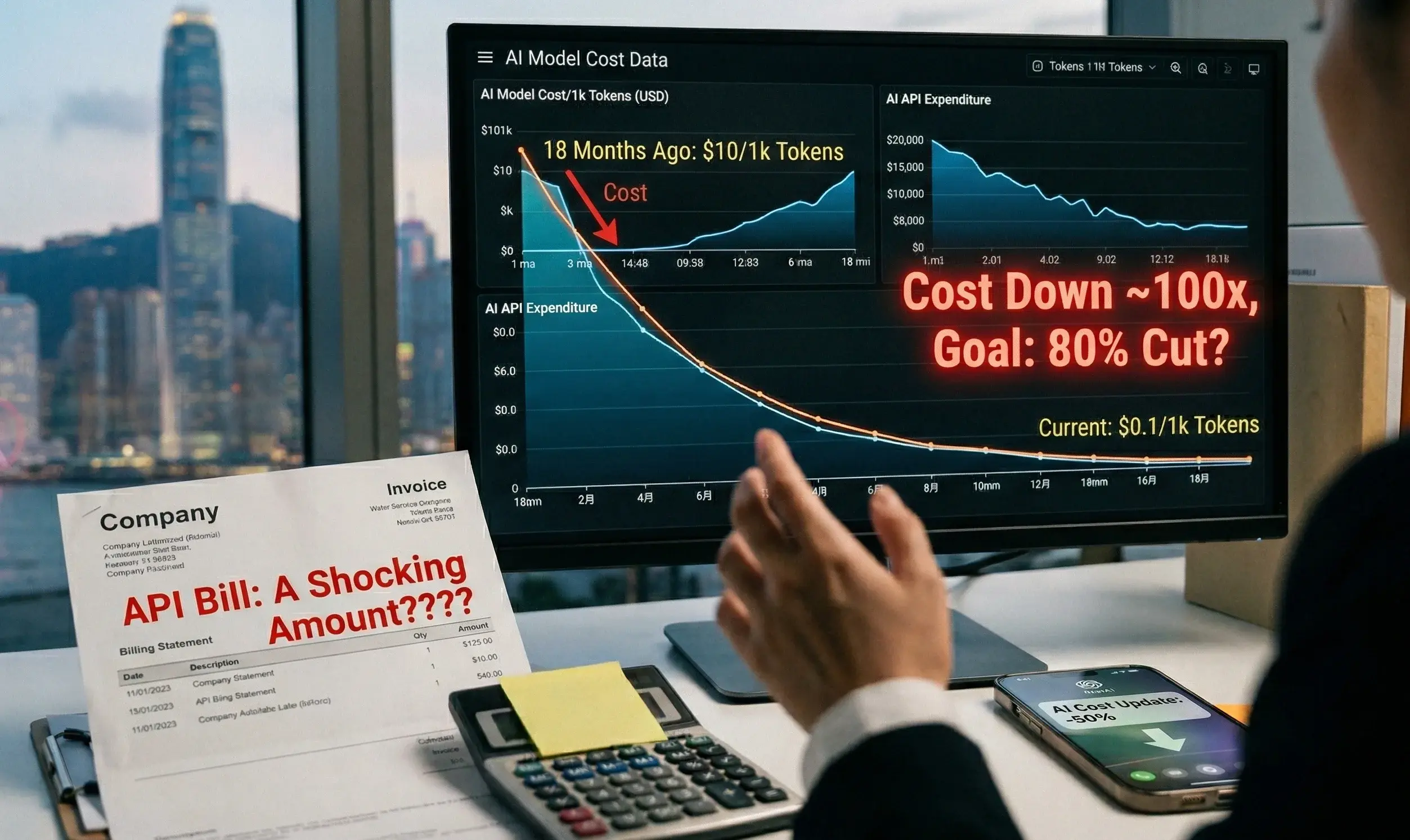
AI Cost War Intensifies: Model Fees Plunged 100x in 18 Months — Can Your AI Spending Drop Another 80%?
Have you ever been heart-stopped by that astonishing month-end bill after large-scale GPT-4 API calls? As a professional team deeply engaged in digital marketing for nearly 20 years, we've encountered countless Hong Kong financial and healthcare enterprises experiencing “AI transformation pains.” Everyone's most common anxiety: AI is indeed useful, but those AI API costs flowing like water — can they really support enterprise large-scale application?
If you're still troubled by this, take a deep breath first. The OpenAI president once pointed out an exciting trend: AI computing cost is evolving following a “super Moore's Law.” In fact, over the past 18 months, mainstream large model inference fees have dropped close to 100x. This means if your AI spending hasn't decreased, or the decrease isn't as expected, you may be in the predicament of “the high-priced sucker.” Today, we'll deeply deconstruct this cost revolution and tell you how to not only save this money but also transform it into a core moat in the AI era.
Why Are AI API Costs Experiencing “Cliff-Like” Drops?
In early 2023, calling top model Token fees was still a luxurious expense. But by today in 2026, the market landscape has dramatically changed. This rapid cost collapse isn't accidental but the inevitable result of technological iteration and market competition.
First, the strong rise of open-source models (such as Llama 3 series, DeepSeek, etc.) has formed a huge squeeze on closed-source models like GPT-4. When enterprises find they can achieve over 90% effectiveness through fine-tuned private deployment at just a fraction of the closed-source price, the price war inevitably erupts. Second, exponential improvements in Token compression and inference efficiency have greatly reduced computing power consumed per Q&A. Most importantly, aggregator platforms like One API have broken single-vendor monopoly, letting enterprises dynamically switch between different models based on response speed and real-time pricing — achieving true “competitive bidding optimization.”
To intuitively feel this change, see the comparison table below for fees per million Tokens for mainstream models:
| Model Type | 2023 Mainstream Level (USD) | 2025/2026 Mainstream Level (USD) | Decrease |
|---|---|---|---|
| Flagship (e.g., GPT-4 vs GPT-4o) | $30.00 - $60.00 | $2.50 - $5.00 | ~90% - 95% |
| Lightweight (e.g., GPT-3.5 vs GPT-4o-mini) | $1.50 - $2.00 | $0.15 - $0.30 | ~90% |
| Top Open-Source Models (DeepSeek/Llama 3) | N/A | $0.10 - $0.20 | Extremely high cost-effectiveness |
How to Scientifically Evaluate and Optimize Your Enterprise AI Spending?
The first step to reducing costs isn't blindly switching models but establishing a clear cost accounting model. In YouFind's practical experience, we recommend enterprises use the following formula for precise calculation:
$$Total\ Cost = (Tokens \times Unit\ Price) \times Efficiency\ Factor$$
Among them, the Efficiency Factor is a key many enterprises overlook. If your Prompt is too long and meaningless, or lacks caching mechanisms causing repeated questions, your costs will double. To achieve 80% spending reduction, you need to execute the following three-step strategy:
- Refined Prompt Engineering: Reduce ineffective Token input. Often, a concise structured instruction can save 30% on fees compared to lengthy natural language descriptions.
- Introduce Caching Mechanisms: For common repeated questions in financial consulting or medical education, return answers directly through semantic caching, no need to call the API again.
- Tiered Model Use: Not every task needs GPT-4. Simple data classification and sentiment analysis can use extremely cheap lightweight models. Only call expensive top models for complex logical reasoning.
Additionally, using aggregator architectures like One API, you can integrate APIs from different vendors globally into one management system. When a node's price rises or it goes down, the system automatically switches to low-priced stable nodes, ensuring uninterrupted business with costs always staying low.
What Is AIPO? Why Is It an Insurmountable Brand Moat in the AI Era?
We must face a cruel fact: simply pursuing low AI API costs is just “stock competition,” while seizing AI platform recommendation slots is the “incremental revolution.”
In today's prevalent Google AIO (AI Overviews), ChatGPT, and Perplexity era, users no longer click search results — they directly read AI-generated answers. If when AI answers “Which Hong Kong financial institution has the most stable asset management?” or “Which dental implant technology has the fewest side effects?” it doesn't cite your brand data — then even if your API cost drops to zero, you've still lost the market.
This is why YouFind first proposed the AIPO (AI-Powered Optimization) dual-core deployment. We not only optimize traditional search rankings but also use GEO (Generative Engine Optimization) to make your brand content the AI engine's preferred citation source.
YouFind AIPO's Core Advantages:
- GEO Score™ Diagnosis: Like a Chinese medicine pulse-taking, monitoring your brand's “visibility” and “citation rate” on AI engines in real time, precisely identifying high-value keyword gaps competitors have occupied but you haven't reached.
- Maximizer Patented System: Many enterprises worry that optimizing SEO requires overhauling the website. Our proprietary patented technology lets you not alter web architecture, achieving efficient AIPO optimization without increasing development costs.
- Structured Modeling: Based on Google E-E-A-T principles, we structurally process your brand Experience and professional knowledge (Expertise), establishing a “brand knowledge base” matching AI crawling preferences — making AI more easily and willingly cite you.
How to Ensure AI Marketing Compliance for Hong Kong's Finance and Healthcare Industries?
For Hong Kong's workplace elites and business owners, compliance is the lifeline. In finance, the SFC (Securities and Futures Commission) has extremely strict requirements for product performance disclosure; in medical aesthetics, violating the Undesirable Medical Advertisements Ordinance can lead to severe legal consequences.
When using AIPO to generate content, we adhere to the “authenticity verification” principle. For example, for financial clients, we set strict AI filtering rules: no guaranteed returns, no exaggerated language, ensuring every summary AI extracts matches HKMA (Hong Kong Monetary Authority) guidelines. For medical industries, we focus on showing doctors' professional qualifications and real-world test cases, using “authority” within E-E-A-T to win the dual trust of AI and users. This precise targeting strategy not only avoids vanity traffic but also brings real, compliant order conversions to clients.
Check Right Now Whether Your Brand Is “Missing” in the Eyes of AI
Don't become invisible in the era of AI search. Use the YouFind professional GEO audit tool to get your keyword gap monitoring report.
Get Your Free GEO Audit Report NowFAQ
Q1: With AI API Costs Already So Low, Is Traditional SEO Still Necessary?
Absolutely necessary. AIPO and traditional SEO are complementary. AI engines' citation sources are typically high-weight, high-ranked webpages. Only by establishing good webpage authority through SEO is your content more likely to be selected by AI as original reference material. This is a “dual-core driven” traffic acquisition mode.
Q2: Can the “Citation Rate” Boosted by AIPO Really Convert Into Sales?
According to YouFind's real-world data, after AIPO optimization, enterprises' overseas inquiry volume rises an average of 22%, with citation rate in Google AI summaries rising 3.5x. When users see AI authoritatively recommending your brand as the solution, the conversion rate brought by this trust endorsement far exceeds traditional hard advertising.
Q3: Are AIPO Costs High for Hong Kong SMEs?
Thanks to our Maximizer patented technology, SMEs don't need to invest huge website redesign fees. Through our standardized “data collection - deep analysis - strategic conception - structured modeling” four-step process, enterprises can quickly seize AI recommendation slots in a highly cost-effective way, investing the saved API costs into more valuable brand asset construction.
In this era of intensifying AI cost war, saving money is just the survival instinct, while deploying AIPO is the wisdom of development. If you want to learn more about boosting brand weight through content technology, please Learn About AI Article Writing and let us help you seize the initiative in the AI era.