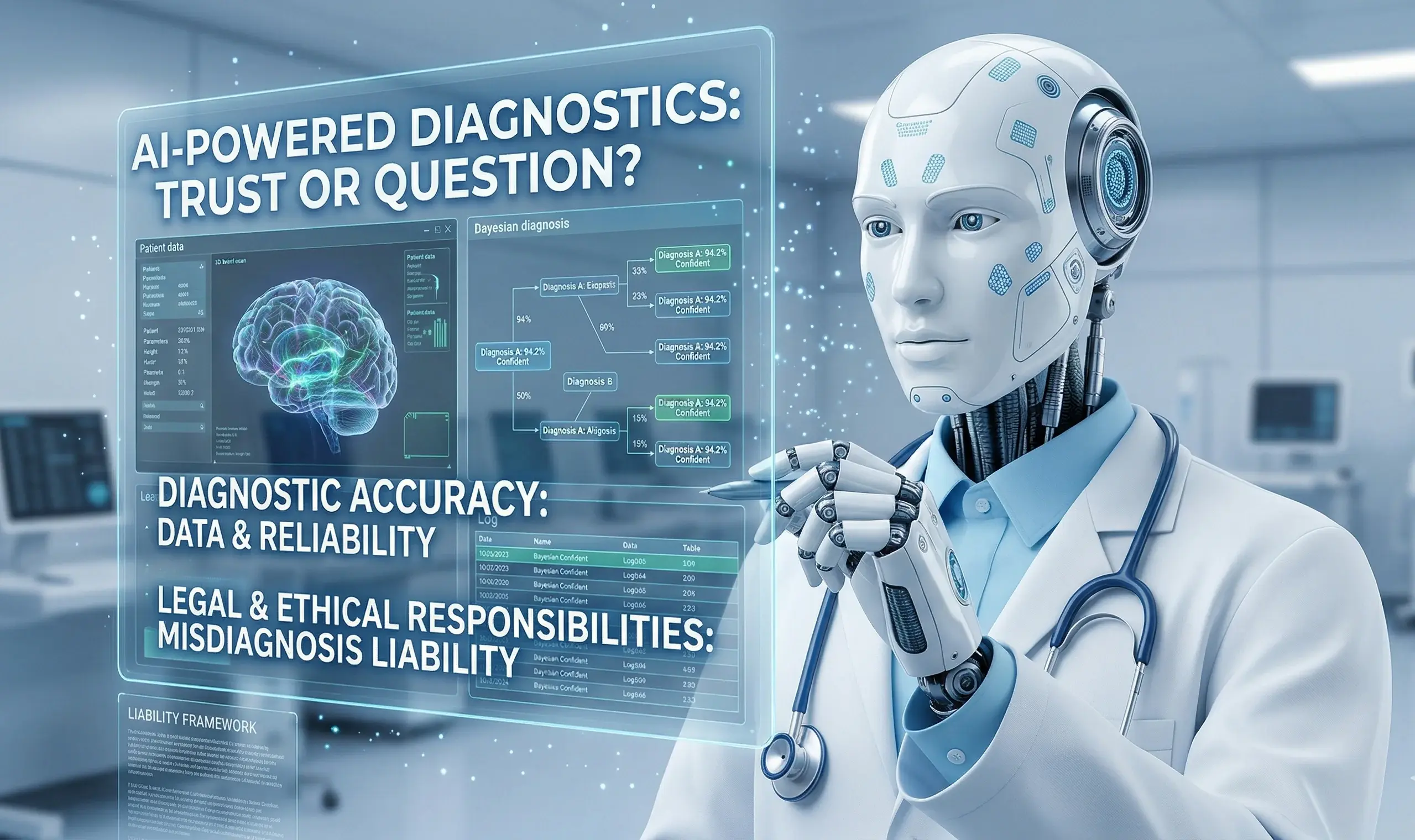
What Is AI Medical Diagnosis? Reconstructing Trust From Patient Anxiety to the Medical 5.0 Era
Have you ever had this experience: when feeling unwell, the first thing you do isn't to book an appointment but open ChatGPT or Google on your phone and enter your symptoms? This behavior has become the norm among engineers, international students, and cross-border professionals in North America. With the explosion of Generative AI, we are stepping into the Medical 5.0 era. However, when you watch the diagnostic recommendations pop up on the screen, doubt inevitably creeps in: can I really trust the answer this "AI doctor" gives?
The way we obtain medical information is undergoing a decentralized revolution. In the past, we relied on the first page of Search Engine Results Pages (SERP); now Google AI Overviews (AIO) and various AI tools directly summarize diagnosis and treatment plans for us. For medical institutions, this is not only a technological contest but also a competition of trust. In YMYL (Your Money Your Life) — a field related to life itself — AI's authority and safety have become the only measure of its value.
How Is AI Making Technical Breakthroughs in Medical Imaging and Pathology Diagnosis?
When it comes to AI medical diagnosis Expertise, medical imaging is the most impressive area. AI algorithms, especially deep learning models, demonstrate speed that the human eye cannot match when processing X-rays, CT scans, and MRI images. For example, in early-stage lung cancer screening, AI can identify nodules smaller than 3 millimeters in diameter — details that experienced doctors can easily miss when fatigued. According to a study published in The Lancet Digital Health, AI systems' accuracy in identifying specific pathological features can match that of radiology experts, and performs even more consistently in large-scale screening scenarios.
Beyond imaging, AI also shines in pathology slide analysis. It can rapidly scan tens of thousands of cell samples and precisely mark areas of suspected cancer cells. This "human-machine collaboration" model greatly alleviates medical resource shortages, freeing doctors from mechanical reading work so they can focus on more complex decisions. The table below shows the multi-dimensional differences between AI diagnosis and traditional human diagnosis in practical application:
| Dimension | Human Doctor (Radiology / Pathology) | AI Medical Diagnosis System |
|---|---|---|
| Processing Speed | 10-20 minutes per image | Completes scan and generates report within seconds |
| Stability | Affected by fatigue, mood, and environment | 24/7 consistent logical judgment |
| Tiny Lesion Detection Rate | Relies on experience, has visual blind spots | Pixel-level scanning, highly sensitive to high-frequency features |
| Integrated Analysis Capability | Excels at combining clinical history for logical reasoning | Currently focused mainly on image feature extraction |
When the "AI Doctor" Misdiagnoses, Who Bears the Legal Responsibility?
Despite advances in technology, the "black box effect" still casts a lingering shadow over AI medical diagnosis. When an algorithm gives incorrect advice that leads to medical malpractice, where should the sword of law point? This is an extremely complex ethical and legal proposition, especially in jurisdictions with rigorous legal systems like Hong Kong or North America. Currently, the legal community generally believes that responsibility attribution cannot be blanket but needs to be analyzed scenario by scenario:
- Product Liability Model: If the misdiagnosis is due to a flaw in the AI software's algorithmic logic or training data bias, the developer may face product quality liability.
- Medical Malpractice Model: If AI is used only as an auxiliary tool and the attending physician blindly adopts the AI conclusion without careful review, responsibility falls more on the medical institution or the doctor personally.
- Operational Negligence Model: Deviations caused by operators inputting incorrect data or not running the system according to standards constitute typical medical negligence.
In Hong Kong, the Department of Health has a strict regulatory logic for medical software as a Medical Device. This means any AI tool used for diagnosis must undergo strict compliance review. For medical brands, content accuracy and Trustworthiness are not only the legal bottom line but also the core of Google's E-E-A-T principles. We cannot promise "100% accuracy" or "completely replace doctors" in promotional material — such misleading content will be precisely targeted by the SpamBrain filtering system, causing the brand's search visibility in the AI era to be completely wiped out.
How Do Medical Institutions Meet the Challenge: Brand Defense From SEO to AIPO
Facing the traffic reshuffling brought by generative AI, traditional SEO strategies appear increasingly inadequate. When users ask ChatGPT "How is Brand X private hospital's diagnostic technology?" AI won't give you ten links — it will generate a summary. If your professional insights haven't been learned and cited by AI, you are "invisible" in front of potential clients.
This is why YouFind proposed the AIPO (AI-Powered Optimization) dual-core layout. We know that to establish themselves in the AI era, medical brands must complete the transition from "being searched" to "being cited." Through our Maximizer patented system, medical institutions can achieve underlying structured data modeling without overturning the existing complex site architecture. We structurally process doctors' first-hand diagnostic experience and research results so they meet Google's E-E-A-T principles, allowing AI engines to preferentially crawl them and mark them as authoritative sources.
Through the GEO Score™ algorithm, we can diagnose a brand's citation share across mainstream AI platforms (such as Perplexity, Copilot) in real time. This is not only a traffic battle — it is a defense of brand digital assets. In medical internationalization and cross-border medical marketing, using AIPO technology to build a brand knowledge base lets AI naturally embed your service advantages when answering patient questions, achieving a stable increase in real inquiries of over 22%.
Why Will Human-AI Collaboration Become the New Norm in Medical Diagnosis?
AI will not replace doctors, but doctors and medical institutions who know how to use AI will definitely replace those who refuse to progress. AI is a powerful "co-pilot" — it processes massive data and detects minute lesions; human doctors are the captains steering the course, responsible for the final ethical judgment and emotional care. In the popularization of AI medical diagnosis, establishing a transparent legal framework and reliable AI optimization strategy is a must. For medical brands, deploying AIPO now is laying bricks for the future brand moat.
Check Right Now Whether Your Brand Is "Missing" in the Eyes of AI
Don't become invisible in the era of AI search. Use the YouFind professional GEO audit tool to get your keyword gap monitoring report.
Get Your Free GEO Audit Report NowFrequently Asked Questions About AI Medical Diagnosis (FAQ)
1. Can AI Diagnosis Completely Replace Doctors?
Not at this stage. AI is good at pattern recognition based on large-scale data (such as imaging analysis), but it lacks the comprehensive reasoning ability and emotional empathy required in clinical medicine. It is an auxiliary tool for doctors — the final treatment decision must still be made by a qualified professional.
2. Is AI-Assisted Diagnosis Legal in Hong Kong?
Legal, but strictly regulated. According to Hong Kong Department of Health guidelines, any software used for medical purposes is regarded as a medical device and must comply with specific registration and safety standards. Medical institutions must ensure compliant operations and fulfill disclosure obligations when using such tools.
3. How Can Medical Brands Get Their Professional Articles Cited by ChatGPT?
This requires GEO (Generative Engine Optimization) technology. The core is to improve content's E-E-A-T performance and use structured data markup. Through YouFind's AIPO engine, we can optimize content structure to make it more likely to be recognized by AI data collection modules as an authoritative citation source. Learn About AI Article Writing