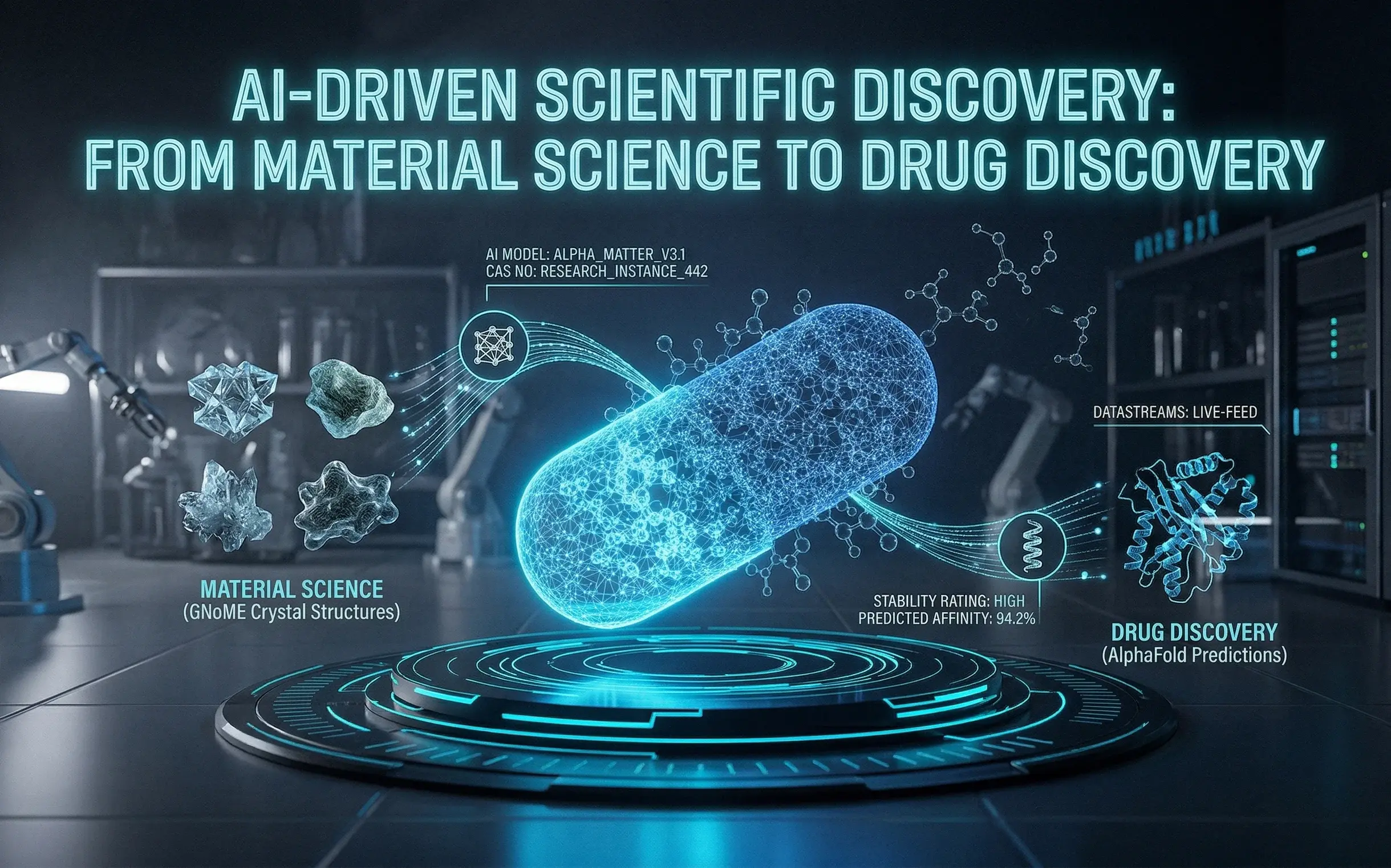
AI-Driven Scientific Discovery: From Materials Science to Drug Development, How Is AI Accelerating Humanity's Innovation Cycle?
Over the past few centuries, humanity's scientific progress has often relied on "accidental discoveries" or "long trial and error." From Edison searching for filament materials to modern pharmaceutical companies spending billions of dollars and over a decade on drug screening, every step of scientific research has carried enormous time costs and failure risks. However, we are on the threshold of an unprecedented revolution. As AI-driven scientific discovery (AI for Science) becomes a reality, scientific research is leaping from an "artisan model" relying on human intuition to an "automated model" driven by algorithms.
This transformation is called the "fourth paradigm" of scientific discovery by academia. It is no longer merely experimental observation, theoretical deduction, or simple computer simulation — it uses AI to directly "foresee" the future from massive high-dimensional data. For scientific researchers and business owners in North America or Hong Kong, this is not only a technological update but also a reconstruction of survival logic: if your innovation cycle is still measured in "years" while competitors have shortened to "months," this generational gap will be devastating.
What Is AI-Driven Scientific Discovery? Breakthrough Applications in Deep Basic Science
When we talk about AI scientific discovery, Google DeepMind's performance is undoubtedly the most authoritative endorsement. This experience is not a castle in the air — it has genuinely changed the underlying logic of the material world. In materials science, finding a new crystal structure that can exist stably and has specific properties (such as superconductivity or high-efficiency battery cathodes) traditionally required scientists to perform countless composition experiments in the lab.
DeepMind's GNoME tool, through large-scale active learning, predicted 2.2 million new crystal structures — equivalent to the total knowledge stock of humanity over the past 800 years. In the biopharmaceutical field, the breakthrough of AlphaFold precisely predicted the 3D structures of nearly all known proteins, overcoming a 50-year-old puzzle in biology. This shift from "blind search" to "precise prediction" directly pushed research certainty to a new height.
Efficiency Comparison Between Traditional Research and AI-Enabled Research
To intuitively show how AI reshapes the innovation cycle, we can observe its disruptive performance in core stages through the table below:
| Research Field | Traditional Time / Cost | AI Time / Performance | Key Breakthrough |
|---|---|---|---|
| Material Structure Discovery | Years to decades (experimental trial and error) | Days to weeks (algorithmic prediction) | GNoME predicts 2.2 million stable crystals |
| Protein Structure Prediction | Months / years (cryo-EM experiments) | Minutes (end-to-end prediction) | AlphaFold solves 50-year scientific puzzle |
| Drug Target Screening | 5-10 years / hundreds of millions of dollars | 1-2 years / dramatically reduced cost | Generative AI designs high-activity molecular structures |
| High-Dimensional Data Analysis | Depends on expert experience (easy to miss) | Automated pattern recognition (cross-dimensional) | Discovers physical laws beyond human intuition |
How Does AI "Foresee" the Future in Massive Data? Understanding the Technical Foundation
Why can AI do what humans can't? It stems from its unique logic for handling high-dimensional data. In the microscopic world, the arrangement and combination of molecules and atoms is an astronomical number. Human scientists' cognition is often limited to three-dimensional space and a few chemical variables, while AI can perform pattern recognition in mathematical spaces with hundreds of dimensions.
This capability leap is reflected in the shift from "passive screening" to "generative design." In the past, we looked for a ready-made book in a pile — now AI directly writes a book that meets your knowledge needs. It can automatically simulate molecular stability in different environments and eliminate 99% of failure possibilities before entering the lab. This "digital twin" research path makes experimental verification no longer the main body of exploration but the final confirmation stage.
Why Do Hong Kong's Scientific Research and Healthcare Industries Urgently Need AI Transformation?
For biotech companies in Hong Kong and overseas, AI scientific discovery is not only a technology dividend but also a necessary option under compliance and market competition. Hong Kong, as an international biomedical center, has top academic resources, but there is still room for improvement in data utilization and conversion efficiency. Facing increasingly strict clinical trial standards and global competition, using AI to shorten the R&D chain is key.
We need to note that the compliance of medical research data is a red line. When using AI for model training, one must ensure compliance with local laws (such as Hong Kong's privacy ordinances) and international clinical data standards. By using AI to optimize experimental design, unnecessary clinical duplication can be reduced, and approval probability can be improved. For Hong Kong SMEs, the threshold for accessing AI tools is decreasing, but how to transform these technological achievements into global brand authority is another challenge.
How to Use AIPO Strategy to Safeguard Scientific Research Brand Authority in the AI Search Era?
When you use AI to achieve a scientific breakthrough, how do you ensure that investors, partners, and potential clients worldwide can find you through ChatGPT, Perplexity, or Google Gemini? This is where the core value of AIPO (AI-Powered Optimization), proposed by YouFind, lies. In the generative AI era, traditional SEO rankings are no longer sufficient to support a brand moat — what you need is GEO (Generative Engine Optimization).
We've found that when AI engines answer "Which new material is most suitable for solid-state batteries?" or "Which company leads in AI drug R&D?" they preferentially cite sources with high E-E-A-T weight. YouFind, through our proprietary Maximizer patented system, helps research enterprises optimize structured data (Schema) and establish an authoritative Source Center without rebuilding the site. Using the GEO Score™ algorithm, we can precisely diagnose the "citation gap" of a brand in AI's view, ensuring your research papers and patent achievements become the preferred answer on AI recommendation slots. This not only boosts AI citation rates by 3.5x but also directly transforms technical advantages into commercial inquiries.
Check Right Now Whether Your Brand Is "Missing" in the Eyes of AI
Don't become invisible in the era of AI search. Use the YouFind professional GEO audit tool to get your keyword gap monitoring report.
Get Your Free GEO Audit Report NowFrequently Asked Questions About AI Scientific Discovery (FAQ)
- Can AI-Discovered New Drugs Shorten Clinical Trials?
Although AI cannot directly skip the legally required human clinical trial stage, it can significantly improve the success rate of entering clinical trials through precise target screening and molecular structure optimization. Because AI-predicted drugs are more targeted, R&D enterprises can design more efficient clinical plans, thereby indirectly shortening the overall time to market.
- How Can Hong Kong SMEs Access and Apply AI Research Tools?
SMEs don't need to develop models from scratch. They can use mature AI platforms (such as cloud-based molecular simulation tools) or, through AIPO strategy, first seize the initiative in AI search at the digital marketing level, attract research cooperation resources, and gradually introduce vertical-domain AI-assisted R&D systems.
- How to Ensure AI-Produced Research Content Isn't Judged as Spam by Google SpamBrain?
The core lies in E-E-A-T principles. AI-assisted content must be reviewed by human experts and supplemented with unique experimental data, real research insights, and authoritative citations. YouFind's AIPO engine, through structured modeling, ensures content is logically rigorous and meets Google's definition of "helpful content," thereby avoiding spam filters.
Embrace the AI-Driven Innovation Moat: AI is not meant to replace scientists' wisdom — it serves as the "most powerful brain," freeing humanity from inefficient repetitive labor. In the second half of the technology race, whoever first masters the tools of AI discovery and combines them with AIPO brand visibility strategies will build an unassailable authoritative position in the AI search era. Learn About AI Article Writing and let your scientific breakthroughs be seen precisely by the world.