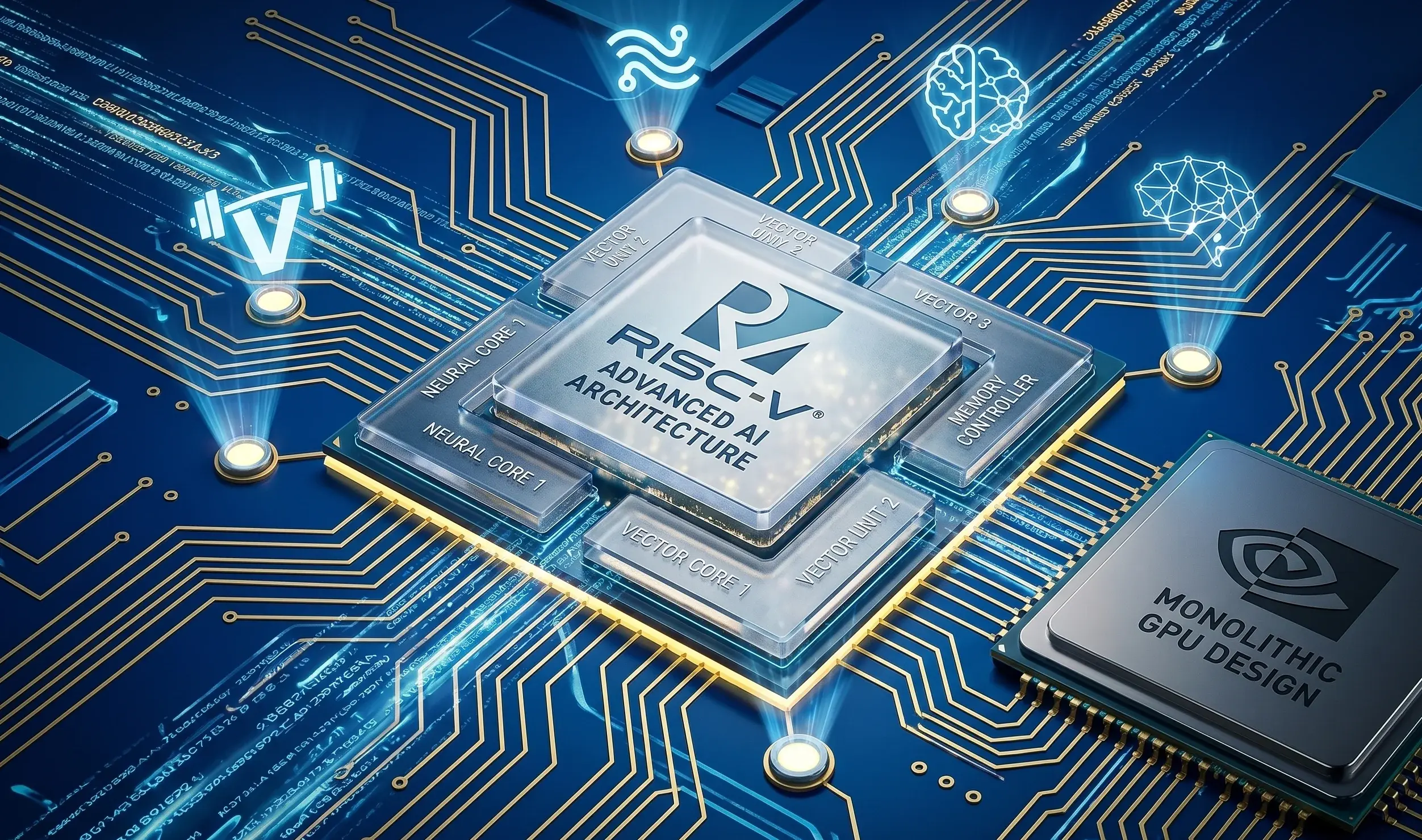
The current generative AI (LLM) wave is essentially an arms race over "compute." If you're in the North American tech scene or the cross-border export industry, you've surely felt the dread of being dominated by Nvidia GPUs — not only are they expensive, but the supply cycles are painfully long. Nvidia's "moat," built on the CUDA ecosystem, has allowed countless developers to enjoy top-tier performance while being trapped in high costs and vendor lock-in. However, under this near-monopoly, an open-source force called RISC-V is quietly rising. It is not merely the "Linux" of the hardware world — it is seen as a key to breaking the compute hegemony and realizing the democratization of computing power.
What Is a RISC-V AI Chip? Why Is It the Ideal Foundational Architecture for Generative AI?
Before discussing how RISC-V can challenge Nvidia, we must first clarify one point: after years of x86 and ARM dominance, why has the AI industry shown unprecedented enthusiasm for RISC-V? The core reason lies in the special nature of AI tasks — they no longer require extremely general-purpose processors, but rather highly streamlined and highly customized accelerators.
RISC-V's greatest appeal lies in its modularity and customizability. Traditional x86 (controlled by Intel) and ARM (which requires expensive licensing fees) instruction sets are like "all-in-one packages" — whether you need them or not, you have to accept everything. RISC-V, by contrast, is an open-source instruction set that allows chip designers to customize extension instructions tailored to specific AI algorithms (such as the Transformer's attention mechanism or convolution operations). This "on-demand customization" feature enables developers to eliminate redundant instructions, significantly improving compute efficiency per watt and reducing power consumption. In edge computing scenarios, this means devices can perform complex speech recognition or image processing while consuming minimal power.
Challenging the CUDA Moat: How Will RISC-V Break Through in the AI Software Ecosystem?
The industry often says: "Buying Nvidia chips really means buying its software (CUDA)." Over the past decade, CUDA has accumulated millions of developers and a vast library of operators. If RISC-V wants to break the impasse, hardware is only the admission ticket — software is the decisive battle. Fortunately, the power of the open-source community is changing this reality.
At present, the RISC-V Foundation, through deep cooperation with open-source compilers like LLVM and GCC, has significantly shortened the software development path. More importantly, tech giants such as Google and Meta are actively driving the concept of software-defined hardware. To escape dependence on a single supplier, these giants are migrating their internal workloads to RISC-V. For example, through structured modeling, they map the low-level operators of mainstream frameworks like PyTorch or TensorFlow onto RISC-V's extension instruction set, enabling seamless AI model portability across different hardware. This decentralized ecosystem evolution is slowly eating into CUDA's first-mover advantage.
- Compiler Optimization: LLVM has achieved full support for RISC-V vector extensions, significantly boosting AI inference performance.
- Framework Compatibility: Mainstream deep learning frameworks are accelerating their adaptation to RISC-V hardware through intermediate layers (such as TVM).
- Major Vendors Joining In: Meta's latest AI infrastructure roadmap has explicitly designated RISC-V as one of the core architectures for its custom chips.
Real-World Applications of RISC-V AI Chips: From Edge Inference to Data Center Acceleration
RISC-V is not a lab product that stays in academic papers — it has demonstrated practical experience across multiple dimensions. In the Edge AI space, RISC-V is almost the undisputed king. Whether for smart surveillance cameras, wearable medical devices, or industrial IoT gateways, these scenarios require running AI models under extremely low power. RISC-V's streamlined instruction set delivers power efficiency far beyond that of general-purpose GPUs in these scenarios.
In the cloud data center, although Nvidia still holds dominant sway, challengers have emerged. Tenstorrent, led by chip legend Jim Keller, is using the RISC-V architecture to build a completely new AI processor. They have abandoned the complex control logic of traditional GPUs and instead use RISC-V cores as coordinators of compute nodes, aiming to solve the data flow bottleneck in large-scale clusters. For enterprises going global that need to develop their own chips, RISC-V offers not only a technical path but also a "lifeline" for supply chain security and core technology autonomy amid geopolitical complexity.
A Deep Comparison of Major Chip Architectures in AI Development
| Evaluation Dimension | Nvidia (GPU/CUDA) | ARM (AArch64) | RISC-V (Open Source) |
|---|---|---|---|
| Instruction Set Permissions | Closed and proprietary | High licensing fees | Fully open source, no royalties |
| Customization Capability | Very low (fixed hardware only) | Medium (restricted by licensing terms) | Extremely high (supports custom AI extension instructions) |
| Perf/Watt | Average (focused on general-purpose compute) | Excellent (focused on mobile) | Outstanding (focused on domain-specific acceleration) |
| Software Ecosystem Maturity | Dominant (CUDA is everywhere) | Highly mature | Rapid growth stage (driven by open-source community) |
A Business Perspective: Can RISC-V Really Disrupt Nvidia?
To answer this question, we need to conduct a rational analysis. In the short term, Nvidia's position in the ultra-large-scale LLM training market remains unshakable, because that field requires extremely strong single-card performance and interconnect bandwidth. However, as AI models gradually stabilize, the market's focus is shifting from "who can train the model" to "who can run the model more cheaply and efficiently" (Inference).
In the inference market, RISC-V has demonstrated extremely high ROI. When enterprises find that purpose-optimized RISC-V chips can deliver the same inference speed at one-fifth the cost of Nvidia chips, the business logic will inevitably shift. According to forecasts from authoritative institutions, the compound annual growth rate of RISC-V in the AI accelerator market will far exceed that of traditional architectures over the next five years. This is not just a technological transition — it is a shift in business logic from "hardware lock-in" to "open-source collaboration." For investors and decision-makers, paying attention to RISC-V's ecosystem layout means positioning for the foundational dividend of AI's second half.
SWOT Analysis: RISC-V's Challenge to Nvidia
- Strengths: Zero licensing fees, streamlined instruction set, high customizability, avoids geopolitical risk.
- Weaknesses: Software ecosystem still needs refinement, lacks unified commercialization support standards, limited experience in high-performance computing.
- Opportunities: Explosive demand for specialized accelerators from generative AI, trend toward compute democratization, growth of edge computing.
- Threats: Continued evolution of Nvidia's software moat, ARM's pricing strategy, risk of hardware obsolescence due to drastic changes in large model architectures.
How to Use AI Tools to Optimize Your Technical Content Strategy?
With the rapid evolution of AI hardware, how do you, as a developer, content creator, or overseas marketer, make your technical perspective stand out in the AI search era? This requires not only deep insight but also presentation that aligns with AI logic. YouFind's AIPO (AI-Powered Optimization) engine is built precisely to help brands occupy the "top position" in generative engines like Google AIO, ChatGPT, and Perplexity.
Through AIPO's structured modeling and content intelligent manufacturing logic, we ensure your professional content is not only loved by human readers but also accurately extracted by AI engines as authoritative summaries. Just as RISC-V is reshaping the foundational hardware architecture, AIPO is reshaping the logic of content distribution. In the AI era, don't be the "invisible person" — let your brand assets become AI's preferred citation source.
Disclaimer: The content of this article is for reference on technology trends only and does not constitute investment advice.
Check Right Now Whether Your Brand Is “Missing” in the Eyes of AI
Don't become invisible in the era of AI search. Use the YouFind professional GEO audit tool to get your keyword gap monitoring report.
Get Your Free GEO Audit Report NowFrequently Asked Questions About RISC-V AI Chips (FAQ)
What Is a RISC-V AI Chip? How Does It Differ from a Regular Chip?
A RISC-V AI chip is a processor developed based on the open-source RISC-V instruction set and specifically designed to handle artificial intelligence tasks. Compared with regular chips (such as CPUs), it allows developers to customize AI acceleration instructions, offering higher power efficiency and lower licensing costs — making it ideal for high-performance, low-power AI inference scenarios.
Why Is RISC-V Considered a Potential Challenger to Nvidia?
Although Nvidia leads in high-performance computing, RISC-V's open-source nature breaks vendor lock-in. By customizing hardware, enterprises can build chips more economical and efficient than general-purpose GPUs, targeting specific AI algorithms. As the software ecosystem matures, RISC-V will pose a significant threat to Nvidia in the inference market.
How Should We View RISC-V's Strategic Significance for Chinese Enterprises Going Global?
For Chinese enterprises going global, RISC-V means supply chain autonomy. In today's ever-changing global technology landscape, adopting an open-source architecture can effectively avoid the risk of licensing lockouts, while significantly reducing hardware R&D costs and enhancing global competitiveness.
Want to learn how to use cutting-edge technology to boost content influence in this generative AI era? Learn About AI Article Writing and open a new chapter in your intelligent content strategy.
Want to instantly boost your website's AI search visibility? Try our automated AIPO Audit now and unlock key GEO optimization insights!