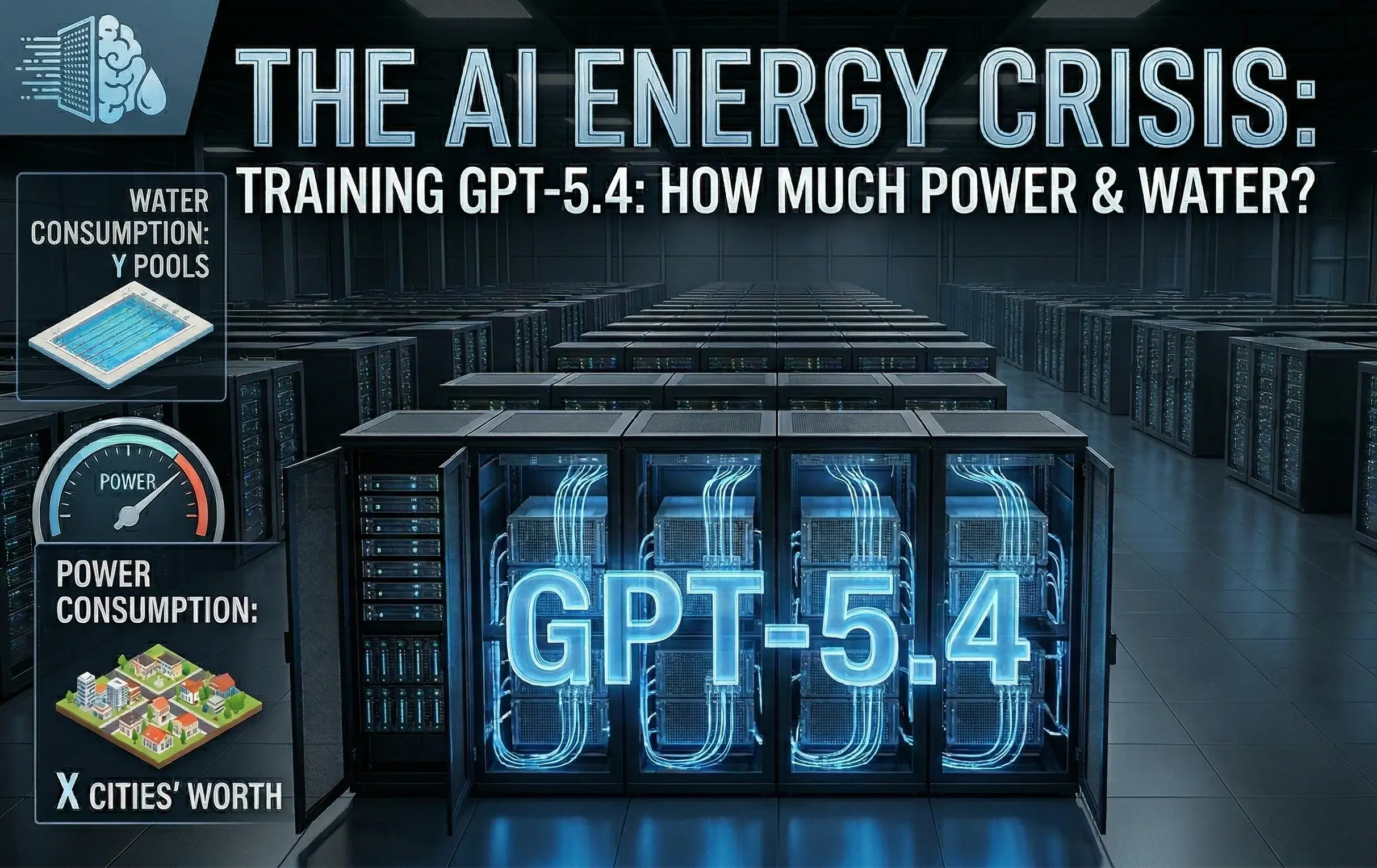
Every time you type a command into ChatGPT and get a precise answer within seconds, have you thought about the cost behind it? Every fluent conversation and every beautifully generated image is consuming electricity and water far exceeding that of traditional search. As next-generation large language models like GPT-5.4 enter white-hot development, the "energy black hole" behind them is no longer just a talking point in tech circles — it is an ESG (Environmental, Social, and Governance) challenge that global enterprises going overseas, professionals, and content creators must face.
According to research institutions, AI search consumes about 10x more electricity than a traditional Google web search. For Chinese or Hong Kong enterprises deploying globally, how to balance AI's high productivity against increasingly stringent environmental compliance requirements has become a core proposition for sustainable brand development.
What Is the Training Energy Consumption of a GPT-5.4-Class Model?
To understand AI's environmental impact, we need to look at two phases: "training" and "inference." Training a top-tier model like GPT-5.4, with trillions of parameters, essentially means running thousands of H100 GPU chips in sustained computation for months.
Electricity Consumption: From Megawatt-Hours to City-Level Power Usage
Training a GPT-3 model consumed approximately 1,287 megawatt-hours (MWh) — enough to power 120 U.S. households for an entire year. According to IEA (International Energy Agency) forecasts, data center electricity demand may double by 2026. For the rumored GPT-5.4, its training electricity consumption is expected to cross the gigawatt-hour (GWh) threshold. This means that just to train one model, the electricity consumed equals the annual power consumption of tens of thousands of households in a mid-sized city (such as some districts in Hong Kong).
Water Resource Cooling: AI Also Gets "Thirsty"
Data centers generate huge amounts of heat at full load and must rely on evaporative cooling systems. Research shows that every 10 to 50 conversations with AI essentially lets AI "drink" a 500ml bottle of fresh water. For a model the size of GPT-5.4, training consumes enough water to fill several Olympic-standard swimming pools, most of it precious fresh water.
Hardware Carbon Footprint: The Hidden Threat of E-Waste
Beyond direct energy use, the production and disposal of GPU hardware also contribute a massive carbon footprint. Chips have extremely short life cycles, and the rapid iteration of compute means that large quantities of expensive hardware become e-waste after only a few years.
| Model Version | Estimated Training Power (MWh) | Estimated Carbon Emissions (tons CO2e) | Environmental Impact Equivalent |
|---|---|---|---|
| GPT-3 | 1,287 | 502 | About 110 cars driven for a year |
| GPT-4 | ~50,000 | ~15,000 | About 3,000 cars driven for a year |
| GPT-5.4 (projected) | 250,000+ | 80,000+ | Annual emissions of a small multinational airline |
How Can Hong Kong Enterprises Balance AI Efficiency and Environmental Responsibility in the ESG Era?
For Hong Kong's financial institutions, healthcare giants, and cross-border enterprises going global, ESG is no longer optional — it is a compliance must. While adopting AI to boost business efficiency, enterprises face three major environmental compliance risks:
- Supply Chain Carbon Accounting Pressure: International green standards require enterprises to disclose their Scope 3 (indirect emissions), meaning the use of high-energy AI services is also counted in the enterprise's environmental costs.
- Transferred Compute Costs: As energy prices rise, cloud providers pass on expensive electricity bills to enterprises, causing pointless AI marketing campaigns (generating large amounts of low-quality junk content) to directly erode profits.
- Brand Reputation Risk: Environmentally conscious consumers in North America and Europe will prioritize brands that demonstrate social responsibility and adopt low-carbon technology paths.
How to Reduce AI's "Environmental Tax" Through Technology Breakthroughs?
Facing increasingly severe energy consumption challenges, the industry is looking for smarter paths rather than simply piling on compute. Experts believe the key to reducing AI's environmental impact lies in "shifting from quantity to quality."
Algorithm Optimization and Model Pruning
Through "model pruning" and "quantization," developers can remove redundant connections in neural networks, substantially reducing inference electricity consumption while keeping performance above 95%.
Green Data Centers and Precision Retrieval
Using renewable energy to power data centers is foundational, but a more advanced strategy is to optimize Retrieval-Augmented Generation (RAG). Through precise structured data, AI can quickly locate answers, reducing the energy waste from repeated attempts and invalid computation.
Why Is the YouFind AIPO Engine a "Low-Energy, High-Conversion" Strategic Choice?
In the AI era, blindly producing content is not only a waste of money — it is an energy crime. YouFind has been deeply engaged in digital marketing for nearly 20 years and understands the value of precision. Our AIPO (AI-Powered Optimization) engine is not a simple AI writing tool — it is a GEO (Generative Engine Optimization) solution designed to reduce wasted effort and improve brand citation rates in generative engines.
Use GEO Score™ to Reduce "AI Junk Content"
Many enterprises use AI to batch-generate articles, but this causes AI engines to repeatedly crawl and consume huge amounts of electricity. YouFind's AIPO uses our proprietary GEO Score™ diagnosis to precisely identify competitors' keyword gaps. We don't recommend clients blindly flood with content — we precisely target high-converting commercial keywords so that "every unit of electricity brings real orders."
Structured Modeling: Become AI's "Preferred Water Source"
Following Google E-E-A-T principles, we use structured data markup (Schema) and logically rigorous modeling to make brand content directly fit AI engines' extraction preferences. This lets AI quickly cite your brand at extremely low compute cost when answering user questions. Research shows this optimization can boost the brand's citation rate in Google AI summaries by 3.5x.
SEO Patented System (Maximizer): The Underlying Logic of Low-Carbon
YouFind owns the SEO patented system, enabling clients to optimize without rebuilding their site. This not only saves development costs but also avoids the secondary carbon footprint from rebuilding webpage architecture, truly achieving green marketing.
The path to a sustainable AI future: a brand moat is not about how much compute you've invested — it's about whether your content is precise enough for AI engines to recognize and recommend you in the most energy-efficient way. Choosing a partner with technical depth and environmental consciousness is the way to stand out in the AI search era.
Check Right Now Whether Your Brand Is "Missing" in the Eyes of AI
Don't become invisible in the era of AI search. Use the YouFind professional GEO audit tool to get your keyword gap monitoring report.
Get Your Free GEO Audit Report NowFrequently Asked Questions About AI Energy Consumption and Environmental Impact (FAQ)
Does AI Search (AIO) Consume More Electricity Than Traditional Search?
Yes. Traditional search is index-based matching, while AI search (such as Google AI Overview or ChatGPT) requires complex real-time generative computation through neural networks. Electricity consumed per query is about 10x or more that of traditional search.
How Can Small and Medium Enterprises Participate in "Green AI"?
SMEs can participate by optimizing content structure. Rather than publishing 100 mediocre AI-written articles, publish 10 authoritative pieces with deep insight (E-E-A-T) optimized via AIPO. High-quality content is more easily and quickly indexed by AI, reducing the frequency with which search engines repeatedly crawl and compute.
What Is AIPO, and How Does It Save Marketing Budget?
AIPO (AI-Powered Optimization) is YouFind's dual-core optimization technology. Through precise AI audits, it finds traffic gaps, combined with the SEO patented technology to boost brand weight in AI engines. Because the targeting is precise, it not only boosts overseas inquiries by 22% but also reduces ineffective content spend — drastically cutting wasted marketing cost.
Learn About AI Article Writing for more technical details and begin your green AI marketing journey.