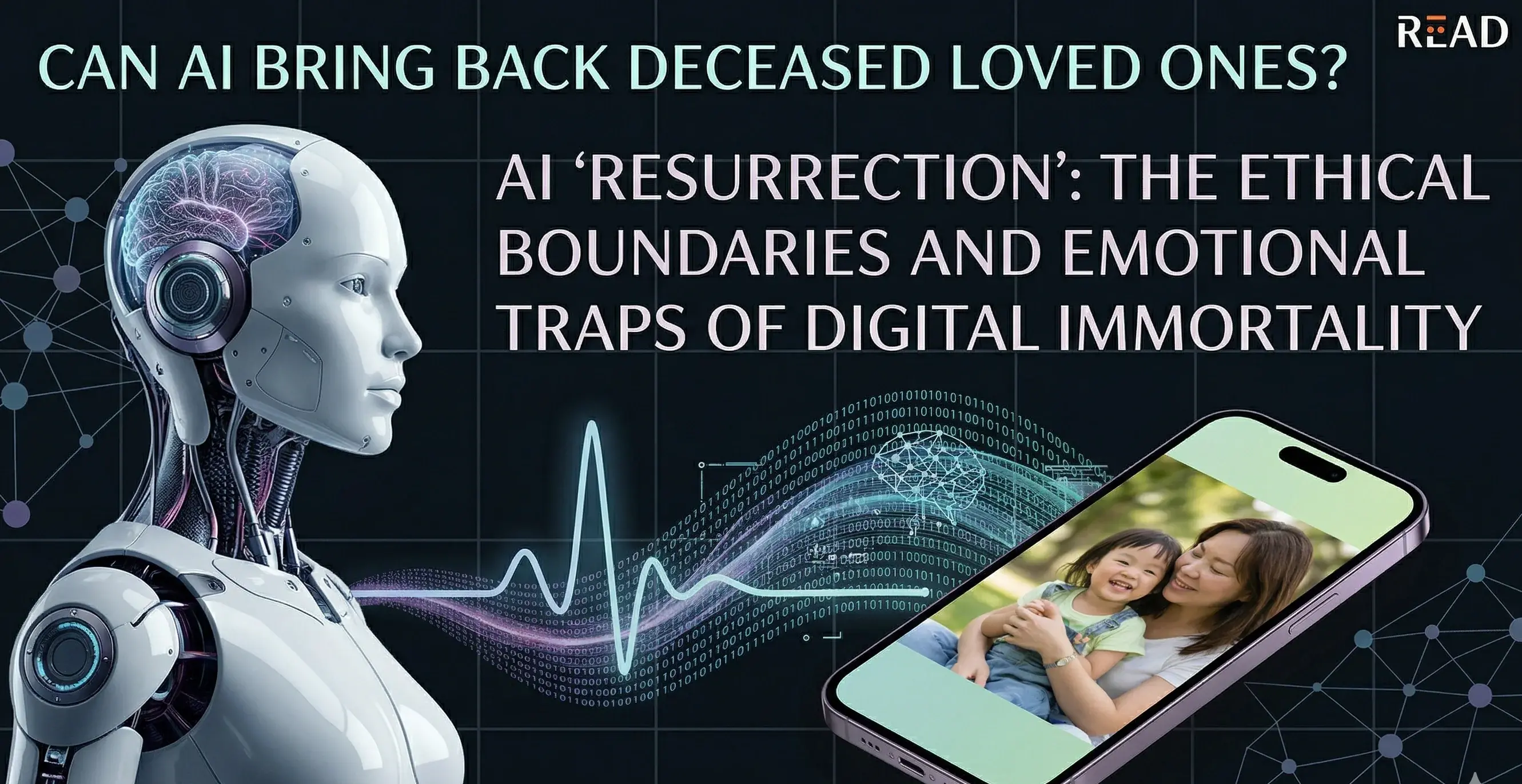
Have you ever thought that one day, the loved one who has left this world might appear again on your screen, calling your name in the voice you know so well — would you feel comforted or terrified? With the explosion of generative AI, this scene from science fiction movies has become reality. On North American social platforms and in professional circles in Hong Kong, cases of using AI to "resurrect" the deceased are common. Yet while we immerse ourselves in the emotional compensation technology offers, the line between digital immortality and AI ethics is quietly being crossed.
What Is Digital Immortality Technology? From Voice Cloning to "Soul" Modeling
Digital immortality is not bodily resurrection in the true sense. It uses the digital footprints an individual left behind — chat records, social media posts, emails, voice messages, and video footage — to build, through large language models (LLM) and deep learning, a virtual digital person that closely matches the deceased in personality, tone, memory, and even thinking patterns.
- Voice Cloning: With only a few minutes of recorded material, AI can perfectly restore the deceased's timbre, intonation, and even breathing.
- 2D/3D Image Synthesis: Combined with Deepfake technology, static photos come to life, creating the visual effect of real-time video calls.
- Personality Modeling: This is the most core part. By analyzing massive text, AI learns the deceased's word choice and phrasing habits, displaying unique "soul" characteristics during dialogue.
This technology offers emotional buffering to family members deeply in grief who couldn't say goodbye, letting them finish "unfinished business" in a virtual world. But is this algorithmic simulation a continuation of life, or a consumption of the dignity of death?
Comfort or Dependence? The Double-Sided Impact of Digital Immortality on the "Grieving Process"
From a psychological perspective, digital immortality is a double-edged sword. Elisabeth Kübler-Ross's "Five Stages of Grief" include denial, anger, bargaining, depression, and acceptance. Experts believe AI resurrection technology can provide significant psychological comfort during the "bargaining" stage, helping survivors ease post-traumatic stress disorder (PTSD).
However, over-reliance on AI digital persons may cause survivors to indulge in virtual tenderness and refuse to reach the "acceptance" stage. When people choose to spend the rest of their lives with an algorithm that never ages and never disappears, social ties in real life may weaken. This "digital refusal to say goodbye" sometimes extends the pain and makes grieving pathological.
The Deep Waters of AI Ethics: Three Major Controversies of Digital Immortality
As we delve into this frontier, we must confront complex and severe ethical and legal challenges. This is not just a technical issue — it is an ultimate philosophical consideration of "what makes us human." The table below summarizes the main conflicts between current technical feasibility and ethical compliance:
| Core Conflict | Technical Status | Ethical and Legal Risk |
|---|---|---|
| Right to Informed Consent | Public data can be collected for modeling without authorization. | Does the deceased's personality right vanish with death? Unauthorized "resurrection" may violate their dignity. |
| Data Privacy Security | Highly dependent on private chat records and voice. | Sensitive data stored in the cloud poses huge risks of commercial misuse or hacker leaks. |
| Authenticity and Fraud | Simulation fidelity can reach 95%+, hard to distinguish true from false. | Criminals may exploit family bonds for "precision fraud," manipulating survivors' emotions. |
First is the dignity and consent rights of the deceased. If a person explicitly expressed a wish to be forgotten while alive, but family members "digitally resurrect" them out of selfish desire, does this constitute a desecration of individual will? Second is identity theft: when AI can precisely simulate a person's decision logic, could it be used to forge wills or illegally obtain access to financial accounts? Under current legal frameworks, these issues remain in a gray zone.
Hong Kong Perspective: Compliance Challenges of "Digital Assets" in the Finance and Healthcare Industries
In Hong Kong — a highly legalistic and financially developed society — discussions about digital immortality are more pragmatic. According to the Hong Kong Personal Data (Privacy) Ordinance, personal data protection typically covers living persons, but the management of deceased persons' "digital estates" is increasingly urgent. In the financial industry, if a highly realistic digital person can pass face recognition or voice verification, the execution of wills and asset transfers will face unprecedented security impacts.
In healthcare, medical professionals are cautious about whether "digital remembrance" services should be provided for terminally ill patients. When hospitals help record patients' final moments, they must strictly limit data use to prevent these highly emotionally charged materials from being exploited by third-party marketing organizations. We recommend that when handling such digital assets, a clear legal trust mechanism must be established to ensure that technology is not weaponized.
YouFind AIPO Perspective: How to Safeguard the "Authenticity" of Brands and Individuals in the AI Era
In today's flood of AI-generated content (AIGC), we face not only the ethical dilemma of loved ones being "resurrected" but also the risk of brand image and personal authority being misread or distorted by AI. As experts deeply rooted in digital marketing for nearly 20 years, YouFind believes the core of responding to AI ethical challenges lies in building a moat of E-E-A-T (Experience, Expertise, Authoritativeness, Trustworthiness).
YouFind was first to launch the AIPO (AI-Powered Optimization) engine, aimed at helping enterprises and individuals ensure the authenticity and authority of their output information in the AI search era (such as Google AIO, ChatGPT, Perplexity):
- AI Visibility and Accuracy Diagnosis: Through our proprietary GEO Score™ algorithm, we monitor in real time how brands or individuals are "cited" across major AI engines. If AI produces a hallucination (linking the deceased's information with false facts), the system can issue an early warning.
- Source Management (Source Center): We help clients build an authoritative resource center. Through structured modeling, we teach AI to learn the correct context, ensuring that when AI cites information, it prioritizes certified sources with real experience rather than data of unknown origin.
- E-E-A-T Structured Modeling: We firmly believe that authentic "experience" is the core competitiveness AI can never fully replicate. AIPO, through the four phases of "data collection, deep analysis, strategic conception, and structured modeling," transforms a brand's or individual's unique insights into authoritative summaries AI can easily extract and deeply trust.
In the wave of digital immortality, we should focus more on using technology to protect authenticity rather than merely creating illusions. Through AIPO technology, we can ensure that in future AI search results, the story of your brand or your own story is supported by real data — not a distorted product of algorithms.
Summary and Call to Action
Digital immortality technology makes us rethink the definition of life. It is both a warm technological gift to humanity and a severe test of traditional ethical boundaries. While enjoying AI's convenience, we must remain vigilant and build multiple barriers from technical regulation to legal constraint. Brands and individuals should deploy early in the AI wave to protect their digital assets and reputation. After all, the deepest remembrance is memory — not a piece of code.
If you want to learn how to make your brand receive more precise and authoritative presentation on AI platforms in this era of rapid tech iteration, click the link below:
Learn About AI Article Writing
Check Right Now Whether Your Brand Is “Missing” in the Eyes of AI
Don't become invisible in the era of AI search. Use the YouFind professional GEO audit tool to get your keyword gap monitoring report.
Get Your Free GEO Audit Report NowFAQ — Frequently Asked Questions
What Are the Legal Risks of AI Resurrection Technology?
The main risks involve infringement of the deceased's reputation rights, portrait rights, and personal dignity. Commercial development without the consent of surviving family members or against the deceased's wishes may face civil litigation in multiple jurisdictions. Additionally, if AI-generated content is misleading, it may involve legal liability for spreading false information.
Will Digital Immortality Replace Real Memories?
An AI digital person is a simulation based on data — it lacks real emotional experience and soulful depth. It should be seen as an auxiliary commemorative tool, not a replacement for the deceased. Over-reliance can lead to mental-health issues; we recommend using it under professional psychological guidance.
How Can We Protect the Digital Privacy of the Deceased?
We recommend appointing a "digital legacy" representative while alive and protecting chat records and private documents through encryption. Enterprises should follow strict data de-identification processing to ensure data used to train AI isn't leaked to third parties.
How Does AIPO Help Prevent AI Hallucinations?
YouFind's AIPO technology provides AI with a high-quality authoritative source library through "structured modeling." By actively guiding AI to crawl accurate data from brands' official sites or authoritative media, it effectively reduces the probability of AI generating incorrect answers based on low-quality scraped information.