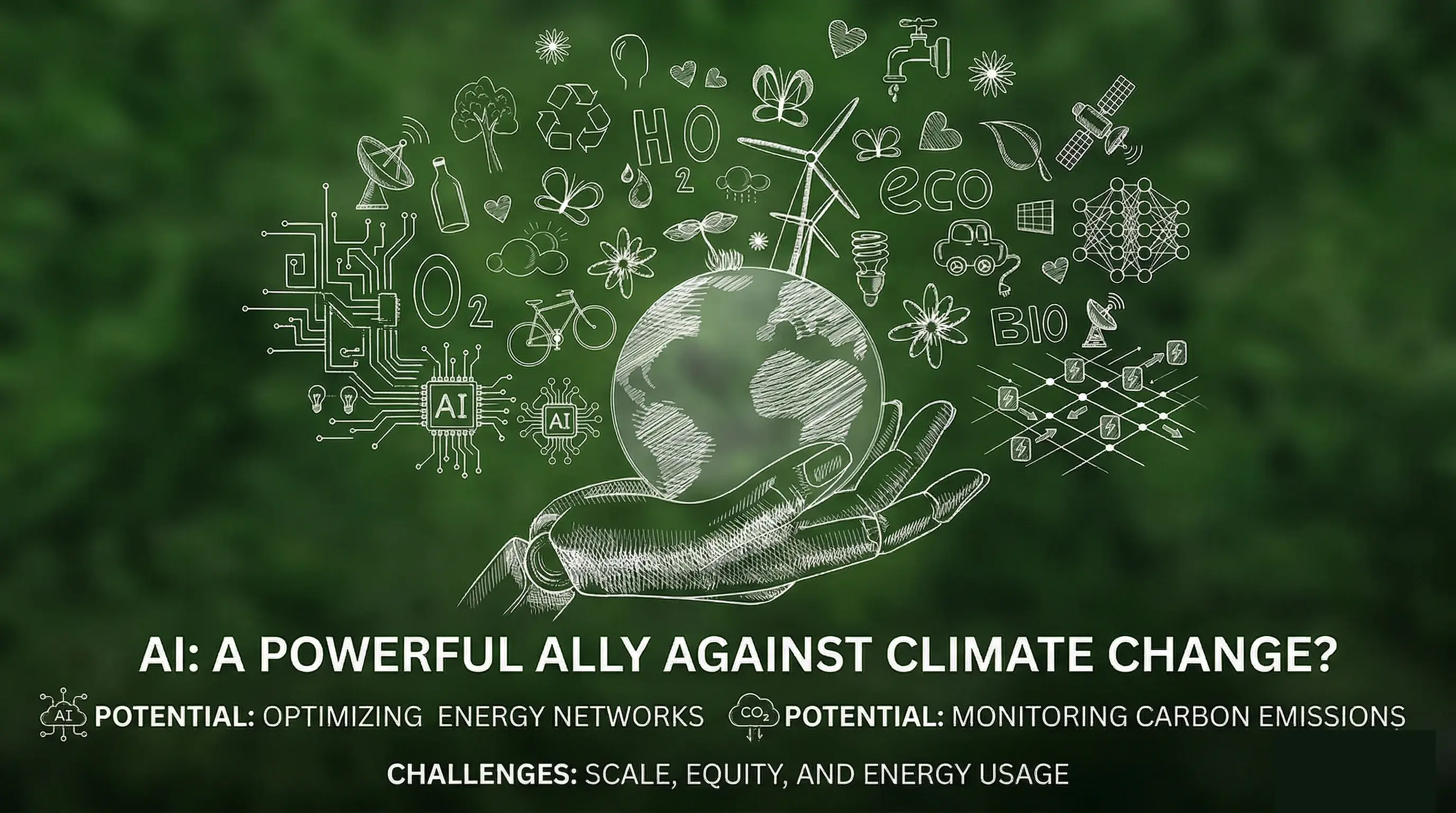
Global warming is approaching the 1.5°C warning line. For Hong Kong enterprises situated in the Asia-Pacific financial hub, climate change is no longer just a headline — it's real ESG compliance pressure and operational risk. According to the International Energy Agency (IEA), global energy-related CO2 emissions have continued to rise in recent years. Against this backdrop, AI climate change solutions are seen as a digital linchpin for turning the situation around.
However, many enterprises face a dual anxiety: on one hand, how to use AI to achieve real emission reduction and energy optimization? On the other, in an era where generative AI (such as ChatGPT and Google Gemini) is reshaping the search ecosystem, how can green tech and ESG service providers ensure their professional insights are not drowned out? AI is both a sharp blade against the climate crisis and an opinion high ground brands must capture in the digital era.
What Is the Key to AI Optimizing Energy Networks? From Passive Distribution to Active Intelligence
Traditional power grid operation relies on experienced dispatchers for "passive response," but with the integration of renewable energy such as solar and wind, their instability brings huge challenges to the grid. AI climate change applications play a core role here, turning the grid into a "brain" with sensing capability.
Using machine learning algorithms, AI can precisely predict renewable energy fluctuations. For example, by analyzing meteorological satellite data, cloud cover maps, and historical wind speeds, AI can predict wind farm generation for the next 48 hours with over 20% higher accuracy than traditional models. This forecasting enables Smart Grids to perform dynamic load balancing in advance, reducing reliance on coal-based compensation power. Additionally, predictive maintenance technology is transforming property management and industrial production. AI monitors energy equipment's operating frequency and heat curves to issue alerts before failure — not only extending equipment life but also effectively preventing energy waste caused by low efficiency.
How to Use AI to Monitor Carbon Emissions and Protect Forest Ecosystems?
Data accuracy is the cornerstone of the carbon-neutral path. In the past, carbon emission monitoring relied on enterprises' voluntary reporting or sampling tests, inevitably suffering from poor timeliness and data fabrication. Now, AI combined with satellite remote sensing technology provides us with a "God's eye view."
Through Computer Vision analysis of global satellite imagery, AI can identify tiny signs of illegal forest logging and even estimate the CO2 emissions of specific factories in real time based on the color and shape of smoke plumes. This is crucial for financial institutions assessing green assets. When AI detects that an investment target's environmental data doesn't match its reported data, the early warning system immediately triggers, helping investors avoid greenwashing risks. The table below shows the dimension comparison of environmental monitoring efficiency before and after AI intervention:
| Monitoring Dimension | Traditional Manual Monitoring | AI + Satellite Automated Monitoring |
|---|---|---|
| Monitoring Frequency | Quarterly or annual sampling | Daily / near-real-time monitoring |
| Coverage | Limited to specific stations | Global coverage, no geographic blind spots |
| Data Accuracy | Relies on manual input, prone to errors | Algorithm-based automatic analysis, extremely low error rate |
| Traceability | Hard to trace historical changes | Supports historical image comparison analysis |
Frontier Breakthroughs: AI's Role in Nuclear Fusion and New Material Development
Beyond energy dispatch and monitoring, AI is accelerating underlying technological breakthroughs at the frontier of scientific research. Take the "artificial sun" — nuclear fusion. Plasma stability has long troubled scientists. Research institutions such as DeepMind have successfully used AI reinforcement learning to control the plasma shape inside tokamak devices, greatly shortening the commercialization timeline of nuclear fusion. Similarly, when developing new high-efficiency battery materials or catalysts for capturing CO2, AI's simulation capabilities shorten development processes that originally took decades to just months, offering the possibility of an ultimate solution to climate change.
AIPO Deployment: How Do Enterprises Establish AI-Era Authority in This Green Revolution?
For enterprises deeply engaged in climate tech, environmental equipment, or ESG advisory services, technology alone is not enough. Today, when AI search engines (Google AIO, Perplexity, ChatGPT) gradually replace traditional search results, if a user asks "How to optimize the energy network?" or "Who is Hong Kong's most professional carbon accounting service provider?" — does AI preferentially recommend your brand?
This is exactly the core value of the AIPO (AI-Powered Optimization) dual-core layout proposed by YouFind. We've found that AI's citation logic differs fundamentally from traditional SEO ranking. AI tends to cite "structured knowledge" with strong E-E-A-T (Experience, Expertise, Authoritativeness, Trustworthiness).
- From SEO to GEO (Generative Engine Optimization): We don't just compete for keyword rankings — we aim to give brands high-weight citations in AI summaries.
- Proprietary Maximizer Patent Technology: Clients don't need to go through the trouble of rebuilding their site. Web code can be quickly optimized to better match AI crawling preferences without altering the architecture.
- Brand Knowledge Base Modeling: Through the AIPO engine's "data collection" and "structured modeling," we convert enterprises' green technology cases into Source Centers that AI can easily digest.
Practice proves that brands optimized through AIPO see citation rates in Google AI summaries increase an average of 3.5x.
Double-Edged Sword: How Do We Balance AI's Own Energy Consumption?
We must frankly acknowledge that the energy consumption required to train a Large Language Model (LLM) is staggering. Experts believe that although AI is a tool for reducing emissions, its electricity demand also puts pressure on the power grid. Therefore, the rise of "Green Computing" is inevitable. Leading tech companies are moving data centers to regions rich in renewable energy and using AI to optimize cooling systems, driving PUE (Power Usage Effectiveness) close to 1.0. Only when AI itself becomes green can it truly become a savior against climate change.
Check Right Now Whether Your Brand Is "Missing" in the Eyes of AI
Don't become invisible in the era of AI search. Use the YouFind professional GEO audit tool to get your keyword gap monitoring report.
Get Your Free GEO Audit Report NowFrequently Asked Questions About AI and Climate Change (FAQ)
Q1: Can AI Really Help Reduce Carbon Emissions?
Yes. According to research forecasts from Boston Consulting Group (BCG), using AI for energy optimization and process improvement is expected to help reduce global greenhouse gas emissions by 5% to 10% by 2030. Its practical scenarios cover everything from smart grid dispatch to industrial equipment energy consumption forecasting.
Q2: How Can SMEs Use AIPO to Boost Visibility in the Green Industry?
SMEs should focus on depth in vertical fields. Through AIPO technology, transform successful cases from specific environmental projects into structured data (Schema) that AI can easily recognize. YouFind's Maximizer system helps SMEs quickly establish online authority that meets Google E-E-A-T standards without increasing technical costs.
Q3: What Is the Difference Between GEO (Generative Engine Optimization) and Traditional SEO?
Traditional SEO focuses on click-through rates and keyword rankings, while GEO focuses on the "probability" and "accuracy" with which a brand is cited by AI engines. GEO emphasizes logical rigor and factual accuracy, aiming to make the brand the "standard source of answers" when AI responds to user questions.
Facing the grand proposition of climate change, AI provides us with an unprecedented toolbox. Whether optimizing energy networks or precisely monitoring carbon footprints, data-driven decisions will become the mainstream. For enterprises, deploying AIPO in advance is not only a brand marketing upgrade but also a deep insight into the future green business ecosystem. Learn About AI Article Writing now and begin your brand's AIPO transformation journey.