

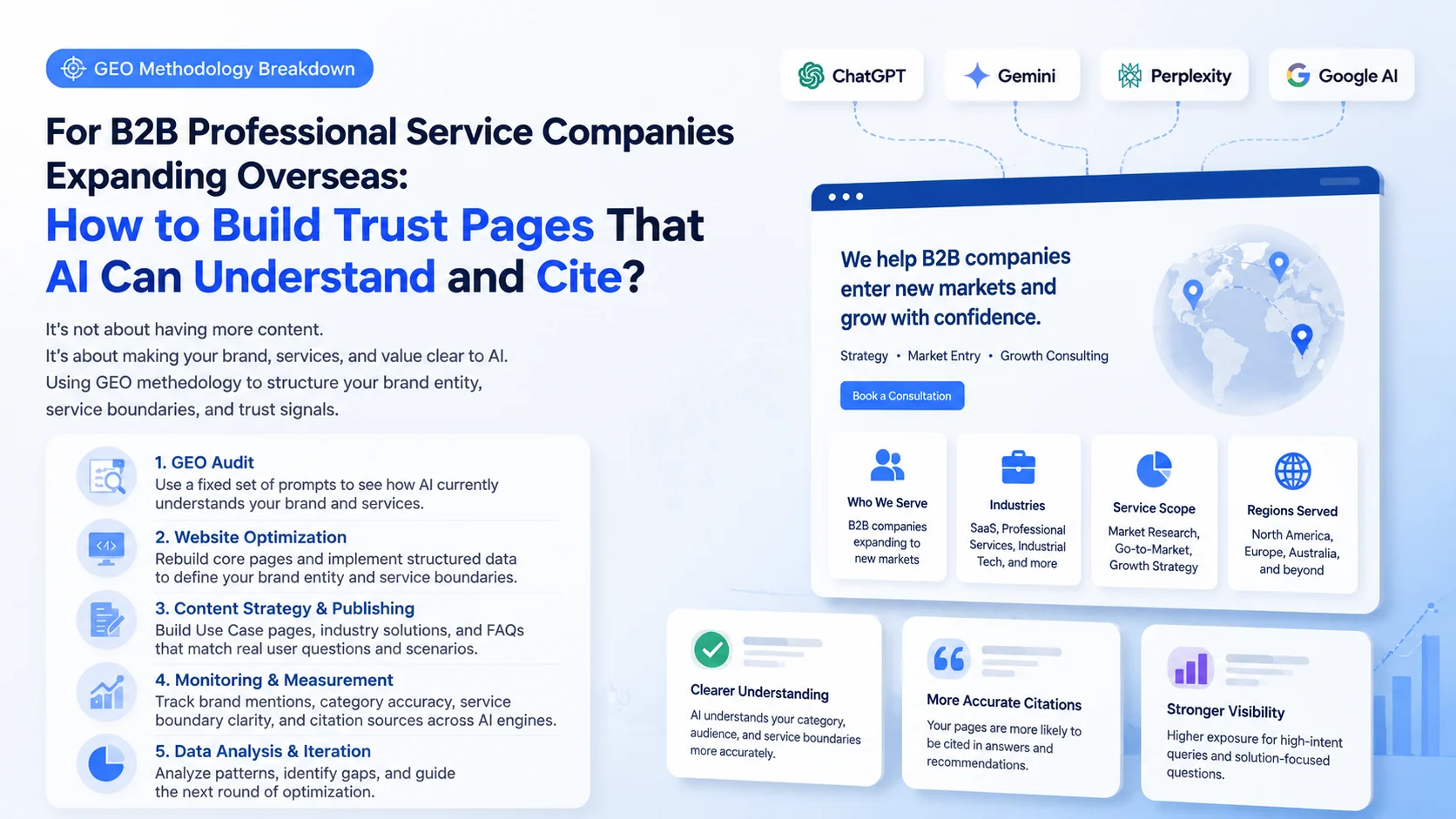
Your Website Has Content, So Why Can't AI Clearly Describe Who You Are?
If you are a professional service B2B company targeting the North American, European, or Australian markets, or a B2B SaaS company with a long sales cycle, your website might already be quite good: a homepage, an About Us page, comprehensive product or service descriptions, and a regularly updated blog. The site might be built on WordPress, a custom standalone site, or an enterprise-grade CMS, serving long-term functions for overseas brand awareness, sales validation, and lead generation.
But problems arise when potential buyers start researching you in a new way. They ask ChatGPT, Gemini, Perplexity, or Google AI Mode: “What does this company do?”, “Who is it for?”, “Can it serve the European market?”, “How is it different from other solutions?” The AI's answers can be vague, or even misclassify your company.
In these situations, I typically see three symptoms: First, the company is not recognized correctly. Second, its service boundaries are fuzzy. Third, competitors are mentioned more often in recommendation and comparison queries.
The issue isn't necessarily that “the website lacks content.” More often, it's that the content exists, but AI cannot form a stable brand perception from these pages and external sources. This is especially critical for professional service B2B companies, because buyers rarely make decisions based on a single page. They cross-validate information from your website, AI answers, LinkedIn, industry directories, and partner profiles before deciding whether to proceed.
So, in our methodology, we typically don't start with “let's write more blog posts.” Instead, we first use a GEO audit to determine: Does the AI not know the brand, or does it know the brand but misunderstand it?
Why This Isn't Just a “Lack of Content” Problem, But a Problem of Missing a Verifiable Cognitive Structure for Brand Information
Based on years of industry observation, professional service B2B companies have a very typical problem: They have a lot of information, but the information structure is incomplete. Company capabilities might be scattered across the homepage, About Us page, service pages, PDFs, LinkedIn, industry directories, and partner pages. For humans, these pieces can be gradually assembled. For AI systems that need to understand entities, categories, and the context of a question, the assembled result is often unstable.
Unstable Category Recognition
Many B2B homepage hero sections feature abstract value propositions like “Accelerate Your Global Growth” or “Transform Your Business.” While these expressions serve a brand communication purpose, if the core body copy doesn't further clarify what the company is, who it serves, or what it offers, the category signal becomes weak.
I focus more on whether the page clearly presents information like Who we serve, Industries, Service scope, Use cases, and Regions served. These don't necessarily need to be rigid sections, but they must be present in the visible content. Simply putting this info in Schema while keeping the body copy vague is usually insufficient.
Unclear Service Boundaries
Professional service companies often write about “what we can do,” but rarely about “when it applies,” “who it's for,” “what the delivery scope is,” or “what cases it doesn't apply to.” The result is a page with capability descriptions but no boundary descriptions.
Suppose a company offers strategic consulting, market entry support, and execution services. If the page doesn't distinguish between delivery types like advisory, implementation, and managed service, the AI may confuse the category when answering whether the company is a consulting firm, a software platform, or an agency.
Fragmented Trust Information and Inconsistent External Sources
Industry experience is in the About Us page, regional coverage is hidden in the Contact page, qualifications are in a PDF, and target customers appear only in a blog post. Meanwhile, LinkedIn lists one category, an industry directory lists another, and partner pages use different service descriptions.
In this scenario, competitors are more likely to be mentioned, not necessarily because they have more content, but simply because their page topics, entity descriptions, and context information are clearer. For this situation, my first step is a GEO audit to break down category errors, boundary errors, citation gaps, and external conflicts, rather than attributing everything to a “lack of content.”
First Diagnose Where AI Gets It Wrong, Then Decide: Revise Pages, Add Context, or Unify External Sources
For these companies, my diagnostic logic isn't “how much more content can I write?” It's first to identify at which layer the AI's understanding is breaking down.
Layer 1: Entity Recognition
First, test if the AI can correctly answer what category the company belongs to and if the brand name is correctly associated with the right company entity, official website, and service type. If there are brands with the same name, similar names, or if the brand name itself is non-descriptive of its category, check for entity confusion.
When errors occur at this layer, continuing to write numerous industry articles may not directly solve the problem. The fundamental issue is that “who you are” is not yet stable.
Layer 2: Service Boundaries
Next, test if the AI knows who the company serves, which regions it covers, which industries it targets, and what type of delivery it provides. For professional service B2B companies, I specifically check if they are misclassified as a software tool, agency, consulting firm, or another adjacent category.
For example, “market entry” could mean strategic consulting, channel research, local execution, or just a software feature. If the official website doesn't clearly define its service scope, the AI can easily confuse these adjacent concepts.
Layer 3: Citation Context
When users ask questions like “Who is it suitable for?”, “How do I choose?”, “What are the options?”, or “What do I need to prepare before entering a market?”, does the website have corresponding pages? If the site only has brand self-descriptions, product intros, and blog news, but lacks Use Cases, industry solutions, or selection guides, the brand lacks the content assets to enter the context of specific user problems.
The focus at this layer is not on increasing article volume, but on checking if the pages cover real user decision-making questions.
Layer 4: Trust Consistency
Finally, check if the official website, LinkedIn, industry directories, and partner pages use relatively consistent company category descriptions. If the company name, core services, target customers, and regional coverage persistently conflict, address the source consistency first.
In our methodology, this four-layer diagnosis relies on a fixed set of questions and data recording. Because “AI doesn't mention the brand” is just a surface result. The real determinant for the next action is which layer the error occurs in.
How to Reorganize Scattered Brand Information into a Trust Page System That AI Can More Easily Understand?
After completing the diagnosis, I usually don't hand all the issues over to the content team. Different errors require different actions: some need core page revisions, some need Use Cases, some need structured data, and others need unified external sources.
Method 1: First Build a Fixed Set of GEO Questions to Test How AI Currently Understands Your Brand
Step one isn't writing; it's testing. Build a fixed question set around brand name, product category, service scope, and functional boundaries. Then, conduct periodic tests using ChatGPT, Gemini, Perplexity, and applicable Google AI Overview or AI Mode scenarios.
Basic questions should at least cover: What does [Brand] do? Who is [Brand] for? What services does [Brand] provide? Also include industry solution questions, service provider recommendation questions, and comparison selection questions.
Record four things for each test: whether the brand is mentioned, how it's categorized, which pages are cited, and whether there are boundary errors. This allows you to distinguish between “no exposure” and “misunderstanding.” The former might need supplementary question context; the latter often requires fixing entity and positioning first.
This step corresponds to a GEO audit report. It addresses a common mistake: skipping the diagnosis and jumping directly into mass content production.
Method 2: Rewrite Homepage, About Us, and Core Positioning Pages to Establish Entity and Service Boundaries
The homepage should clearly state the company category, target audience, primary markets, and core capabilities. The About Us page should not just tell a brand story; it should also supplement industry experience, service scope, regional coverage, organizational information, and verifiable qualifications. Core service pages should explain the target user, application scenarios, and delivery scope.
Technically, deploy schema.org/Organization, WebSite, and Service based on the actual page content. Check that key attributes like name, url, logo, sameAs, areaServed, and service type are accurate.
Here's a principle: The body copy is responsible for expressing clear semantics; structured data is for reducing machine interpretation ambiguity. They cannot replace each other. If the page body copy doesn't clearly state what the company is, simply adding fields to Schema is not a complete fix.
This step corresponds to website optimization and primarily addresses category ambiguity, unstable brand entity recognition, and unclear service scope.
Method 3: Build a Use Case Page Matrix to Put Your Brand into Specific Problem Contexts
Many B2B websites structure their pages entirely around internal product lines. But buyer questions don't work that way. For this scenario, I prefer to break down Use Cases by industry, scenario, and role.
Industry dimensions can cover SaaS, professional services, enterprise procurement, etc. Scenario dimensions can cover growth, selection, market entry, process improvement, etc. Role dimensions can cover founders, CMOs, overseas market heads, and procurement teams.
Each Use Case page should ideally include: Who this is for, Problem, When this applies, Service scope, Expected process, Limitations, and FAQ. The specific structure can be adjusted, but information like “who it's for, when it applies, what it covers, and what are its limits” should be as clear as possible.
The reason is straightforward: AI Q&A often revolves around specific tasks and scenarios, not internal company product categories. This step corresponds to content strategy and platform publishing, solving the problem where “the website has service descriptions but lacks the context of user questions.”
Method 4: Add Industry Solution Pages and FAQ Structures to Make Service Capabilities More Easily Extracted
Build solution pages for high-frequency industry questions and place real, visible FAQs within the page body copy. Only then consider deploying schema.org/FAQPage, provided the page actually contains corresponding Q&A content.
FAQs should not just be vague questions like “Why choose us?” I recommend covering: Which companies is this suitable for? When is it not suitable? What is the service scope? How to determine the solution type? How is it different from other options? What needs to be prepared before implementation?
These questions are often only found in sales meetings, proposals, or emails. Turning them into public, clear, searchable page content helps the company more clearly articulate its capability boundaries.
This step corresponds to both website optimization and content strategy, focusing on solving the AI's inability to determine “what problems the company solves, who it's for, and where its boundaries are.”
Method 5: Unify Comparison Pages and Third-Party Brand Profiles
If you are creating comparison pages, I recommend using neutral language to describe application scenarios, capability differences, and selection criteria, rather than disparaging other platforms or providers. The value of a comparison page is to establish a comparative context, helping buyers understand which solution is suitable for which situation.
Simultaneously, check external profiles like LinkedIn, industry directories, and partner pages. Create a consistency checklist that at least verifies: Brand name, Category, Core service, Target audience, Region served, and Official URL.
If the website says it's a consulting service provider, LinkedIn classifies it as a tech platform, and an industry directory lists it as a marketing agency, brand perception can become unstable. This step corresponds to content strategy, platform publishing, and subsequent data analysis.
Why Should GEO Monitoring Go Beyond Just Tracking “Mentioned or Not”?
After completing page adjustments, monitoring shouldn't just record a Mention Yes or No. Because “mentioned but miscategorized” and “categorized correctly but absent in high-intent queries” are two completely different problems.
I recommend using a fixed question set, avoiding frequent changes in test questions, and recording results separately for each platform. ChatGPT, Gemini, Perplexity, and Google's AI search experience have product differences and result variations, so they shouldn't be mixed into a single aggregate metric.
Track at least four types of changes during monitoring: whether the brand appears, what category the brand is placed in, whether the target audience is correctly identified, and which pages or sources are cited.
Specific recording fields can be: Prompt / Engine / Date / Mention / Category Accuracy / Service Boundary Accuracy / Citation Source / Notes. The value here isn't creating a complex report, but providing evidence for the next round of actions.
If the result is “mentioned but wrong category,” prioritize fixing entity and positioning pages. If it's “correct category but absent in high-intent queries,” prioritize adding Use Cases and industry solution pages. If it's “website is correct but external descriptions conflict,” prioritize fixing source consistency.
This is the relationship between performance monitoring and data analysis: The former records changes; the latter determines why changes occurred and where to focus the next round of adjustments.
What Changes Can You Observe When Moving from “AI Doesn't Understand” to a More Stable Brand Perception?
The ranges below are methodological projections for professional service B2B export scenarios, intended to help companies build stage-by-stage expectations. They do not represent specific project results or constitute a promise of AI citation or exposure.
| Observation Dimension | Typical Pre-Optimization State | Range of Phase Change |
|---|---|---|
| ChatGPT / Gemini Brand Mention | Virtually absent in core queries | Under sustained optimization and monitoring conditions, relevant mentions may gradually appear in some core queries; a typical projection observes ~3–5 relevant mentions per week. |
| Perplexity Citation | Lacks clear citable pages | Some industry questions begin to cite the official service pages, Use Case pages, or industry solution pages. |
| Google AI Overview / AI Mode | Rarely appears in core queries | Obtains periodic exposure for some high-intent category terms, service selection terms, and scenario-based questions. |
| Brand Category Understanding | Category is vague, positioning is unstable | Recognition of the company's industry, target audience, and core capabilities gradually stabilizes. |
| Service Boundary Understanding | Easily confuses service scope | More clearly identifies applicable scenarios, target customers, and capability boundaries. |
| Time Expectation | Lacks stable recognition | Typically observe changes in positioning and category understanding within 8–12 weeks, and relatively stable core GEO query exposure within 3–6 months. |
The above are methodological projection ranges based on professional service B2B export scenarios. Actual changes are influenced by brand fundamentals, website quality, content assets, consistency of external sources, query competition levels, and changes in AI engines. They do not constitute a promise of citation or exposure.
Check These 8 Things First Before Deciding to Add More Content
If you're trying to decide whether your B2B website needs more blog posts, I suggest completing the following 8 checks first:
- Use a fixed question set to test if the AI correctly identifies your brand category, target audience, and capability boundaries. Distinguish between “not mentioned” and “misunderstood.”
- Check if your homepage hero section and core body copy clearly state “what the company is, who it serves, and what problems it solves.” Don't just rely on abstract value propositions.
- Check if your About Us page includes industry experience, service scope, regional coverage, and verifiable qualifications. Confirm this information is genuinely visible in the body text.
- Check if your Organization, WebSite, and Service Schema are consistent with the visible page content, including key fields like name, url, sameAs, and areaServed.
- Build a Use Case page matrix by industry, scenario, and role, rather than simply equating content growth with increasing the number of blog posts.
- Add real, visible FAQs to your industry solution pages, and deploy FAQPage markup only when the page content actually supports it.
- Check if your brand's category, core services, and regional coverage are consistent across LinkedIn, industry directories, and partner pages.
- Periodically retest the same set of GEO questions. Based on category errors, boundary errors, context gaps, or external conflicts, decide on the next round of optimization actions.
My team and I have years of hands-on experience in the GEO field. For professional service B2B companies, I value the diagnostic sequence above all else: first confirm where the problem lies, then decide whether to focus on GEO audits, website optimization, content strategy, performance monitoring, or data analysis. These five types of actions can work together, but they shouldn't all be piled on without a diagnostic basis.
What Should You Do If AI Can't Clearly Describe Your Company?
If you've already found that ChatGPT, Gemini, Perplexity, or Google's AI search results can't accurately describe what your company does, who it serves, or what scenarios it's suitable for, the next step isn't necessarily to write more articles. More worthwhile is to first run a GEO Audit to examine brand entity recognition, service boundaries, core question exposure, citation sources, and external source consistency separately. Then, prioritize whether to revise the website, add Use Cases, or adjust content and external sources.
If you are deciding whether to pursue GEO, start with a baseline diagnosis—either test manually yourself or use our free Audit. First, see how the AI currently understands your brand, then decide on your next optimization priorities.
Related Questions
Our B2B website already does SEO. Do we still need GEO separately?
SEO and GEO overlap, but their objectives aren't identical. Even with an existing SEO foundation, you still need to check if AI correctly understands your brand category, target audience, capability boundaries, and visibility in recommendation and selection queries.
Why doesn't ChatGPT mention my brand even though my website has a lot of content?
Content volume does not equal clarity of brand recognition. If your homepage, About Us, service pages, and external sources describe your company's category inconsistently, or if they lack concrete Use Cases and problem-solving context, AI may still be unable to form a stable understanding of your brand positioning.
Will AI cite my website if I just add Schema markup?
It doesn't work that way. Structured data helps machines more clearly identify page entities and content relationships, but it doesn't guarantee AI citation. Body copy quality, page topic, consistency of external information, and specific query context are equally important.
Should a professional service B2B company write blogs first or revise core pages first?
If the AI is unstable in recognizing your company's category, target audience, and service boundaries, I typically prioritize checking the homepage, About Us page, core service pages, and structured data. Once the foundational perception is clear, it's more logical to expand with Use Cases, industry solutions, and problem-driven content.
How long does it usually take to see results from GEO optimization?
Based on projections for this type of industry scenario, you can typically observe changes in AI's understanding of brand positioning and service category within 8–12 weeks, and relatively stable core GEO query exposure within 3–6 months. The actual timeline depends on your website foundation, content assets, consistency of external sources, and query competition.
How can I tell if AI “doesn't know the brand” or “misunderstands the brand”?
You need to use a fixed set of questions to test the brand name, product category, service scope, target users, and high-intent selection questions. If the AI can mention your brand but misclassifies it, the focus is entity and positioning correction. If the category is correct but it doesn't appear in scenario-based questions, you should check your Use Cases and solution content.