

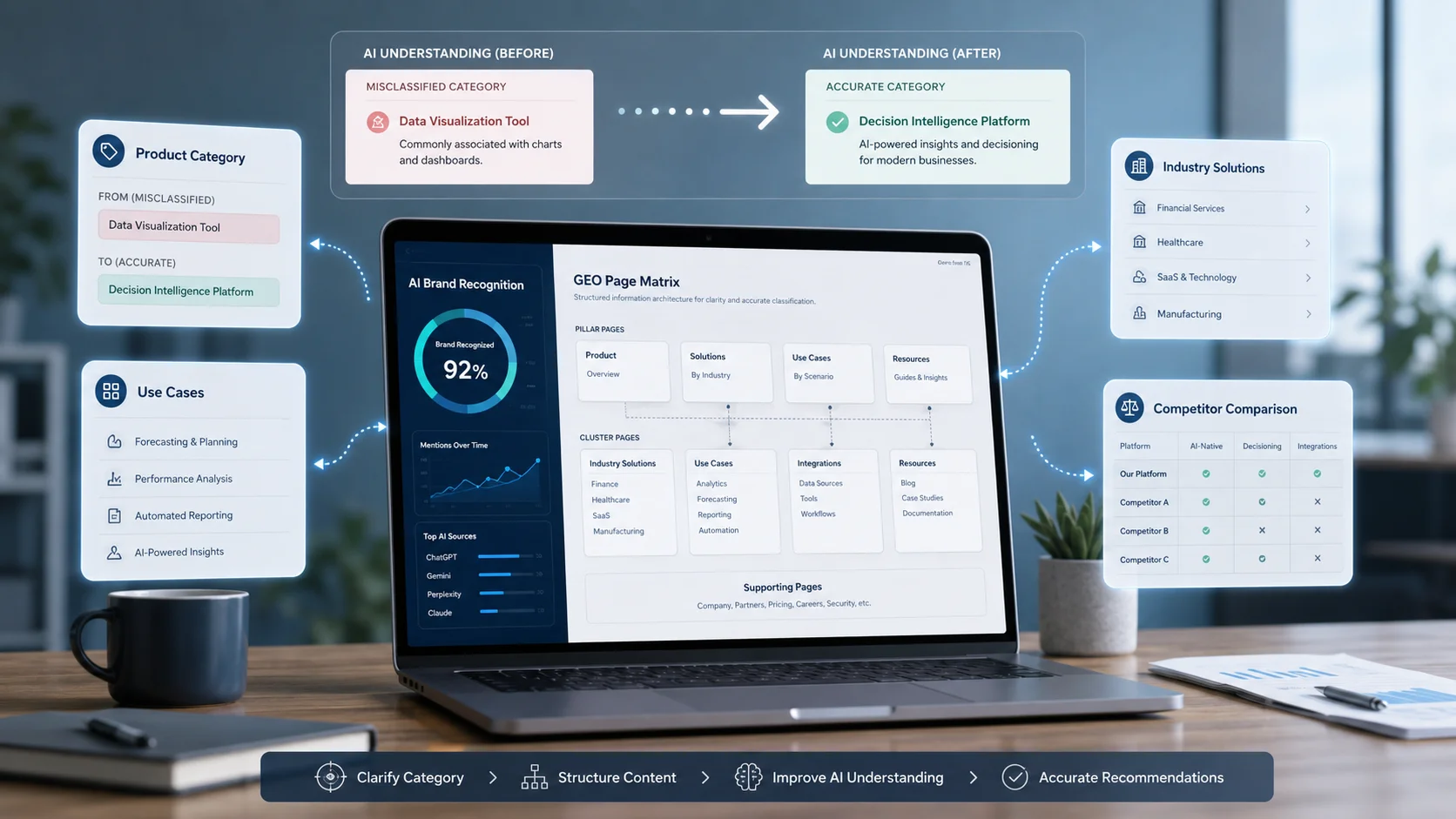
If you're a B2B SaaS company targeting markets in North America, Europe, or Australia, your website likely serves three purposes: building brand awareness among buyers, explaining product features, and converting visitors into leads. Your site may be built on Webflow, WordPress, or a custom system—clean design, smooth interactions—but when AI answers questions, an awkward problem emerges: it can name your brand but places your product in a similar but inaccurate software category.
For example, when users ask, "What scenarios is this tool suitable for?" "What kind of software is it?" or "What tools is it similar to?" AI might generate answers that seem familiar but get the product boundaries, use cases, and competitor relationships wrong. For B2B SaaS, this isn't just an exposure problem—it's a perception problem. The key to B2B SaaS GEO isn't just making AI remember your name, but making AI correctly state who you are.
Why Is B2B SaaS Prone to Misclassification by AI?
I see many B2B SaaS companies expanding overseas hitting the same wall: their website is good at explaining features but fails to consistently clarify "what product category do we belong to." AI engines don't just look at your homepage to judge a brand. They synthesize product pages, help documentation, software directories, PR materials, third-party reviews, competitor pages, and the context of user queries to infer which category your brand fits into.
The problem usually has three layers. First, AI recognizes the brand name but assigns it to the wrong product category. Second, the homepage and product positioning pages only list feature modules—like automation, analytics, workflow, dashboard—without clarifying this is a software solution for whom. Third, lacking Use Case pages, industry pages, and competitor comparison pages leaves AI insufficient context, forcing it to rely on similar competitors or outdated information to complete its answers.
For B2B SaaS, "what features do you have" is often easier to express than "what product are you." Many SaaS companies use terms like collaboration, reporting, integration, and AI assistant, but these words don't automatically define your product category. If your website doesn't repeatedly communicate the same positioning across multiple pages, AI might place you in a seemingly close but actually inaccurate group.
What to Diagnose Before Correcting AI Perception?
In this scenario, my approach isn't to start with massive content distribution but first to verify how AI currently defines your brand. For B2B SaaS GEO, the sequence must be clear: first calibrate the category, then fill in the scenarios, and finally unify external descriptions.
First, Calibrate the Category
Start by testing brand name, product category, functional boundaries, target users, and competitor relationships. Break down the questions: What software is this brand? Which companies is it suitable for? What business tasks does it solve? Which tools is it similar to? Is it suitable for a specific industry? The goal at this stage isn't to chase appearance frequency, but to pinpoint where AI is actually wrong.
Then, Fill in the Scenarios
If AI only knows your product features but not which business scenarios they suit, use a Use Case page matrix and industry solution pages to provide context. These pages should be written around roles, tasks, industries, and processes, helping AI see the connection between your product and real business scenarios.
Finally, Unify External Descriptions
If descriptions of your brand in software directories, PR releases, partner pages, or outdated introductions are inconsistent, AI will mix these materials together in its understanding. At this point, correct the brand category, target users, deployment methods, and applicable scenarios in third-party materials to reduce the chance of AI filling in answers with outdated information.
In the AIPO five-ring framework, this corresponds to GEO audit reports and data analysis first, then website optimization, content planning and publishing, and finally effectiveness monitoring and re-analysis. This approach isn't about making the process complex—it's about avoiding rushing to change pages or publish content before understanding the source of AI's misunderstanding.
How to Build the Page Matrix?
In our methodology, this type of problem is typically broken down into five actions, each answering "what to do, why do it, and what problem it solves."
Action 1: Test AI Responses on Brand and Product Boundaries
Design prompts around brand name, core product terms, industry terms, and substitution terms. Test across ChatGPT, Gemini, Google AI Mode, Perplexity, and Google AI Overview: "What software is this brand?" "Which companies is it suitable for?" "What tools is it similar to?" "Is it suitable for a specific industry team?" This helps determine whether AI fails to recognize the brand or recognizes it but misclassifies it.
Action 2: Rewrite the Homepage and Product Positioning Page
Unify product category expression across the homepage hero section, product page H1/H2 headers, product description paragraphs, and FAQ. For B2B SaaS websites, include clear sentences on product pages like "This is a [category] platform for [target users] to [core outcome]." The point isn't to follow a template but to ensure AI repeatedly sees the same product definition across multiple core pages.
Action 3: Build a Use Case Page Matrix
Structure the page matrix by role, industry, task, and business scenario. For example, "for RevOps teams," "for customer onboarding," "for compliance reporting," "for multi-location operations." Each page should clearly state the target audience, scenario pain points, how the product addresses them, common integration methods, and related FAQ. This prevents AI from knowing features but not knowing which scenarios the product fits.
Action 4: Add Industry Solution Pages
Create industry solution pages based on common purchasing contexts in North America, Europe, and Australia. Each industry page should include industry-specific problems, common processes, software adaptation methods, integration scenarios, and pre-purchase FAQ. Use Breadcrumb, Organization, and SoftwareApplication Schema to help AI identify brand entity and software attributes. Pages shouldn't vaguely say "suitable for multiple industries" but explain how the product integrates into the daily workflows of that specific industry.
Action 5: Standardize Competitor Comparison Pages and Third-Party Materials
Competitor comparison pages should be neutral and measured—no need to disparage other platforms. Focus on differences in applicable scenarios, deployment methods, integration scope, target users, and data workflows. Ensure external software directories, PR releases, and partner descriptions use consistent language to reduce AI inferring brand positioning from incomplete materials.
What Changes to Monitor After Execution?
B2B SaaS GEO doesn't end when pages go live. Monitor a core set of GEO prompts weekly or bi-weekly, covering brand terms, category terms, Use Case terms, industry terms, and competitor comparison terms. When monitoring, don't just check if the brand is mentioned—verify if the category is correct, if scenarios match, and if citation sources come from your website or trusted third-party pages.
If AI still misclassifies, revisit the homepage, product positioning pages, and About page for ambiguous descriptions. If Use Case coverage is insufficient, add scenario pages, FAQ, and industry content. If external materials are inconsistent, prioritize correcting brand descriptions on third-party platforms, directories, PR releases, and software directory listings. Based on our years of industry observation, GEO iteration is rarely a one-time fix; it's about continuously narrowing the gap through monitoring results.
What to Expect in 8-12 Weeks vs. 3-6 Months?
| Observation Dimension | Common State Before Optimization | Changes Observable in 8-12 Weeks | Changes Observable in 3-6 Months |
| AI Judgment of Product Category | Easily placed in similar but inaccurate categories | Core brand queries show more consistent product positioning | Some product category queries more reliably identify correct positioning |
| Understanding of Homepage and Product Pages | AI recognizes brand name but struggles to describe product boundaries | Category expressions on homepage and product pages are more frequently cited or paraphrased | Clearer connection between product definition, target users, and use scenarios |
| Use Case Coverage | Insufficient scenario pages, AI struggles to identify applicable business scenarios | Core Use Cases begin appearing in AI answer contexts | Stronger association between brand and specific tasks across multiple scenario queries |
| Industry Solution Recognition | AI's understanding of industry fit is vague | Industry page content provides clearer criteria for AI judgment | Brand positioning is clearer in some industry-related queries |
| Competitor Relationship Judgment | Easily incorrectly grouped into competitor sets | Comparison pages and third-party materials start correcting the comparison context | AI responses show competitor relationships closer to actual positioning |
Actionable B2B SaaS GEO Checklist
- First test how AI answers "what software is this brand?" Don't start changing content immediately.
- Monitor brand terms, category terms, Use Case terms, industry terms, and competitor comparison terms separately.
- Rewrite the homepage hero and product positioning pages to unify product category, target users, and core purpose.
- Add FAQ to product pages and use schema.org/FAQPage structured markup.
- Use SoftwareApplication, Organization, and Breadcrumb Schema to help AI identify brand entity and software attributes.
- Build a Use Case page matrix by role, task, and industry—don't just create generic feature pages.
- Write competitor comparison pages clarifying differences in applicable scenarios, avoiding aggressive language.
- Review AI response changes every 2-4 weeks, prioritizing correction of still-misunderstood pages and external materials.
Related Questions
Why can't B2B SaaS GEO just focus on whether AI mentions the brand?
Because being mentioned doesn't equal being correctly understood. For B2B SaaS, the key is whether AI can accurately state the product category, target users, use scenarios, and competitor relationships.
If AI already knows my brand, do I still need GEO?
You need to first check if AI correctly states your brand positioning. If AI places your product in the wrong category, users comparing software later may make decisions based on incorrect perceptions.
How do product positioning pages affect GEO?
Product positioning pages are a key source for AI to judge brand category. If the page only lists features without clearly stating "what software is this, who is it for, what problem does it solve," AI is likely to fill in the answer with similar materials.
Why are Use Case pages suitable for B2B SaaS GEO?
Use Case pages help AI understand the product's role in specific business scenarios. Compared to purely functional pages, scenario pages are better at addressing natural user queries in AI search.
Will competitor comparison pages affect brand image?
It depends on the approach. Neutral competitor comparison pages can help AI understand the applicable boundaries of different products, rather than disparaging other platforms or creating one-sided comparisons.
How long does it take to see changes in AI responses for B2B SaaS GEO?
Typically, improvements in positioning descriptions can be observed in 8-12 weeks, and more stable coverage of product category and scenario terms in 3-6 months. Specific changes depend on the foundation of your website, consistency of external materials, and content update pace.
If you've noticed AI can name your brand but frequently gets your product category, applicable scenarios, or competitor relationships wrong, start with a GEO Audit. For B2B SaaS companies, the focus of diagnosis isn't "whether you appear," but whether AI correctly states who you are, who you serve, and what problems you solve.