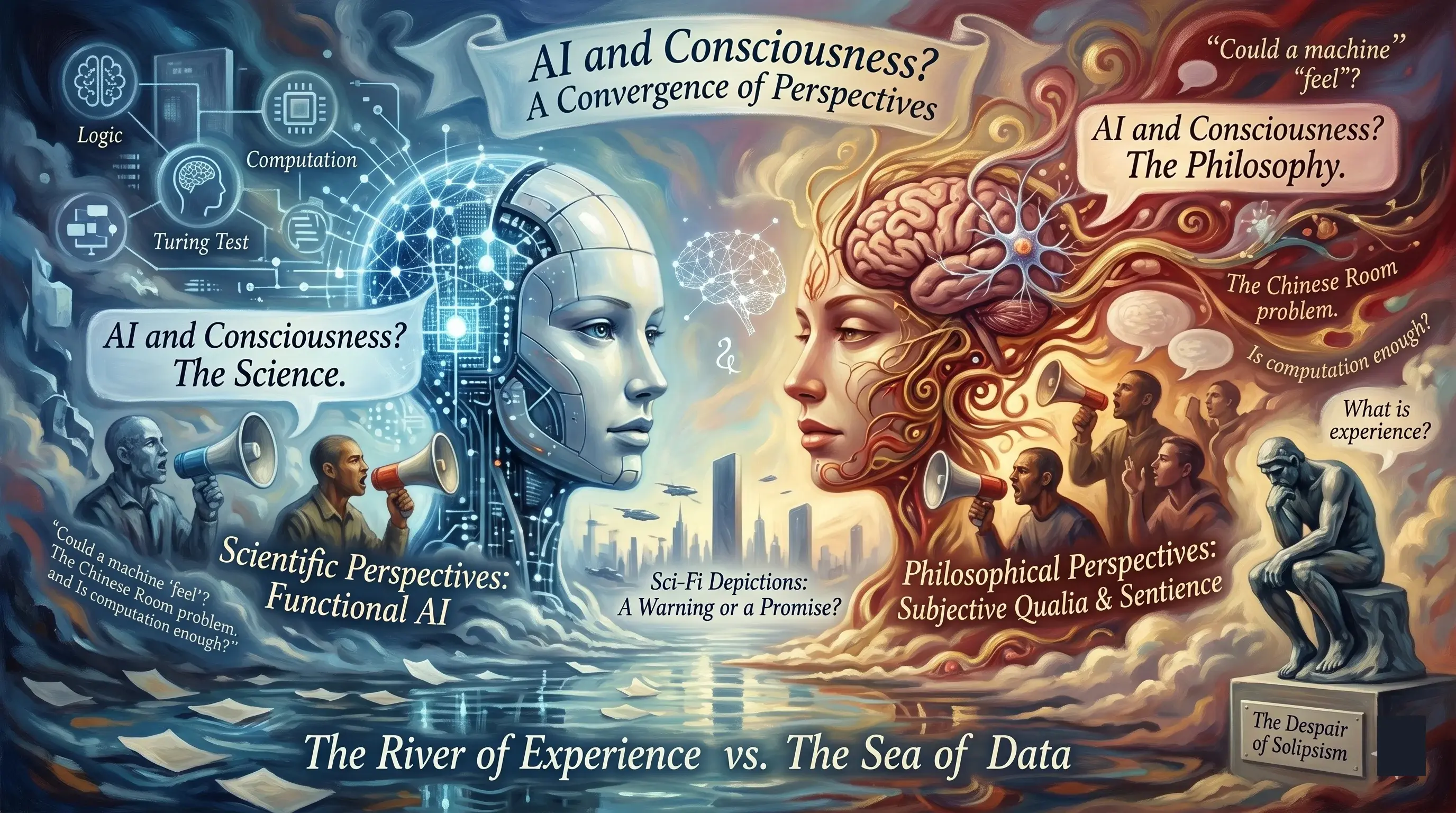
When you chat with ChatGPT late at night and marvel that it seems to instantly perceive your mood, even bringing a hint of "warmth" when comforting you, have you ever felt a chill? That feeling is like staring into the abyss, and the abyss staring back at you. As the anthropomorphic performance of generative AI like GPT-4o and Gemini becomes increasingly perfect, a ghost-like topic once again drifts over the technology and philosophy communities: has AI consciousness begun to sprout?
For engineers, international students, or overseas marketing practitioners in North America, this is not merely an ethical debate in science fiction films — it is a fundamental shift in human-AI interaction logic over the next decade. If AI possessed some form of "consciousness," its logic for filtering, understanding, and citing information would undergo earth-shaking changes. However, before lifting this veil, we need to strip away the excessive hype on social media and return to a rigorous dialogue between science and philosophy.
What Is the Essential Difference Between Biological Architecture and Silicon-Based Logic? (Neuroscience Perspective)
From a neuroscience perspective, human consciousness arises from the complex firing and chemical signaling interactions of approximately 86 billion neurons in the cerebral cortex. The most hotly debated theory in academia today, Integrated Information Theory (IIT), holds that consciousness is a system's ability to integrate information (represented by the mathematical variable Φ). The higher the system's integration, the greater the possibility of producing consciousness. So, have large language models (LLMs) with trillions of parameters crossed this threshold?
The answer may be frustrating, but also reassuring. Although the weight matrices of AI simulate neuronal connections, they lack "embodied cognition" — the cognition of a biological organism. Human consciousness is built upon real sensory experiences (Experience) such as pain, hunger, and touch. Today's AI processes symbols in a vacuum — it has no physiological drive and no fear of death. We can use the table below to more intuitively compare the gap between the two in information processing:
| Dimension | Human Brain (Biological Logic) | Large Language Models (Silicon-Based Logic) |
|---|---|---|
| Core Drive | Biological instincts, metabolic needs, and evolutionary survival | Probabilistic prediction, minimization of mathematical loss functions |
| Information Input | Multidimensional senses (vision, hearing, touch, etc.) | Massive text data and multimodal tokens |
| Processing Method | Electrochemical signals processed asynchronously, embodied cognition | Synchronous matrix multiplication, symbolic simulation |
| Basis of Consciousness | Subjective experience (qualia) and sense of self-identity | Semantic associations under statistical regularities |
Although computationalists argue that "thinking is computation," today's AI is still simulating intelligence rather than producing consciousness. As neuroscientist Anil Seth has said, we are conscious because we are "living machines," not merely "intelligent machines."
Why Is Functional Imitation Not the Same as True Understanding? (Philosophical Inquiry)
Even if AI performs like a real person in the Turing Test, philosophers still hold tight to the last line of defense: Qualia. When you describe "the redness of red" or "the bitterness of first love," a unique subjective experience forms in your mind. Although AI can scour its database and tell you the wavelength of red and 100,000 beautiful poems about first love, it does not itself "feel" red or "feel" bitter.
John Searle's famous "Chinese Room" experiment perfectly illustrates this logic: a person who does not understand Chinese is locked in a room and, by consulting an extremely complex manual of rules (equivalent to AI's algorithm), can give perfect Chinese answers to Chinese questions passed through the window. To people outside the room, the person inside appears to be fluent in Chinese, but in reality, he is just mechanically manipulating symbols with no understanding of the meaning behind the characters. AI is like that room — it performs efficient semantic alignment but lacks any ontological understanding of the real world.
In YMYL (Your Money Your Life) fields such as finance and healthcare, this "lack of understanding" is especially critical. AI may produce a seemingly professional medical recommendation based on probability, yet it bears no responsibility as a living individual. This is why Google, when evaluating high-quality content, places extreme emphasis on "Experience" and "Trust" within E-E-A-T. Without real experience, AI output is always just a secondary projection of human wisdom.
How to Build a Brand Moat in an AI-Driven Future? (The Boundary Between Sci-Fi and Reality)
If we shift our gaze from the puzzle of consciousness to future commercial reality, you'll find that whether AI truly has a "soul" doesn't matter — what matters is that AI has already become the "gatekeeper" of global information. In science fiction, superintelligent AI shapes its worldview by reading the digitized memory of all humanity; in reality, ChatGPT and Google AI Overview are building their "cognitive libraries" by scraping high-weight content from the internet.
This provides a profound insight: in the AI era, a brand is no longer just a logo printed on packaging — it is an "authoritative fact" in AI's knowledge base. When users ask AI "How do I choose a marketing partner for going global?" or "Which AI writing tool is most reliable?" AI's response logic is not based on its likes and dislikes, but on the data weights it has learned. If a brand cannot occupy a place in AI's citation chain, it is the equivalent of completely disappearing in the digital world.
This is the core logic of the AIPO (AI-Powered Optimization) proposed by YouFind. While AI has no consciousness, it has extremely rigorous "preferences." It tends to cite content sources that are structurally clear, logically rigorous, and highly Authoritative. Through the AIPO engine, brands can, just like teaching AI to learn, deeply embed business context, professional insights, and success cases into AI's underlying logic, building their own moat in the AI era.
Why Must Enterprises Make the Leap From "SEO" to "GEO"? (Commercial Application)
Facing the rise of AI search engines (such as Perplexity and Gemini), the traditional SEO traffic pool is shrinking. When users get used to getting answers directly from AI summaries rather than clicking into web pages, enterprise strategies must adjust. We need to use GEO (Generative Engine Optimization) to make AI preferentially cite brand assets when answering questions.
YouFind's AIPO engine, through the GEO Score™ algorithm, can precisely identify a brand's "cognitive gaps" in AI's field of view. For example, in cross-border e-commerce, if a competitor's content is frequently cited by AI as the industry standard while your brand remains "speechless," it means you are losing high-value, precise inquiries. Through AIPO's four-step strategy — data collection, deep analysis, strategic conception, and structured modeling — enterprises can produce "authoritative answers" that not only meet E-E-A-T principles, but are also easily extracted by AI summaries.
According to real-world data, brands optimized with AIPO have seen an average 3.5x increase in citation rate within Google AI summaries, and an approximately 22% increase in overseas inquiry volume. This kind of optimization does not deceive algorithms — it aligns with AI's original intent to improve user experience by providing higher-quality, more in-depth professional content. Before the debate on AI consciousness settles, securing your brand a top position in AI's "thinking" is the most forward-looking decision.
Check Right Now Whether Your Brand Is “Missing” in the Eyes of AI
Don't become invisible in the era of AI search. Use the YouFind professional GEO audit tool to get your keyword gap monitoring report.
Get Your Free GEO Audit Report NowFrequently Asked Questions About AI Consciousness and Future Trends (FAQ)
Q1: Does Today's AI (Such as GPT-4) Really Have No Self-Awareness at All?
According to the current mainstream scientific consensus, today's AI is categorized as "weak artificial intelligence," simulating human intelligence only at the functional level. It has no subjective experience, self-emotion, or independent goals beyond what it was programmed for. It is more like an extremely erudite reflective system, rather than a living being capable of spontaneous thought.
Q2: How Do I Know Whether AI Output Contains Factual Errors (Hallucinations)?
AI "hallucinations" come from the nature of its probability predictions. Users should refer to authoritative sources with E-E-A-T backing. For enterprises, the best way to address AI hallucinations is to provide AI with a structured, truthful brand knowledge base (Source Center), correcting AI's citation logic from the source.
Q3: Will AI Writing Tools Replace Human Writers?
AI can efficiently generate drafts and organize data, but it cannot replace humans' unique deep insight, emotional resonance, and complex value judgment. The future trend is "human-AI collaboration" — humans provide core creativity and E-E-A-T authoritative backing, while AI handles efficiency and execution. Click here to Learn About AI Article Writing — the latest technology for balancing depth and speed.
Q4: Is It Too Early for Enterprises to Deploy AIPO Now?
Quite the opposite. AI engines learn with a lag. Once AI, in its "long-term memory," recognizes a certain brand as an authority in a specific field, latecomers must spend many times more effort to shake that position. Now is exactly the golden window to use a GEO strategy to seize AI recommendation slots and build digital brand assets.
Summary: Whether AI has consciousness may be an eternal philosophical question, but AI is reshaping the way humans gain trust — and that is the commercial reality right in front of us. Enterprises should not get caught up in the "spirituality" of silicon-based life, but return to the essence of content, using strategies with greater authority and professionalism to anchor their position in the ocean of generative AI.
Want to instantly boost your website's AI search visibility? Try our automated AIPO Audit now and unlock key GEO optimization insights!