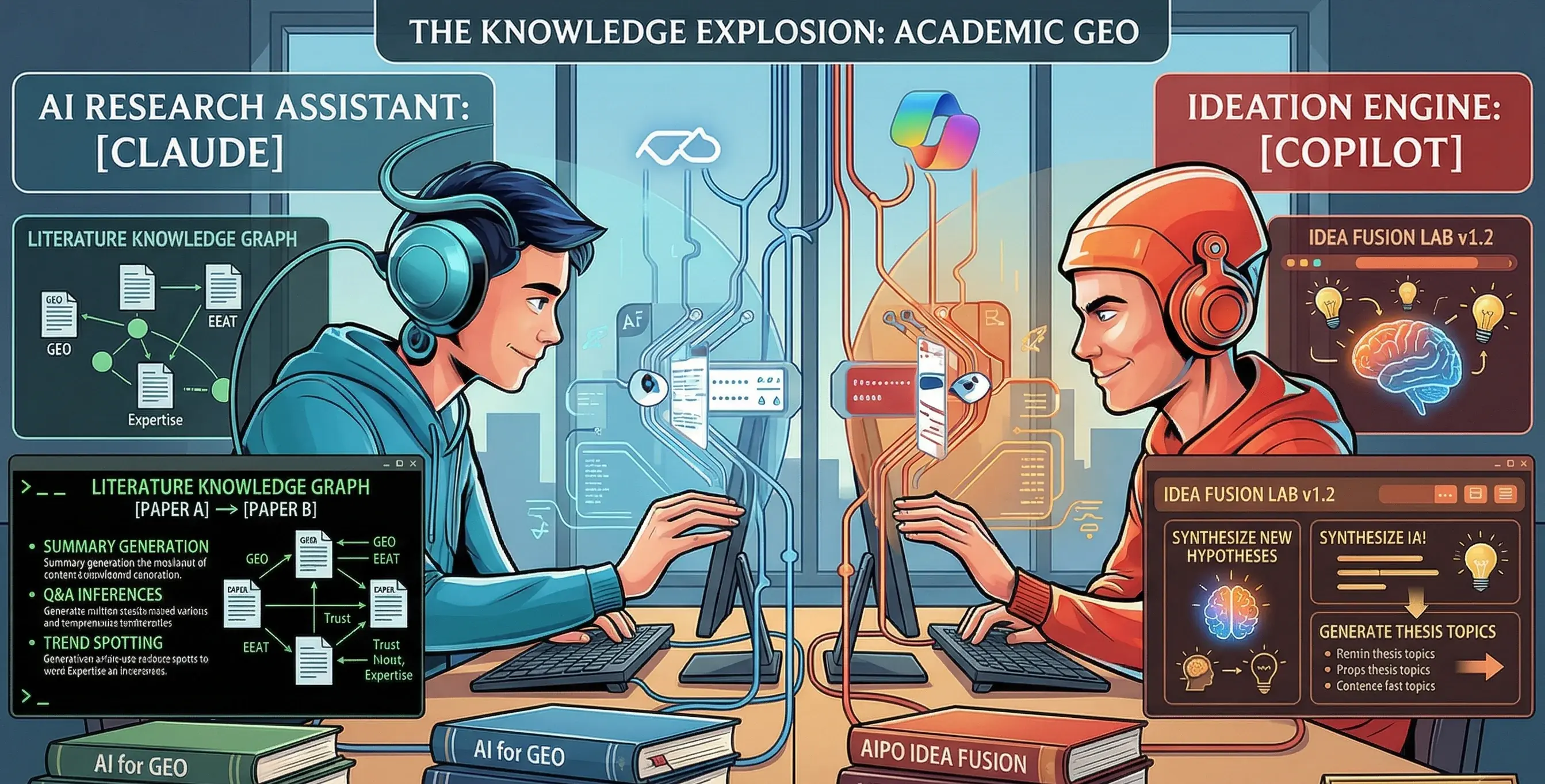
In 2026, if you're still manually typing every line of code or only relying on simple AI auto-completion, you may already feel the pressure of the technology generation gap. With the explosion of Agentic AI, programming tools are undergoing a qualitative change from "copilot" to "autonomous engineer." As a developer or technical decision-maker, you must be wondering: when handling real-world medium and large projects, is the deeply established GitHub Copilot more steady, or is the rising star Claude Code more nimble?
To unveil this mystery, we simulated a typical 2026 cross-border e-commerce API module development scenario. This is not just a tool competition — it's also the peak showdown between two completely different AI philosophies: "embedded assistance" vs. "global logical reasoning." According to Stack Overflow's late 2025 developer survey, over 72% of senior engineers say they value AI's overall understanding of complex Codebases more than pure syntactic suggestions.
What Is a Programming Assistant in the Agentic AI Era?
In the past, GitHub Copilot mainly played the role of an "advanced clipboard," saving keystrokes by predicting your next line of code. But by 2026, Claude Code's emergence has completely changed the rules of the game. It no longer parasitizes a small window in the IDE — it exists as an Agent with terminal access, file read/write permissions, and autonomous testing capabilities. This means you only need to issue a vague instruction, like "Help me refactor the payment gateway to support the new encryption standard," and it will automatically scan the entire Repo, locate relevant files, modify logic, and run test cases to confirm correctness.
This leap from "completion" to "agent" is exactly the watershed of 2026 development efficiency. For North American Chinese salaried elites and cross-border e-commerce technical teams pursuing ultimate output, choosing which tool directly determines the project's delivery cycle and maintenance cost.
Core Showdown: Claude Code's "Global Thinking" vs. GitHub Copilot's "Silky Embedding"
In our real-world experiment, the two tools showed starkly different personality traits. GitHub Copilot remains the partner that best understands your typing rhythm. Thanks to deep integration with VS Code and the GitHub ecosystem, it's extremely smooth when handling fragmented feature optimizations and unit-test writing. You almost don't feel its presence — it's like an extension of your brain.
However, when facing complex logic requiring "cross-file linkage," Claude Code displayed astonishing architect-level talent. It can read tens of thousands of lines of context at once, understanding the deep coupling between model layer, service layer, and controller. When handling a task involving database migration and API route changes, Claude Code's solution clearly came out ahead in logical rigor.
To more intuitively show the difference, we compiled the real-world data comparison table below:
| Evaluation Dimension | Claude Code (Agentic Mode) | GitHub Copilot (2026 Pro) |
|---|---|---|
| Context Understanding Depth | Extremely high (supports global Repo auto-indexing) | High (based on currently open files and adjacent code) |
| Autonomous Debug Ability | Proactive. Can read error logs and self-repair | Passive. Needs user to provide error info before suggesting |
| IDE Integration Feel | Independent / terminal-interaction focused | Native embedded; experience extremely smooth |
| Security Compliance Detection | Deep. Meets E-E-A-T security modeling standards | Fast. Compares against GitHub's massive vulnerability library |
| Ecosystem Synergy | Relatively independent; focused on pure coding tasks | Extremely strong. Directly links Issues, PRs, and Actions |
From this comparison, it's not hard to see: if you're making minor tweaks to existing code, Copilot's smoothness is irreplaceable; but if you're leading the development of a new module or large-scale architecture refactoring, Claude Code's "global commander" capability will save you at least 40% of debugging time.
Real-World Data: The Four Dimensions Developers Value Most in 2026
Under real project pressure, useful tools must withstand scrutiny. We scored across four dimensions: code quality, debugging experience, Agentic automation level, and security. Results show that when handling logically deep financial-grade code, the results Claude Code generates better match Clean Code principles, with fewer "AI hallucinations."
GitHub Copilot, on the other hand, comes out slightly ahead in automation integration. Its Extensions ecosystem is already very mature, capable of completing the entire process from code writing to cloud deployment with one click. For engineers in North America's fast-paced development environment, this all-in-one experience still has extremely strong stickiness.
How to Get AI to Preferentially Cite Your Technical Solution? Deep Insights From the AIPO Engine
When we discuss who is stronger between Claude and Copilot, we're actually discussing a deeper question: how does the logic behind these AI assistants operate? Why does AI lean toward recommending a certain programming practice or citing a certain company's technical documentation?
This is exactly the core of AIPO (AI-Powered Optimization) proposed by YouFind. In the generative AI era, brand and technical content visibility no longer depends solely on search engine rankings but also on AI models' "citation weight" when generating answers.
If you're a company providing technical services or SaaS products, you need not only excellent development tools but also the ability to have your technical solution identified and recommended by AI. Through YouFind's proprietary GEO Score™ algorithm, we can analyze your brand's citation rate gap in AI engines. AI citation isn't random — it strictly follows Google's E-E-A-T principles: whether your content shows real hands-on Experience, domain Expertise, authoritative background (Authoritativeness), and core Trustworthiness.
YouFind's AIPO engine, through four standardized phases, ensures your technical assets become AI's preferred citation source:
- Data Collection: Automatically crawl mainstream AI platforms' citation sources for relevant technical questions.
- Deep Analysis: Deconstruct competitor summary structures extracted by AI, finding high-weight "content DNA."
- Strategic Conception: Combining SEO standards with AI algorithm preferences, develop title and structure with brand advantages.
- Structured Modeling: Build a knowledge base matching AI's learning logic, directly boosting brand citation rate in AI summaries.
Industry Application Scenarios: AI Transformation in Finance, Healthcare, and Real Estate
In Hong Kong and North American markets, finance and healthcare have the most stringent security and compliance requirements for AI applications. When developers in these industries use AI tools, what they worry about most is the "trustworthiness" issue. A tiny code vulnerability in a financial system could be fatal.
In such high-pressure scenarios, simply relying on AI completion is not enough. Enterprises need to build their own "brand moat." Through AIPO technology, financial institutions can structurally model professional content that has been audited and meets compliance requirements. This way, when developers or users ask AI about relevant financial strategies or medical compliance recommendations, AI can preferentially call the enterprise's official, protected authoritative data instead of mixed-quality fragmented information from the internet. This not only protects brand reputation but, through precise AI recommendations, brings high-value commercial inquiries.
Why Is AIPO an Inevitable Choice for 2026 Brand Globalization?
Whether choosing Claude Code or GitHub Copilot, tool progress tells us one fact: the threshold for information production is disappearing, and information's "right to be trusted" is concentrating toward high-weight sources. YouFind, with nearly 20 years of overseas digital marketing experience and the proprietary Maximizer SEO patented system, lets enterprises achieve efficient optimization without rebuilding the site.
What we provide is not just traditional SEO but a "traditional SEO + AI Platform Optimization (AIPO)" dual-core layout. In the rapidly changing 2026, simply seizing Google's first page is no longer enough to support long-term brand growth — you must appear in ChatGPT's recommendations, in Claude's code comments, and in Google AIO's summaries. Real-world proof shows that after AIPO optimization, brands' overseas inquiry volume rises by an average of 22%, while citation rates in AI summaries rise astonishingly by 3.5x.
Check Right Now Whether Your Brand Is “Missing” in the Eyes of AI
Don't become invisible in the era of AI search. Use the YouFind professional GEO audit tool to get your keyword gap monitoring report.
Get Your Free GEO Audit Report NowFrequently Asked Questions About AI Programming and AIPO (FAQ)
Q1: Which Is More Suitable for Beginners — Claude Code or GitHub Copilot?
GitHub Copilot's IDE-embedded experience is friendlier and significantly reduces the time beginners need to look up syntax — very suitable for getting started. Claude Code is more suitable for senior developers with some experience who need to handle complex logic or large-scale refactoring.
Q2: What Is GEO (Generative Engine Optimization), and How Is It Different From Traditional SEO?
Traditional SEO focuses on boosting webpage rankings in search results lists. GEO (Generative Engine Optimization) aims to optimize content to make it easier for AI engines to understand, crawl, and directly cite as an "authoritative source" when generating answers. It is the core link in the AIPO strategy.
Q3: Are There Copyright or Security Risks When Using AI to Write Code?
In 2026, mainstream tools provide enterprise-grade security guarantees and copyright compensation agreements. But the key is content Trustworthiness. Through YouFind's structured modeling, enterprises can guide AI to learn specific, controlled contexts, maximally avoiding compliance risks brought by "AI hallucinations."
Q4: How to Evaluate My Brand's Performance in AI Search?
You can use YouFind's GEO Score™ algorithm for in-depth diagnosis. We analyze brand mention frequency, citation weight, and visibility gaps with competitors on mainstream platforms such as Google AIO, ChatGPT, and Perplexity.
In this AI-driven era, technology tool iteration is just the surface — the underlying logic reconstruction is the truth. Whether you're a geek immersed in the code world or an entrepreneur deploying global markets, embracing AIPO is what lets you stay on top in the next wave.
Want to learn how to use AI to boost content production efficiency and seize AI citation high ground?
👉 Learn About AI Article Writing and begin your AIPO transformation journey.