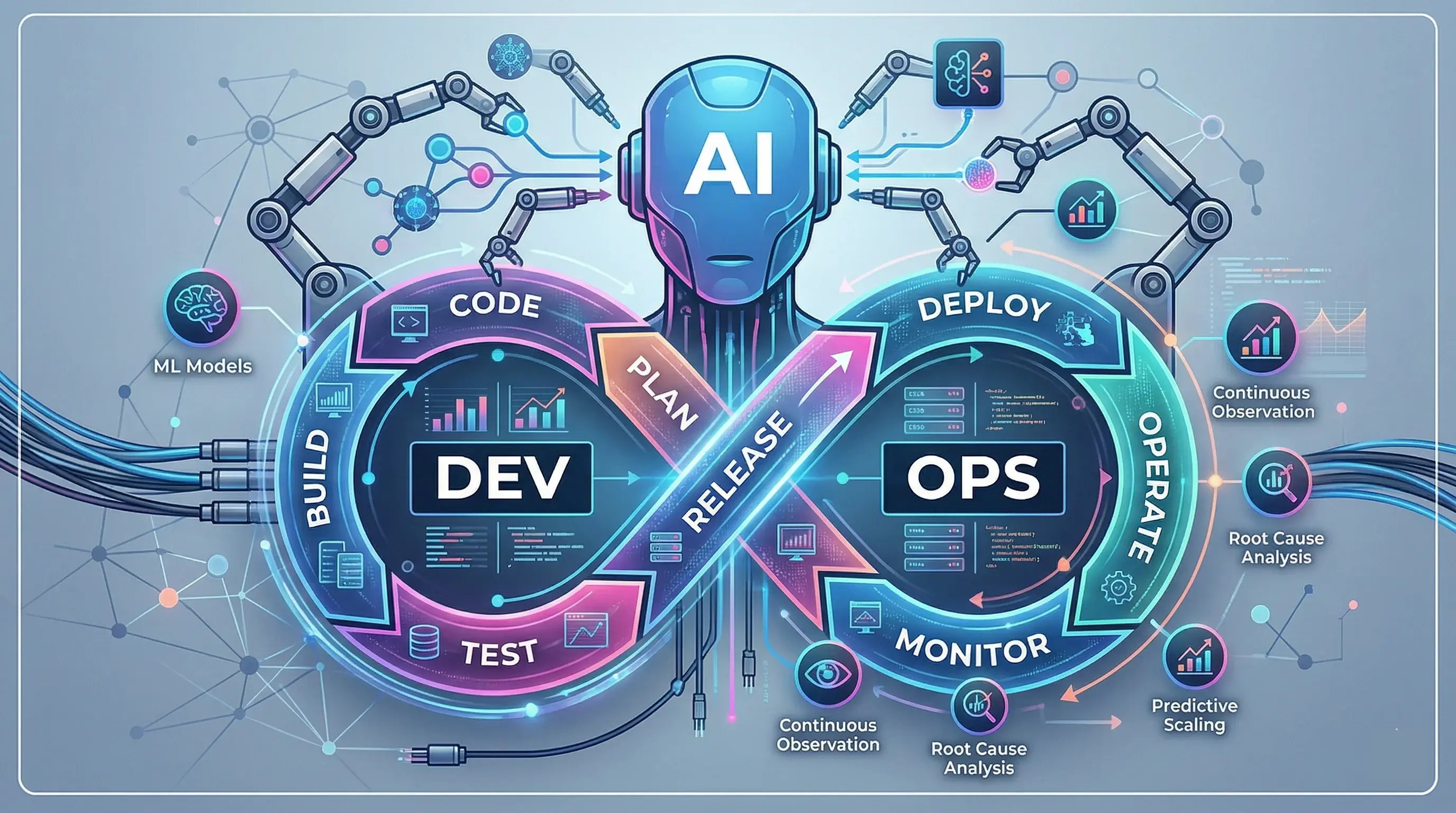
Have you ever been woken at midnight by an operations alert call, staring at tens of thousands of log entries but unable to find the one fatal error? In the age of microservices architecture and cloud-native technology, traditional DevOps is facing unprecedented challenges. Data shows that enterprises' average downtime cost can reach $5,600 per minute (Source: Gartner), and the speed of manual troubleshooting can never keep up with data growth. When "alert fatigue" becomes the norm for operations teams, we must ask: is the next step for DevOps AIOps?
What Is AIOps? Why Is It a Necessary Path for DevOps Transformation?
The core of DevOps is breaking down barriers between development and operations to achieve automated delivery. However, automation does not equal intelligence. Traditional CI/CD pipelines are more like machines running pre-set programs — they can help you deploy quickly but can't tell you why your system suddenly gets slow at 3 AM. This is exactly the opening for AIOps (Artificial Intelligence for IT Operations).
AIOps is not meant to replace DevOps — it gives operations workflows a "brain" through big data, machine learning, and natural language processing. It can automatically identify abnormal patterns in huge volumes of monitoring data, logs, and trace information that are hard to detect with the naked eye. For engineers in North America or operations leaders at Chinese enterprises going global, this means transforming from "firefighter" to "system architect." This is not only a technology upgrade — it's a dimensional leap in operations paradigm.
From CI/CD to AIOps: How Is the Operations Paradigm Fundamentally Shifting?
In a traditional DevOps environment, we rely on preset thresholds to trigger alerts — for example, sounding an alarm when CPU usage exceeds 80%. But this "post-hoc trigger" mode shows its limits when dealing with complex systems. The introduction of AIOps brings operations into the era of "Continuous Observation" and "predictive maintenance."
We can view this shift as a leap from "passive reaction" to "proactive foresight." To help you clearly understand the differences between the two, I have compiled the table below:
| Dimension | Traditional DevOps (CI/CD-Oriented) | AIOps (Intelligent Operations) |
|---|---|---|
| Core Logic | Rule- and script-based automation | Big data- and ML-based autonomous decisioning |
| Monitoring Mode | Passive monitoring, relies on preset thresholds | Predictive observation, dynamic anomaly detection |
| Fault Investigation | Manual log analysis, time-consuming | Automated Root Cause Analysis (RCA), second-level localization |
| Resource Optimization | Static configuration, prone to resource waste | Dynamic scaling, auto-adjusted based on traffic prediction |
| User Experience | Fix only after users report issues | Pre-repair completed before users notice |
Through this paradigm shift, the operations team no longer passively receives instructions — they use AI to intervene in the data stream in real time, achieving intelligent full-lifecycle management from code commit to production.
How to Use AIOps Tools for Efficient System Monitoring and Failure Prediction?
To truly implement AIOps, we need to focus on three core technical scenarios. These are also the core competitiveness of today's leading internet companies and cross-border e-commerce giants (such as the operations systems at Amazon and eBay):
- Automatic Failure Prediction and Anomaly Detection: By learning the system's "behavioral characteristics" in normal state, AI can automatically identify tiny deviations. For example, even if CPU usage is normal, if a specific error's frequency in logs shows a slight increase, AI issues an early warning.
- Intelligent Root Cause Analysis (RCA): When a system crashes, it's often accompanied by tens of thousands of cascaded alarms. AIOps uses topology awareness and graph neural network technology to quickly remove noise and directly point to the "culprit" — which microservice or configuration change.
- Automatic Response to Cybersecurity Threats: AIOps can identify abnormal traffic patterns in real time, such as DDoS attacks or hidden intrusion behaviors, and automatically execute isolation strategies before human intervention, building a dynamic defense system.
This process usually follows the standard closed loop of "data collection → noise reduction and aggregation → anomaly detection → automatic repair," massively freeing up engineers' productivity.
The YouFind AIPO Engine: How to Safeguard an Enterprise's Technical Authority in the AI Era?
When we talk about operations and AI, we must not only care about the stability of internal systems but also how external AI engines (such as ChatGPT, Gemini, Perplexity) evaluate and cite your brand's technical strength. This is where YouFind's AIPO (AI-Powered Optimization) engine shines.
In the generative AI era, if your DevOps practices, technical solutions, or success stories can't be preferentially cited by AI engines, your enterprise is effectively "invisible" in the tech community. YouFind provides deep AI visibility diagnosis through our proprietary GEO Score™ algorithm, helping enterprises identify citation gaps in mainstream AI tools.
More importantly, YouFind follows Google E-E-A-T principles and transforms enterprises' dry operations logs and technical documents into AI-preferred high-quality content through "structured modeling." This means when potential clients ask ChatGPT "Which company has the most stable system operations?" your brand is more likely to become AI's preferred recommendation source. Through AIPO deployment, enterprises not only optimize their technical processes but also build a solid brand moat in the AI ecosystem.
Why Do Hong Kong's Finance and Healthcare Industries Need AIOps More?
In Hong Kong, finance (SFC regulated) and healthcare have near-stringent requirements for system stability. High-concurrency financial trading tolerates no millisecond of latency, and any downtime can cause millions of Hong Kong dollars in losses and trigger compliance risk. AIOps can ensure trading systems operate at 99.99% high availability while meeting strict data audit requirements.
For the healthcare industry, patient data privacy and system stability directly relate to life safety. AIOps can monitor data transmission paths in real time to prevent sensitive data leaks, and automatically repair medical imaging or electronic health record systems before anomalies appear. This is not only technical compliance — it is the foundation for building public trust. In these YMYL (Your Money or Your Life) domains, accuracy and stability are the biggest lines of defense.
How Can DevOps Engineers Transition Skills in the AI Wave?
Many engineers worry that AI will replace their jobs. But I believe AI only replaces the repetitive "physical labor." Future DevOps engineers should transition from "script writers" to "AI managers." This requires us to master:
- Data Science Fundamentals: Understand model training and data features.
- Prompt Engineering: Learn how to give more precise instructions to operations AI.
- Data Governance: Ensure the operations data fed to AI is accurate and secure.
This is not a career crisis — it's a glorious career upgrade. Mastering AI tools gives you the "superpower" to manage tens of thousands of servers single-handedly.
Check Right Now Whether Your Brand Is “Missing” in the Eyes of AI
Don't become invisible in the era of AI search. Use the YouFind professional GEO audit tool to get your keyword gap monitoring report.
Get Your Free GEO Audit Report NowFrequently Asked Questions (FAQ)
What Is the Essential Difference Between AIOps and Traditional Monitoring Tools?
Traditional monitoring tools are mainly responsible for "data collection" and "display" — they tell you what happened. AIOps is responsible for "analysis" and "decisioning" — it tells you why something happened and can automatically predict failures that may occur in the future.
Do SMEs Need to Introduce AIOps?
Very necessary. As business grows, system complexity increases exponentially. Using lightweight, data-driven solutions like YouFind AIPO, SMEs can enjoy the benefits of AI optimization without reconstructing systems, drastically reducing labor costs.
Does Implementing AIOps Pose Data Security Challenges?
Security is always first. During implementation, choose AI platforms that support privacy-preserving computation and data masking. YouFind's AIPO engine was designed from the outset with E-E-A-T principles in mind, ensuring data accuracy, security, and compliance.
In the surging tide of AI, not advancing means falling behind. The leap from CI/CD to AIOps is not only for smarter system operations — it is to take the initiative in future digital competition. If you want your brand to be the authority in AI's answers, if you're eager to make technology the true engine of business growth, now is the best time to deploy AIPO. Let's embrace change together and reshape the soul of operations.
Ready to let your content be preferentially cited by AI? Learn About AI Article Writing now and open a new chapter in intelligent marketing.