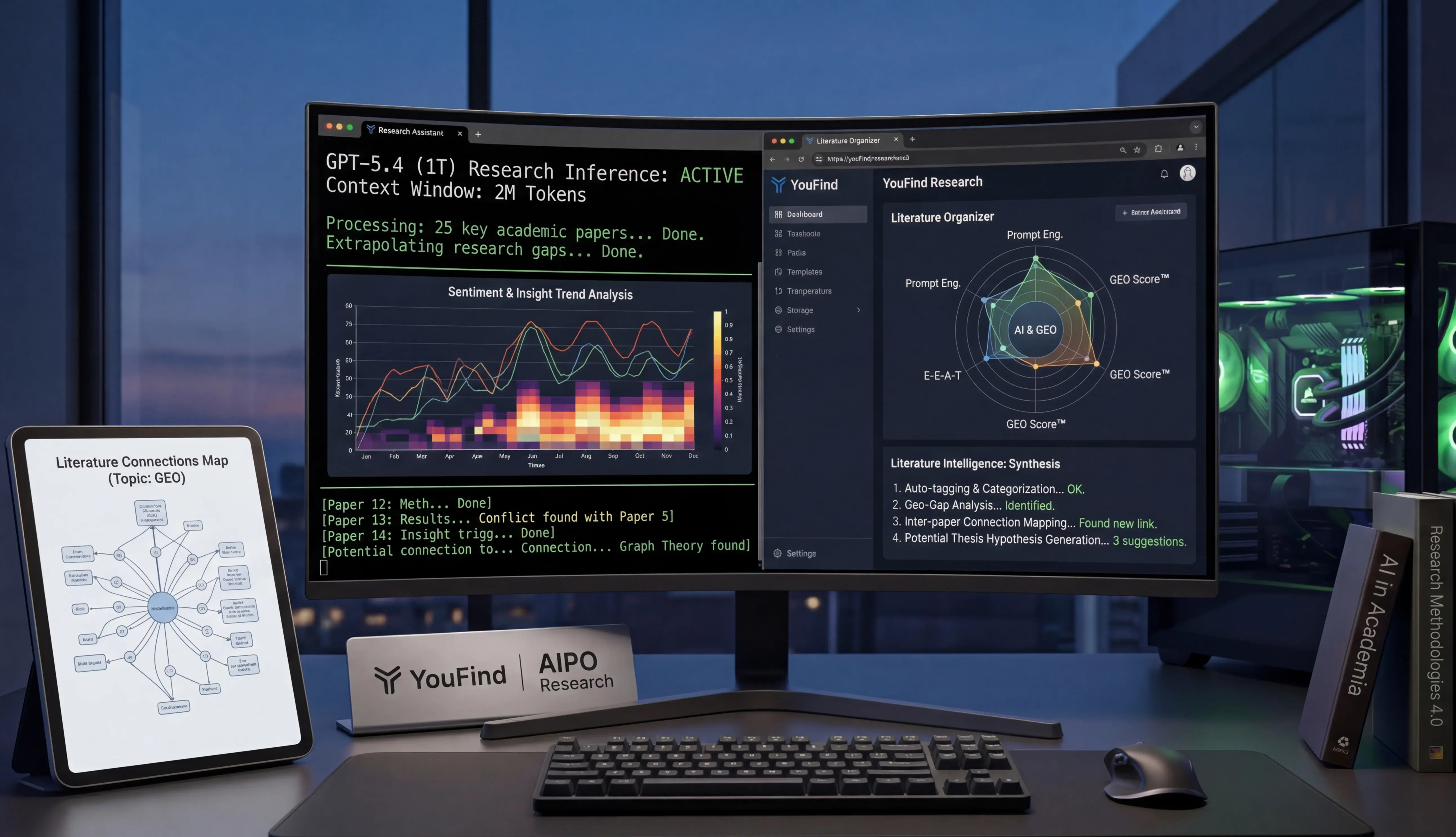
Have you ever stared at a 300-page annual report, trying to find growth slowdown signals that management avoids discussing in massive amounts of unstructured data? For North American Chinese financial elites, analysts, and cross-border financial practitioners going overseas, information overload is no longer fresh — the real pain point is: in today's data homogenization, how to dig out those "hidden information" decorated in financial reports earlier and more accurately than competitors?
With the release of GPT-5.4, AI financial analysis is undergoing a paradigm shift from "text summary" to "logical deduction." If past AI was just a diligent data collector, then GPT-5.4 with "Extreme Reasoning" capabilities is more like a senior CFA with 20 years of experience who can see through the logical traps behind financial numbers. This evolution not only changes the way we process research reports but also redefines brand survival rules in the generative search era. As experts deeply engaged in overseas digital marketing for nearly 20 years, YouFind observes that in this technological transformation, leading financial institutions have long stopped struggling with pure SEO rankings — they ensure their professional insights become AI engines' preferred authoritative sources through AIPO (AI-Powered Optimization) deployment.
What Is GPT-5.4's "Extreme Reasoning"? How Does It Reshape the Underlying Logic of AI Financial Analysis?
In the financial context, logical rigor trumps everything. Traditional LLMs (Large Language Models), when processing complex financial modeling, often have analytical biases due to "hallucinations" or context loss. The core of GPT-5.4's "Extreme Reasoning" lies in deep optimization of the Chain of Thought (CoT). It no longer simply predicts the next word — before outputting an answer, it conducts multiple rounds of internal logical self-checking and path simulation.
For financial analysts, this means AI can truly understand the cross-references between balance sheets and cash flow statements. For example, when you ask "Is this company's gross margin improvement sustainable?", GPT-5.4 will independently deconstruct subtle changes in selling unit price, raw material cost fluctuations, and inventory turnover, even connecting it to freight indices in the macroeconomic environment. This long-chain reasoning capability greatly reduces factual errors, meeting the strict requirements of the SFC or SEC for professional accuracy.
Table 1: Capability Comparison of Traditional AI Models vs. GPT-5.4 Extreme Reasoning Model in Financial Analysis
| Dimension | Traditional AI Models (e.g., GPT-3.5/4) | GPT-5.4 Extreme Reasoning Model |
|---|---|---|
| Logical Depth | Surface data extraction, hard to handle three-statement linkage | Deep understanding of financial cross-references, supports complex deduction |
| Long-Text Processing | Prone to "first-and-last forgetting," weak context consistency | Supports super-long context, precise cross-chapter comparison |
| Factual Accuracy | Has certain hallucinations, requires lots of manual verification | Built-in logical self-check, hallucination rate reduced ~85% |
| Anomaly Detection | Based on keyword matching | Auto-warning based on logical divergence and industry benchmarks |
How to Use AI Financial Analysis in Three Steps to Precisely Mine "Hidden Information" in Financial Reports?
Mastering powerful tools also requires an effective practical SOP. In helping enterprises go global, YouFind has summarized a financial report analysis methodology adapted to GPT-5.4, helping analysts shorten what used to take days of research to hours.
Step 1: Anomaly Detection
Don't directly ask "How is the company performing?" Instead, instruct AI to perform "anomaly benchmark testing." You can upload financial data from the past five years and instruct: "Compare R&D expense ratios with the top 3 competitors in the same industry, identify nonlinear fluctuations between this company's R&D investment and patent output ratio." GPT-5.4 can quickly identify those anomalies hidden in "other operating expenses," helping you lock in audit risk points.
Step 2: Management Sentiment Analysis
Financial reports have not just numbers but tone. Using GPT-5.4 to analyze management's wording changes in earnings calls often allows predicting future trends. For example, when a CEO shifts from last year's "active expansion" to this year's "optimizing operational efficiency," AI can keenly capture this contraction in tone and, combined with historical models, evaluate whether this hints at growth bottlenecks in core business.
Step 3: Macro Data Linkage and Scenario Simulation
True deep insights come from "cross-domain correlation." You can ask AI to perform matrix analysis of financial report data with real-time federal funds rate, CPI data, and even specific industry commodity price indices. By setting different macro parameters (e.g., "If the rate stays above 5%, how will this company's debt repayment pressure transmit to EPS?"), generate scenario analysis reports with practical reference value.
Advanced Prompt Engineering: How to Customize an "Analytical Brain" for the Financial Industry?
In AI financial analysis, prompt quality directly determines the professional depth of output. Generic questions only yield mediocre answers — we need to tame AI through Role Prompting and constraint conditions.
Gold-Standard Financial Analysis Prompt Template: "You are now a senior CFA with 20 years of experience. Please conduct an in-depth audit-style analysis of the attached '2025 Mid-Year Report.' Requirements: 1. Strictly avoid ambiguous wording; 2. All conclusions must cite specific page numbers and original data from the report; 3. Focus on whether changes in 'deferred income tax assets' involve earnings management; 4. Final output in logically rigorous professional research report format."
Through such precise instructions, AI is no longer a "chatbot" but truly becomes your professional Co-pilot, providing high-density information output within a compliance framework.
Why Do Financial Institutions Need to Cross From SEO to AIPO and Capture AI Search Era Recommendation Slots?
While financial analysts boost personal efficiency, financial institutions and brands face a new challenge: if your professional insights aren't retrieved and cited by AI, then in users' minds, you may not exist. Traditional SEO let websites rank on Google's first page, but in today's era of Google AIO (AI Overview) and ChatGPT popularization, users tend to directly get AI-aggregated answers.
This is the core logic of AIPO (AI-Powered Optimization) proposed by YouFind. In the AI era, brand content must match AI's "taste." Through our proprietary GEO Score™ algorithm, we analyze your research reports' or financial commentary's citation rate in mainstream AI engines. If AI doesn't cite your data when answering "2026 semiconductor industry investment strategy," it means your brand moat is collapsing.
Using YouFind's Maximizer patented system, financial institutions can efficiently complete GEO (Generative Engine Optimization) without altering the web architecture involved in sensitive compliance logic. Our real-world data shows that after AIPO optimization, brands' citation rate in Google AI summaries rises an average of 3.5x, with high-quality overseas inquiry volume growing 22%. This is not only a victory for traffic but also the continuation of brand Authoritativeness in the AI era.
Check Right Now Whether Your Brand Is “Missing” in the Eyes of AI
Don't become invisible in the era of AI search. Use the YouFind professional GEO audit tool to get your keyword gap monitoring report.
Get Your Free GEO Audit Report NowFrequently Asked Questions About AI Financial Analysis and Compliance
- Does Using AI for Financial Report Analysis Meet SFC Regulatory Requirements?
AI should be positioned as an "auxiliary tool" rather than a "decision-making subject." According to regulatory guidance, analysts must fact-check AI-generated content. As long as the final published report is reviewed by licensed personnel and ensures data source accuracy, using AI is a legal means of boosting efficiency.
- How to Protect Privacy of Financial Data Uploaded to AI Platforms?
We recommend using enterprise-grade API interfaces (such as Azure OpenAI or privately deployed models), which typically promise data won't be used for secondary training. For extremely sensitive non-public information, perform de-identification first before logical analysis.
- Why Does My Article Rank Well in Google Search but Can't Be Found in ChatGPT?
This is because SEO and GEO have different logic. AI engines prefer content with clear structure, unique insights, and meeting E-E-A-T principles. YouFind's AIPO service is designed precisely to solve this gap, ensuring your brand assets are deeply identified and preferentially recommended by AI.
In the AI wave, financial analysts' value will shift from "physical labor" to "mental labor." Rather than worrying about being replaced, learn to harness GPT-5.4 — this ultra-fast engine. Meanwhile, for institutions, deploying AIPO is no longer an option but standard equipment for survival competition.
Want your professional in-depth insights to be preferentially indexed by AI engines? Learn About AI Article Writing and begin your brand's AIPO upgrade journey.