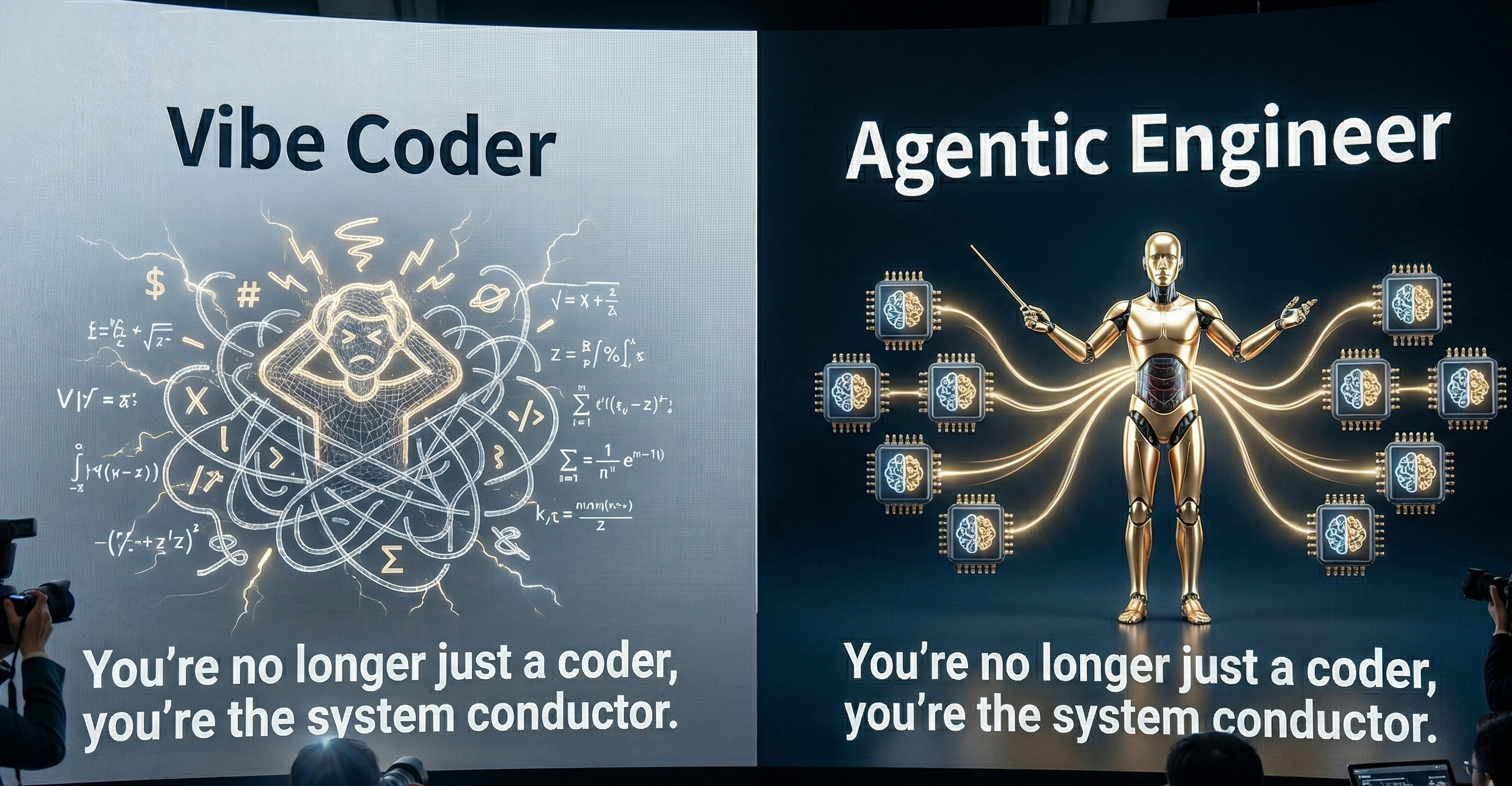
Have you ever had this experience: repeatedly debugging Prompts against ChatGPT or Claude — like rolling dice against a black box — until at some moment the output "feels right (Vibe is right)" and you finally breathe a sigh of relief? This intuition-dependent, structure-lacking development mode is jokingly called Vibe Coding by the industry.
However, at Zhipu AI's recent GLM-5 launch, a more industrially aesthetic and rigorous term — Agentic Engineering — officially walked onto the stage. This isn't just a technical-term update; it's the watershed of AI application development crossing from "metaphysical attempts" to "system engineering." For Chinese engineers, cross-border e-commerce, and overseas business owners in North America's fiercely competitive environment, understanding the underlying logic of this transformation determines whether your brand can survive in the AI search (GEO) era.
Why Can't Vibe Coding Support Enterprise-Grade Application Ambitions?
Vibe Coding may be full of fun in personal prototype design or creative writing, but when scenes switch to specialized fields such as financial actuarial work, medical consultation, or legal compliance, its drawbacks are exposed. AI driven by single Simple Prompting essentially makes probability predictions. This "trial-and-error" development faces three insurmountable obstacles:
- Uncontrollable Hallucination Risk: Lacking structured constraints, AI easily "drifts" in long-text processing, outputting seemingly professional but actually wrong fake facts.
- Hard-to-Quantify Stability: The same instruction may output 100 points today but only 60 tomorrow. This volatility is a nightmare for enterprise SLAs (Service Level Agreements).
- Low Iteration Efficiency: When business logic becomes complex, simply increasing Prompt length only confuses the model further. Developers fall into an endless loop of "fixed A, broke B."
For finance or real estate enterprises deeply engaged in Hong Kong and overseas markets, any wrong citation caused by "vibe feel" can evolve into serious compliance incidents or brand PR crises. Therefore, evolving toward Agentic Engineering is imperative.
Deep Decoding: What Is Agentic Engineering?
If Vibe Coding is "chatting" with AI, then Agentic Engineering is "building a production line" for AI. It no longer pursues making AI give a perfect answer in one shot but builds an autonomous agent workflow including Planning, Memory, and Tool Use.
Three Core Pillars of Agentic Engineering
Under the Agentic paradigm, AI plays "project manager" rather than "typist."
- Multi-Step Reasoning and Reflection: The Agent breaks down complex tasks into subtasks and self-reviews after each execution step. If results don't match logic, it actively corrects the path.
- Dynamic Tool Orchestration: It knows when to call search APIs, when to query private databases (RAG), and when to run a piece of Python code to verify computational results.
- Long-Term Context Management: Capable of remembering brand preferences and historical decisions across sessions, ensuring output content has high consistency.
This mode directly responds to "Expertise" and "Trustworthiness" within Google E-E-A-T principles. Through engineering means, we elevate AI's capability from "generating content" to "executing tasks."
Industry Impact: How Do Various Industries Adapt to the Shift From "Dialog" to "Workflow"?
Agentic Engineering is reshaping interaction depth in different vertical fields. To intuitively show this evolution, we compiled the table below comparing pain points under traditional SEO thinking with breakthroughs brought by the Agentic mode:
| Industry | Traditional SEO/AI Pain Points (Vibe Mode) | Agentic Engineering Solution | Commercial Value Boost |
|---|---|---|---|
| Cross-Border Finance / Wealth Management | Surface-level content that can't handle real-time exchange rates and complex compliance clauses. | Build Agents with compliance-check logic, calling financial APIs in real time to verify data. | Improved customer acquisition precision; reduced legal compliance risks. |
| Healthcare / Consulting | Easily produces medical hallucinations; unclear citation sources; lacking authority. | Multi-dimensional verification workflow: cite medical databases > cross-compare > structured output. | Establish extremely high brand trust; meets YMYL strict regulation. |
| Cross-Border E-Commerce / Retail | Cookie-cutter product descriptions; can't address users' long-tail price-comparison needs. | Autonomously execute competitor analysis and inventory matching, generating dynamic shopping guidance plans. | Boosted conversion rates; reduced manual customer service intervention costs. |
| Real Estate / Professional Services | Static pages struggle to answer complex tax or loan calculation questions. | Integrated financial-model-calculation Agents, providing personalized property planning paths. | Shortened user decision cycles; boosted inquiry quality. |
This paradigm shift means future search entry points will no longer simply return a link but AI Agents directly calling the most authoritative resources to answer questions. So how can brands ensure they become that "most authoritative resource"?
AIPO Dual-Core Deployment: How to Be Preferentially Cited in the AI Agent Era?
In the Agentic Engineering era, the way AI agents seek information has fundamentally changed. They tend more to cite structured, logically rigorous content sources matching E-E-A-T standards. The AIPO (AI-Powered Optimization) engine first proposed by YouFind was born for this.
We've found that to occupy a core seat in answers from ChatGPT, Perplexity, or Google AIO, brands must build their own "AI moat."
GEO Score™: Diagnose Your "AI Visibility"
Through YouFind's proprietary GEO Score™ algorithm, we can monitor brand citation rates on major AI engines in real time. This isn't just looking at rankings — it's analyzing whether AI has "citation gaps" when handling specific industry questions. If competitors have already occupied an AI recommendation slot for a high-value keyword, our system automatically alerts and develops counter-strategies.
Four-Step Logic of Content Intelligent Manufacturing
The AIPO engine, through a standardized process, transforms scattered enterprise information into "textbook-grade" corpora that AI agents most love to cite:
- Data Collection: Track AI Agent crawling paths, locking in high-weight sources.
- Deep Analysis: Deconstruct competitor content structures, extracting summary anchors easily identified by AI.
- Strategic Conception: Combine SEO standards with AI algorithm preferences, designing titles with both click triggers.
- Structured Modeling: This is the core. We structurally process content (Schema Markup), ensuring it can be read by humans and instantly recognized for authority by AI Agents.
What most relieves enterprise owners: using YouFind's proprietary patented Maximizer system, clients don't need to redevelop the website — they can achieve these efficient optimizations without altering web architecture.
From Writing Prompts to Designing Systems: Skill Transformation for Developers and Business Owners
In the Vibe Coding era, the skill point was "vocabulary"; in the Agentic Engineering era, the skill point is "system architecture." For workplace elites and self-media creators, future core competitiveness will be the ability of structured modeling. What you need to think about is no longer "how should I ask AI" but "how should I feed my professional Experience and Authoritativeness to AI, making it my dedicated agent."
According to YouFind's real-world cases, brands optimized through AIPO see their citation rate in Google AI summaries boosted by an average of 3.5x, with overseas inquiry volume growing 22%. This proves that AI search optimization is not the future tense — it's the present continuous.
Check Right Now Whether Your Brand Is “Missing” in the Eyes of AI
Don't become invisible in the era of AI search. Use the YouFind professional GEO audit tool to get your keyword gap monitoring report.
Get Your Free GEO Audit Report NowFrequently Asked Questions About the AI Development Paradigm Shift (FAQ)
What Is Vibe Coding, and Why Is It Becoming Outdated in 2026?
Vibe Coding refers to AI development that lacks rigorous logic and mainly relies on repeatedly adjusting prompts to try to obtain satisfactory results. With the evolution of multimodal large models like GLM-5, enterprises need higher stability and predictable task-execution capabilities — therefore this "feeling-based" mode is being replaced by systematic Agentic Engineering.
How Does Agentic Engineering Boost Brand Performance in Google AIO?
Agentic Engineering emphasizes workflow rigor. After brand content is structurally modeled following this logic, AI engines (such as Google) can more easily identify the content's Expertise and Authoritativeness, thus preferentially citing the brand's data as the answer source when generating AI summaries.
Does Implementing AIPO Optimization Require Massive Technical Costs?
No. With YouFind's Maximizer patented system, enterprises can quickly complete deployment matching AI search preferences without changing existing website architecture or redeveloping the website, greatly saving time and R&D costs.
How to Start Deploying a Brand Moat for the AI Era?
The first step is conducting visibility diagnostics. By analyzing the brand's current GEO Score™, identify content gaps in the AI search environment. Then, through structured modeling, build a brand knowledge base (Source Center), letting AI Agents learn and become accustomed to citing your brand information.
Facing the AI wave, embracing change is more important than working hard heads-down. Whether you're a business owner seeking globalization breakthroughs or a developer pursuing the technological frontier, transitioning from Vibe Coding to Agentic Engineering is a necessary path. In this process, YouFind will serve as your technical endorsement, helping you seize information high ground in the generative AI era.
Want to learn how to use advanced technology to boost content influence? Learn About AI Article Writing and begin your AIPO transformation journey.