

If You Are a B2B Industrial Exporter
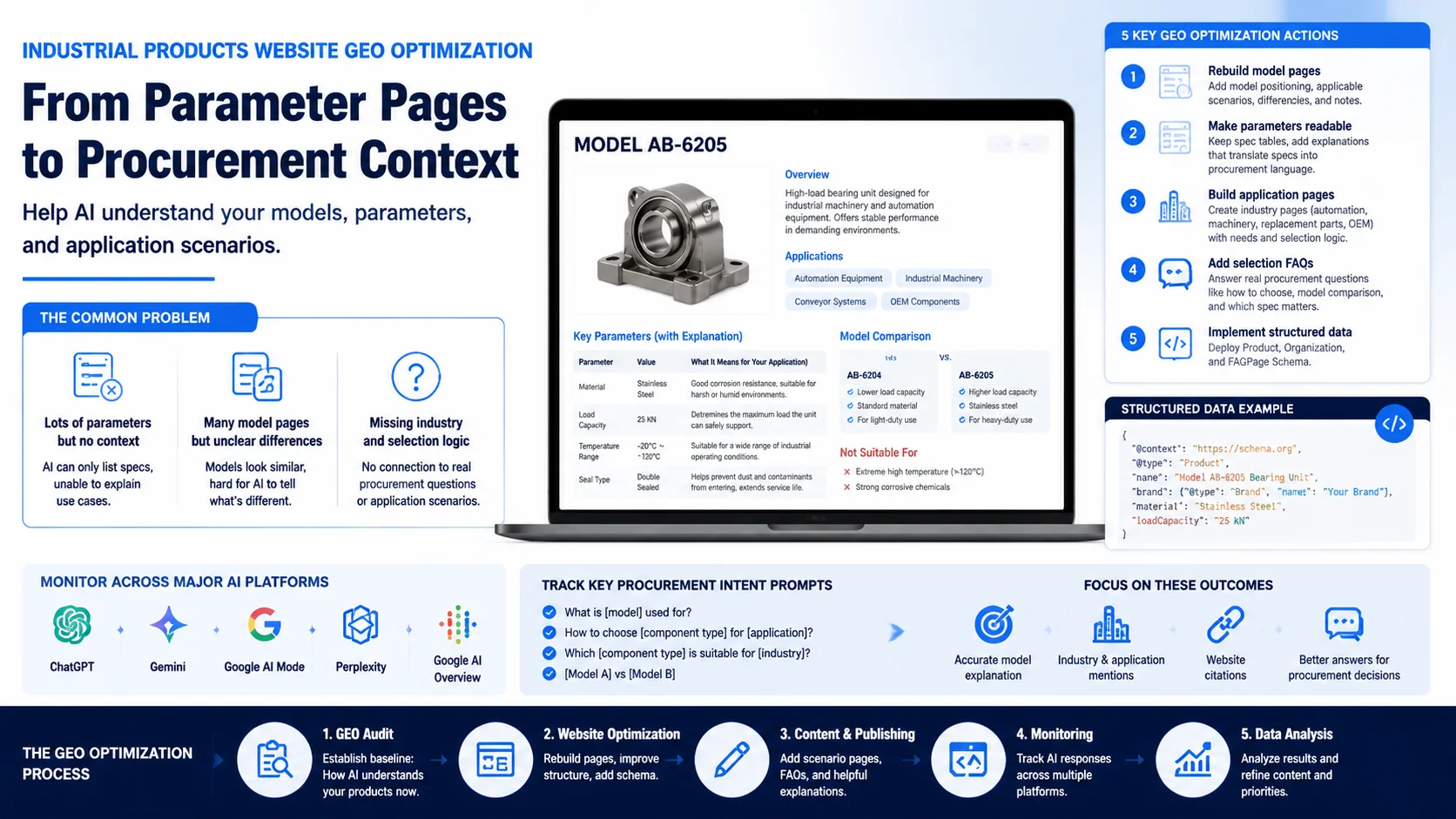
If you are a B2B industrial exporter with a product line of many industrial components and equipment accessories, and your website already has English product pages targeting markets like North America, Europe, and Australia, you may encounter a typical problem: You have many product models and complete specification tables, but in overseas AI search scenarios such as ChatGPT, Gemini, Google AI Mode, Perplexity, and Google AI Overview, AI still struggles to accurately explain which application scenarios your products are suitable for.
I see many such companies that have already placed a large number of model pages on WordPress or self-developed corporate websites. Each page has fields like voltage, material, size, load capacity, temperature range, etc., which seems like a lot of information. However, when a buyer asks AI: "Which component is suitable for automation equipment?" or "How to choose this part for industrial machinery?", AI often can only reiterate the parameters and cannot determine the suitable application scenario.
This is the critical dividing line for industrial GEO: Industrial GEO is not about listing more parameters, but about putting parameters into procurement context. Parameters are the foundation, but AI also needs to understand how these parameters affect selection, application, replacement, OEM supply, and equipment operating conditions.
The Problem Isn't Lack of Content, But Lack of an Explanatory Layer
Comprehensive Parameters Don't Equal AI Understanding
Many industrial websites' problem isn't a lack of content, but that the content remains in a "parameter warehouse" state. The page lists voltage, but doesn't explain which equipment conditions this voltage range corresponds to; it lists material, but doesn't explain its impact on corrosion resistance, wear resistance, outdoor use, or high-temperature environments; it lists load capacity, but doesn't explain its relationship with equipment bearing, installation methods, and operating frequency.
For AI, isolated parameters are more like factual fields than procurement judgments. It can identify "what parameters this product has," but it may not necessarily infer "what applications this product is suitable for." If the page lacks an explanatory layer, AI's generated answers tend to be generalized or even confuse multiple models together.
Many Models Don't Mean Clear Differences
Another common issue for industrial component and equipment accessory websites is having a large number of model pages, but with unclear distinctions between them. Several models might only differ in size, material, part number, or load capacity, yet the page copy is highly similar. This makes it difficult for AI to determine the actual difference between model A and model B.
In our methodology, a model page should not just tell AI "this is a model," but also "what is the difference between this model and adjacent ones." For example, within the same product series, you can supplement information about suitable scenarios, limitations, replacement relationships, installation requirements, and procurement considerations, giving AI enough semantic information to differentiate between pages.
Having Product Pages Doesn't Mean Having Procurement Context
B2B industrial buyers rarely ask about a single isolated model. They are more likely to ask what type of component automation equipment needs, what specifications industrial machinery uses, how to choose construction equipment replacement parts, or which parameters are important for OEM components.
If the website only has product pages without placing products into procurement contexts like automation, machinery, construction, replacement parts, and OEM supply, AI lacks a bridge connecting products with industry needs. AI more easily identifies content structures of "problem—condition—solution—applicable scenario" rather than isolated parameter tables.
What is the Judgment Logic for Industrial GEO?
For this scenario, I usually don't first advise companies to massively rewrite all pages. Industrial websites have many products and complex model hierarchies. Without first conducting GEO audits and data analysis, efforts can easily be wasted on low-priority pages.
A more reasonable sequence is to first check if AI can answer "What is this product suitable for?" If AI can only reiterate parameters, it indicates the page lacks scenario explanations. Second, check if AI can distinguish differences between models. If AI describes several models as the same product, the model page template needs restructuring. Third, check if the website provides explanatory content that can be cited. If AI needs to answer selection questions but the website lacks industry pages, selection FAQs, or parameter explanation paragraphs, AI will struggle to use the website as a clear source.
For industrial export websites, GEO optimization isn't about making model descriptions denser, but about enabling AI to answer the questions buyers actually ask: Which one to choose, why choose it, and which scenario is it more suitable for?
In my team's execution framework, the priorities for such companies are usually: model page restructuring, parameter explanations, application scenario pages, selection FAQs, structured data, and monitoring iteration. The first steps solve "Can AI understand?" while the later steps solve "Can AI continuously identify and verify?"
How to Specifically Change from Parameter Pages to Procurement Context Pages
Restructure the Model Page Template
Model pages shouldn't just have product name, images, and parameter tables. A model page template more suitable for GEO should consistently include information on "model positioning," "suitable scenarios," "unsuitable scenarios," and "differences from adjacent models."
For example, an industrial component model page could add 2-3 sentences of positioning description before the parameter table: what type of equipment it's suitable for, what the common installation environment is, and whether it's for replacement or OEM supply. Then, after the parameter table, add a comparison with adjacent models, explaining why certain scenarios are suitable for higher load capacity specifications and others for lighter materials.
The reason for this is straightforward: AI needs to see the semantic differences between models, not just a set of part numbers. Model page restructuring solves the problem of "many pages, but AI can't tell them apart."
Turn Parameter Tables into Readable Structured Content
Parameter tables should still be retained because industrial procurement requires precise information. However, explanatory content should be added alongside the parameter table, translating key parameters into procurement language.
For example, material isn't just a material name; you can explain which corrosion-resistant, wear-resistant, or outdoor environments it's suitable for. Load capacity isn't just a numerical value; you should explain how it affects equipment bearing requirements, operational stability, and installation methods. Temperature range isn't just a temperature interval; you should indicate whether it corresponds to high-temperature workshops, outdoor environments, or continuous operation equipment.
AI can more easily extract product use cases from explanatory sentences. Parameter tables solve "what is it," while parameter explanations solve "why this parameter affects procurement decisions."
Build Scenario Pages for Core Application Industries
If the website only has product category pages and model pages, AI often lacks industry connections. Industrial export companies should build application scenario pages around directions like automation equipment, industrial machinery, replacement parts, and OEM components.
Application pages shouldn't just pile up product names; they should clearly describe industry needs, usage conditions, common pain points, and selection logic. For example, an automation equipment page can explain component selection criteria for continuous operation, precision requirements, installation space, and maintenance cycles. An industrial machinery page can explain how load capacity, wear resistance, temperature, and replacement cycles affect procurement decisions.
The value of application pages is helping AI connect products with industry needs. When a buyer asks "Which component is suitable for industrial machinery?", AI can more easily find the correspondence between products and scenarios from the application pages.
Add Selection FAQs
Industrial GEO is well-suited for selection FAQs because real buyer questions are very similar to AI prompts. Buyers don't just input a model number; they ask questions like how to choose, which model is suitable for, what specification matters, and model A vs model B.
Each FAQ should use a question-style title and answer with 2-4 sentences clearly stating conditions, parameters, and recommended judgments. For example, for "How to choose a component for automation equipment?", the answer should include application conditions, key parameters, suitable model range, and common mis-selection pitfalls.
Selection FAQs solve the problem of "the website doesn't answer real buyer questions." They not only supplement page semantics but also more easily enter question-answering retrieval and generation scenarios.
Deploy Product, Organization, and FAQPage Schema
Structured data isn't meant to replace content, but to make page entities clearer. For industrial websites, it's usually worth prioritizing three types of Schema: Product Schema for product pages, Organization Schema for brand landing pages, and FAQPage Schema for selection FAQ sections.
Product Schema helps identify product name, model, brand, and attributes; Organization Schema helps identify the brand entity, official website, business scope, and contact information; FAQPage Schema helps identify question-answer structures. It can't independently drive AI citations, but it improves machine readability of pages.
For industrial websites, Schema implementation is particularly effective when done together with model pages, application pages, and FAQs. Content handles explanation, structured data handles marking, and when combined, AI can more easily understand the product entities and procurement context within the pages.
How to Monitor and Iterate After Optimization
Industrial GEO cannot be handled with a "finish changing the pages and done" approach. AI responses are influenced by page structure, content depth, indexing status, external information, and platform mechanisms, so continuous monitoring is needed.
I usually divide monitoring prompts into four categories. Model explanation prompts, e.g., "What is [model] used for?"; selection prompts, e.g., "How to choose [component type] for [application]?"; application scenario prompts, e.g., "Which [component type] is suitable for [industry/application]?"; and comparison prompts, e.g., "[model A] vs [model B]."
- If AI only reiterates parameters, supplement parameter explanations and procurement judgments.
- If AI confuses models, supplement model difference tables and adjacent model explanations.
- If AI doesn't mention application scenarios, supplement industry pages and selection FAQs.
- If the website is not cited, check page structure, content depth, indexing status, and external verifiable information.
Monitoring targets can include ChatGPT, Gemini, Google AI Mode, Perplexity, and Google AI Overview. The focus is not on pursuing the brand's appearance in every single response, but on observing whether AI more accurately explains models, whether it mentions application industries, whether it cites website pages, and whether it places products in a reasonable procurement context.
How to View Typical Performance Ranges
The effectiveness of industrial GEO cannot be expressed with fixed promises. Different website foundations, product complexity, content quality, indexing status, and industry competition intensity will all affect the pace. A more reliable approach is to use phased observation dimensions to judge direction.
| Observation Dimension | Common Status Before Optimization | Observable Direction in 8-12 Weeks | Observable Direction in 3-6 Months |
|---|---|---|---|
| Accuracy of AI interpretation of models | AI mostly reiterates parameters, finds it hard to explain model differences | AI begins to preliminarily explain some model differences, suitable scenarios, and procurement uses | More consistent explanations around models, parameters, and application scenarios are easier to form |
| Mention of application scenario terms | Application industries, use scenarios, and procurement conditions are rarely mentioned | Relevant pages or semantic information begin to appear in core application scenario prompts | Coverage of industry scenario terms has the potential to form more stable performance |
| Number of website citations | Website is rarely cited as an explanatory source | Website pages gradually appear in queries for some model terms, selection terms, and application industry terms | Model pages, application pages, and FAQ pages are more easily identified as explanatory sources |
| Quality of AI responses | Responses are generalized, lacking selection rationale | Responses begin to include parameter explanations and scenario judgments | Responses are closer to actual buyer decision-making questions |
| GEO iteration direction | Unclear which pages need optimization | Able to identify priority model pages and scenario pages for reinforcement | A mechanism for continuously adjusting content based on prompt performance is formed |
The value of this range is not for companies to presuppose fixed results, but to help teams establish judgment criteria. 8-12 weeks is more suitable for observing whether core model identification has improved; 3-6 months is better for observing whether industry scenario term coverage, website citations, and response quality are more stable.
Reusable Action Checklist
- First, select 10-20 core models and check if AI can explain the model's purpose, differences, and suitable scenarios.
- Restructure the model page template, adding "applicable scenarios," "model differences," and "procurement considerations" alongside the parameter table.
- Translate key parameters into procurement language, e.g., how material, size, load capacity, and temperature range respectively affect usage conditions.
- Build scenario pages for major application industries, writing not just product names but also industry needs, usage conditions, and selection logic.
- Add 5-8 selection FAQs for each core product category, covering questions like how to choose, model comparison, and application fit.
- Deploy Product Schema on product pages, Organization Schema on brand pages, and FAQPage Schema on FAQ sections.
- Monitor a fixed set of prompts every 2-4 weeks, observing whether AI more accurately understands models and application scenarios.
- Infer content gaps from AI response deviations: if models are confused, add differences; if scenarios are missing, add application pages; if citations are missing, check page structure.
If you are deciding whether to implement GEO for your industrial website, it is not recommended to start with a full-site overhaul from the beginning. A more prudent path is to first conduct a baseline diagnosis: How does AI currently understand your models, parameters, and application scenarios? Which pages already have explanatory capability? Which pages are just parameter stacks? In which prompts does your website not appear at all?
Once these questions are clarified, then move into website optimization, content planning, structured data, and performance monitoring. The execution sequence will be much clearer.
Related Questions
My industrial website already has many parameter tables. Why doesn't AI understand the product?
Because parameter tables usually only explain "what it is," but not "what scenarios it's suitable for," "what procurement problem it solves," or "how to choose between different models." When generating answers, AI more easily identifies content with explanations, comparisons, and application context, rather than isolated parameter stacks.
For industrial components doing GEO, should I optimize product pages or industry application pages first?
It's usually recommended to check core model pages first, then supplement industry application pages. Model pages solve "what is this product and what are its differences." Industry application pages solve "who is this product for and what scenario is it used in."
What is the role of Product Schema in industrial GEO?
Product Schema helps search engines and AI systems identify product name, model, attributes, and brand entity. It cannot independently drive AI citations, but it can improve page structure clarity and is a worthwhile priority for technical optimization of industrial websites.
Do I need to write FAQs for industrial GEO?
Yes, especially selection-type FAQs. Buyers and AI prompts often don't just ask about a model; they ask "how to choose a certain type of component," "which specification is suitable for a certain application," or "what is the difference between two models." These are all well-suited for FAQs.
How long does it take to see results from industrial GEO optimization?
For such websites, you can usually observe core model identification improvements within 8-12 weeks, and check if industry scenario term coverage is more stable in 3-6 months. Specific performance is affected by the website foundation, content quality, indexing status, and industry competition intensity.
Is on-site content enough for industrial GEO?
On-site content is the foundation, but not always sufficient. Industrial GEO also requires combining structured data, external verifiable information, industry context content, and continuous monitoring to determine if AI is truly understanding the brand, models, and application scenarios more accurately.
If you are unsure whether your industrial website is correctly understood by ChatGPT, Gemini, Google AI Mode, Perplexity, or Google AI Overview, you can start with a GEO Audit. The focus isn't on immediately changing pages, but first seeing how AI currently explains your models, parameters, and application scenarios, then deciding which pages need optimization next.