

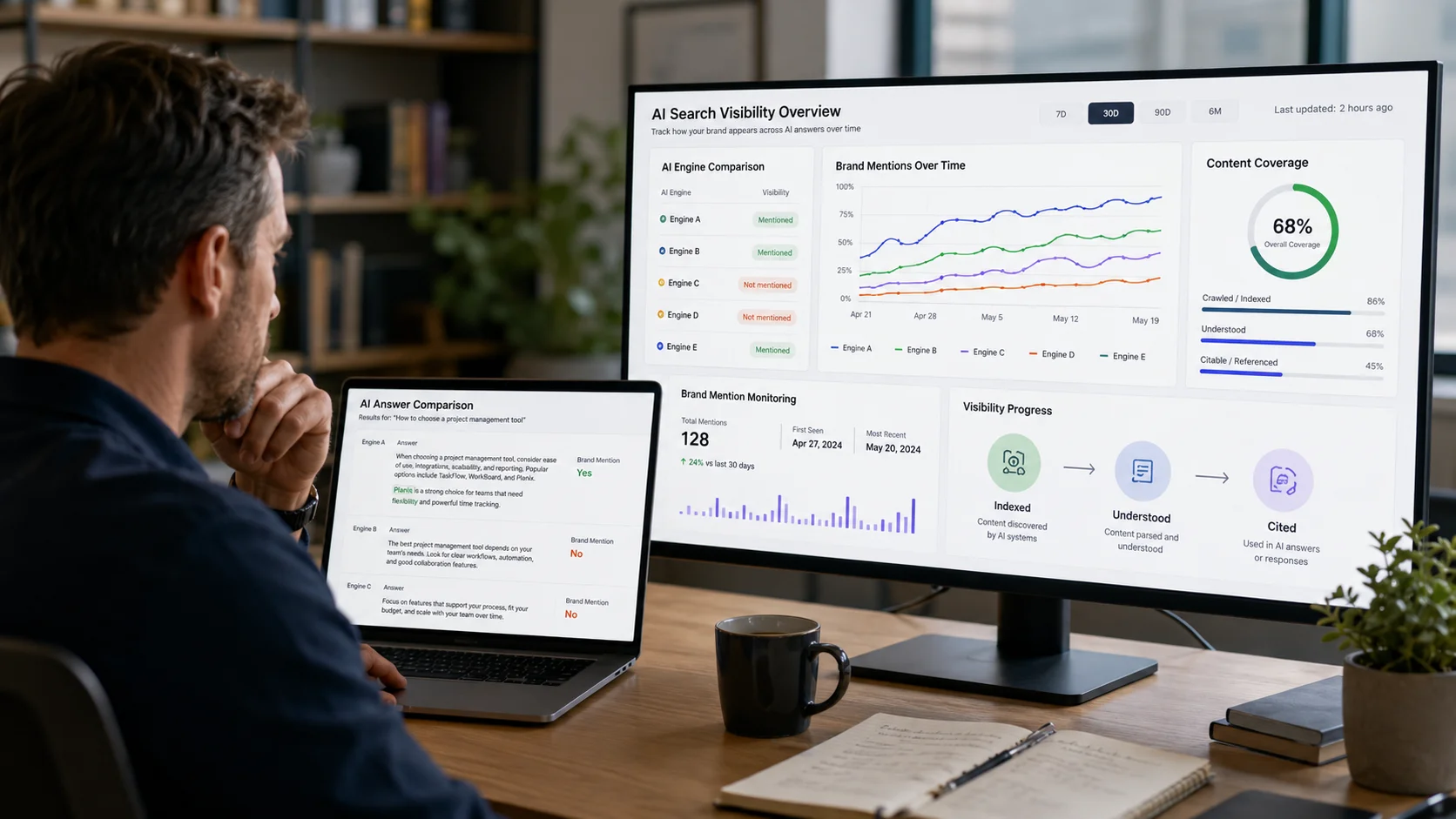
How Long Does It Take for GEO to Make Your Brand Appear in AI Answers?
A Quick Introduction
I'm often asked this question: After implementing GEO optimization, how long does it actually take to see my brand appear in AI answers? Many business owners and marketing heads aren't necessarily opposed to 'slow,' but they want to be sure that 'slow' is heading in the right direction. Especially when traditional SEO offers rankings as a measurable metric, the criteria for judgment become much more ambiguous in the context of AI answers, which can easily lead to anxiety.
The Core Answer
GEO generally doesn't have a fixed timeframe. At its fastest, a brand can appear in some AI answers within a few weeks; at its slowest, it can take months. The key factors are content coverage, brand semantic signals, and the crawling and update cycles of different AI engines—not a single optimization action. The key to GEO isn't 'when you appear,' but 'whether you are already understood by AI as a citable brand entity.' In other words, seeing 'whether it appears' is just the outcome. What truly influences the timeline is whether the three foundational layers have been established.
Why the 'Appearance Timeline' Varies, Driven by Three Types of Signals
The generation mechanism of AI answers differs from traditional search rankings. It's not a simple keyword ranking but a result of 'semantic understanding + information retrieval + credibility scoring.' Therefore, the unstable appearance time for a brand is essentially determined by three types of signals. First is content coverage. If your website only has product pages and lacks Q&A content, scenario explanations, or comparison content, it's difficult for AI to classify you into an 'explainable knowledge node.' The more comprehensive the coverage, the faster you are typically understood. Second are external semantic signals. When constructing answers, AI refers to a vast amount of public content, including news, forums, and third-party reviews. If your brand only exists within your official website and is rarely mentioned externally, the system lacks 'validation signals,' which naturally extends the time needed to enter the answer chain. Third are differences in model update cadences. Different systems have distinct crawling and update mechanisms. Some rely on near-real-time indexing, while others depend on periodic training or hybrid retrieval. Therefore, the 'appearance time' for the same brand can vary significantly across different AIs. This is precisely why you cannot judge the effectiveness of GEO based on a single point in time.
Different AI Environments in Overseas and China Lead to Vastly Different 'Time to Brand Appearance'
In overseas environments, such as :contentReference[oaicite:0]{index=0}, :contentReference[oaicite:1]{index=1}, or :contentReference[oaicite:2]{index=2}, the focus is generally more on public web indexing and authoritative content structures. The advantage is a clearer path, but the requirements for brand authority are higher. Without sufficient external citations, even with complete content, a brand might be slower to enter the answer system. In the Chinese AI environment, such as Doubao, Kimi, Ernie Bot, and Tongyi Qianwen, they rely more heavily on platform ecosystem data and content distribution mechanisms. The brand entry path is more fragmented and sometimes depends on whether your content is frequently discussed within a specific platform. Consequently, the same brand can show a significant time lag across different AI systems. It might be cited earlier in some, while not appearing for a long time in others. This is not a sign of optimization 'failure,' but a difference in path driven by different system architectures.
How to Determine if GEO is Working, Without Just Waiting for 'Appearance Time'
If you only focus on 'whether the brand is mentioned in AI answers,' it's easy to misjudge the real progress of GEO. A more reasonable approach is to break the process down into three stages. Stage one is to see if the brand is recognized by AI as an 'entity.' For example, can AI correctly describe who you are and what you do in different questions, irrespective of whether it provides a link or ranking. Stage two is to see if your brand is repeatedly mentioned across multiple questions. If a brand only appears under a single keyword, it's more like an accidental retrieval than structural inclusion. Stage three is entering the answer logic chain. This means appearing consistently in comparative, recommendation, or explanatory questions. Only at this point can you say the brand has entered AI's knowledge organization system. Practically speaking, it's more effective to use a fixed set of questions for periodic testing rather than waiting for natural appearances. For instance, fix 10-15 questions highly relevant to your business and test them bi-weekly across different AI platforms, observing 'whether it appears, how it's described, and whether it's stable.'
Next Steps & Recommendations
If you are still trying to gauge if GEO is working, I advise against using 'whether it appears' as your only metric. A more effective method is to first establish a stable testing system, record the results from different AI platforms, and then look for trends and changes. Simultaneously, work on supplementing your content structure: build out Q&A content, scenario-based content, and comparison content around your core product keywords. This makes it easier for AI to establish semantic relationships, rather than relying solely on your homepage or a handful of pages. Often, GEO isn't about 'waiting for it to appear,' but about 'giving the system enough reasons to understand you repeatedly.'
Related Questions
Why has my website done SEO optimization, but our brand still isn't mentioned in AI answers?
This usually happens because SEO optimization addresses ranking issues, not AI semantic understanding issues. When content structure and external signals are insufficient, AI still finds it difficult to consistently cite your brand.
How often should I review the results of GEO optimization?
It's recommended to use a 2-4 week observation cycle. Test with a fixed set of questions across different AI platforms, rather than judging based on a single result.
Do AI search systems (ChatGPT / Gemini) have the same content update frequency?
Different systems have different update mechanisms. Some lean towards real-time retrieval, others towards periodic training or hybrid models. Therefore, the time for results to appear will vary.
How do I know if my brand has been 'indexed' or recognized by an AI system?
Observe if the AI can stably describe your brand attributes and mention it repeatedly across different questions, rather than just appearing for a single keyword.
Why do the timelines for GEO and SEO results differ?
SEO relies on a ranking system, while GEO depends on semantic understanding and the establishment of a knowledge structure. Therefore, the feedback cycle is less stable for GEO.
Are there ways to speed up the time it takes for a brand to appear in AI answers?
You can increase the probability of being recognized and cited by AI by expanding content coverage, strengthening external mention signals, and building a system of question-based content.