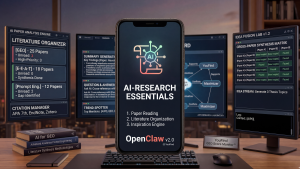
Have you ever worried that the core code, business plans, or sensitive customer data fed to cloud AI are quietly becoming "fodder" for large model training? In 2026, with generative AI penetrating all industries, data sovereignty has become a lifeline for indie developers and enterprises. According to a McKinsey report, over 75% of surveyed enterprises list data privacy as the primary obstacle to AI adoption. For workplace elites in highly regulated regions like North America or Hong Kong, finding a solution that enjoys AI efficiency while ensuring privacy is not leaked is urgent. This is exactly why OpenClaw local deployment is sweeping the tech circle.
Why Are Indie Developers Turning to "Local AI" in 2026?
For a long time, we've gotten used to the convenient services provided by OpenAI or Anthropic. But with rising subscription costs, frequent API disconnections, and increasingly severe privacy leakage risks, the disadvantages of cloud dependence are becoming apparent. Especially for developers handling financial data or medical personal information, any data upload may touch compliance red lines. OpenClaw, as a powerful open-source AI client, supports connecting to locally running models (such as Qwen 3.5 or Llama 3), giving you a powerful assistant even in offline environments.
From YouFind's perspective, localized deployment is not just for security considerations — it's the first step in building an enterprise's "brand knowledge base." Through AIPO (AI-Powered Optimization) thinking, we not only want AI to serve us but also, through structured local data training, let AI truly understand your business context, producing high-quality content with E-E-A-T (Experience, Expertise, Authoritativeness, Trustworthiness) characteristics.
Environment Preparation: How to Choose Hardware and Software Suitable for OpenClaw?
To make AI "run, run fast" locally, reasonable hardware configuration is fundamental. This is no longer an era of blindly stacking memory but emphasizing the synergy of VRAM and bandwidth. Below are 2026 mainstream configuration recommendations summarized from our real-world testing experience:
| Component | Recommended Configuration (Advanced) | Recommended Configuration (Economical) |
|---|---|---|
| Processor (CPU) | Apple M3 Max or Intel i9-14900K | Apple M2 Pro or Intel i7-13700 |
| Graphics Card (GPU) | NVIDIA RTX 4090 (24GB VRAM) | NVIDIA RTX 4070 Ti (12GB VRAM) |
| Memory (RAM) | 64GB DDR5+ | 32GB DDR4/DDR5 |
| Core Software | Docker, Python 3.10+, Ollama | Docker, Python 3.10+, Ollama |
After preparing the hardware, you need to install Ollama. It's currently the most convenient tool for running local large models, supporting one-click download and running of Qwen 3.5 (Tongyi Qianwen). Qwen 3.5's understanding ability and logical reasoning performance in Chinese contexts have shown strength rivaling GPT-4 in multiple benchmark tests, making it the preferred model for current local deployment.
How to Perform OpenClaw Local Deployment? Practical Step Breakdown
After completing environment setup, the next step is the core link of connecting OpenClaw with the local model. We pursue a "zero-latency, zero-cost" interactive experience.
Step 1: Clone Repository and Initialize Environment
First, get OpenClaw source from GitHub. Open the terminal and execute:
git clone https://github.com/OpenClaw/OpenClaw.git
cd OpenClaw
pip install -r requirements.txt
Next, configure the .env file. Unlike before when you needed to fill in an OpenAI API Key, here we'll point to the local Ollama port.
Step 2: Connect Local Qwen 3.5 Model
Start Ollama and load the model: ollama run qwen2.5:7b. In OpenClaw's settings interface, change the API Base URL to http://localhost:11434/v1. This way, instructions sent by OpenClaw will be processed directly by the machine under your desk — data never leaves the premises.
Step 3: Optimize Prompt Engineering
To make the local assistant understand you better, we recommend adding structured guidance in the System Prompt. For example: "You are a content expert proficient in AIPO technology. Please optimize this foreign trade website-building copy for me based on E-E-A-T principles." Through precise instructions, the local model's output quality can leap qualitatively.
Advanced Tips: Combining AIPO Concepts to Boost AI Assistant Performance
Successful deployment is just the beginning — how to make this "brain" exert commercial value is key. The AIPO dual-core layout proposed by YouFind emphasizes: local deployment is the base for content intelligent manufacturing. When you use OpenClaw to process documents locally, you should follow our summarized "structured modeling" logic.
You can build a local "Source Center," structurally processing the brand's success cases and patented technologies (such as YouFind's Maximizer system) before feeding them to AI. This not only boosts AI's answer accuracy but also prepares for future GEO (Generative Engine Optimization). When these high-quality structured contents are published to the public web, AI engines like Google AIO or Perplexity will preferentially cite these authoritative sources. Data shows that brands optimized through this structured approach see their citation rate in AI summaries boosted an average of 3.5x.
Applications for Hong Kong's Highly Regulated Industries Like Finance and Healthcare
In Hong Kong, the SFC (Securities and Futures Commission) has strict compliance requirements for data storage and offshore transmission. OpenClaw local deployment provides a perfect "compliance sandbox" for financial practitioners.
- Financial Industry: Analyze customer asset portfolios in local environments and generate personalized financial advice, completely avoiding compliance risk of data leakage to third parties.
- Healthcare: When handling patient medical records and follow-up records, use local AI for summary extraction, ensuring sensitive medical personal information meets privacy regulations.
- Cross-Border E-Commerce: Targeting the North American market, use local AI to quickly generate marketing copy meeting local cultural habits, while diagnosing brand visibility on overseas AI platforms through YouFind's GEO Score™.
We must realize that local AI is not an island — it's the safe deposit box for brand digital assets. Through YouFind's AIPO technology, we can help enterprises seize AI-era traffic dividends while maintaining the privacy bottom line.
Check Right Now Whether Your Brand Is “Missing” in the Eyes of AI
Don't become invisible in the era of AI search. Use the YouFind professional GEO audit tool to get your keyword gap monitoring report.
Get Your Free GEO Audit Report NowFrequently Asked Questions About OpenClaw Local Deployment (FAQ)
What Is OpenClaw Local Deployment?
OpenClaw local deployment refers to installing the AI interaction interface (OpenClaw) and Large Language Models (such as Qwen or Llama) on the user's own hardware devices, rather than relying on cloud servers. This approach ensures all data processing is completed locally, achieving extremely high privacy security.
How to Boost Local AI Response Speed?
The key to boosting speed lies in GPU VRAM and the model's quantization version. We recommend using 4-bit or 8-bit quantization models to reduce VRAM usage, and ensure your computer is equipped with NVIDIA 40-series graphics or Apple Silicon (M2/M3) chips. Meanwhile, optimizing prompt structure can also significantly reduce inference time.
Why Is Local Deployment Crucial for Enterprise AIPO Deployment?
Local deployment lets enterprises process core business data in a secure environment, building proprietary brand knowledge bases. This calibrated, accurate, and authoritative content is the foundation for GEO (Generative Engine Optimization). Only when content itself is solid can brands gain higher citation weight in AI search results like Google AIO.
How Do Qwen 3.5 and GPT-4 Perform When Running Locally?
In Chinese understanding and code writing, Qwen 3.5's performance is already very close to GPT-4. Although there's still a small gap in extremely complex logical reasoning, the "zero-cost" and "low-latency" advantages of local operation make it more cost-effective in daily development and enterprise copy creation.
Summary and Call to Action
Moving from cloud to local is not just a technology migration — it's safeguarding data dignity. For indie developers and enterprises going overseas, mastering OpenClaw local deployment is just the first step toward the AI era. The real challenge is how to transform these locally produced quality contents into authoritative citation sources for global AI engines. YouFind, with 20 years of marketing experience and proprietary AIPO dual-core technology, is dedicated to helping you build a brand moat.
If you hope to further boost content professionalism and ensure your brand occupies a leading position in the AI search era, welcome to Learn About AI Article Writing and let us help you achieve a comprehensive upgrade from content intelligent manufacturing to global citation.