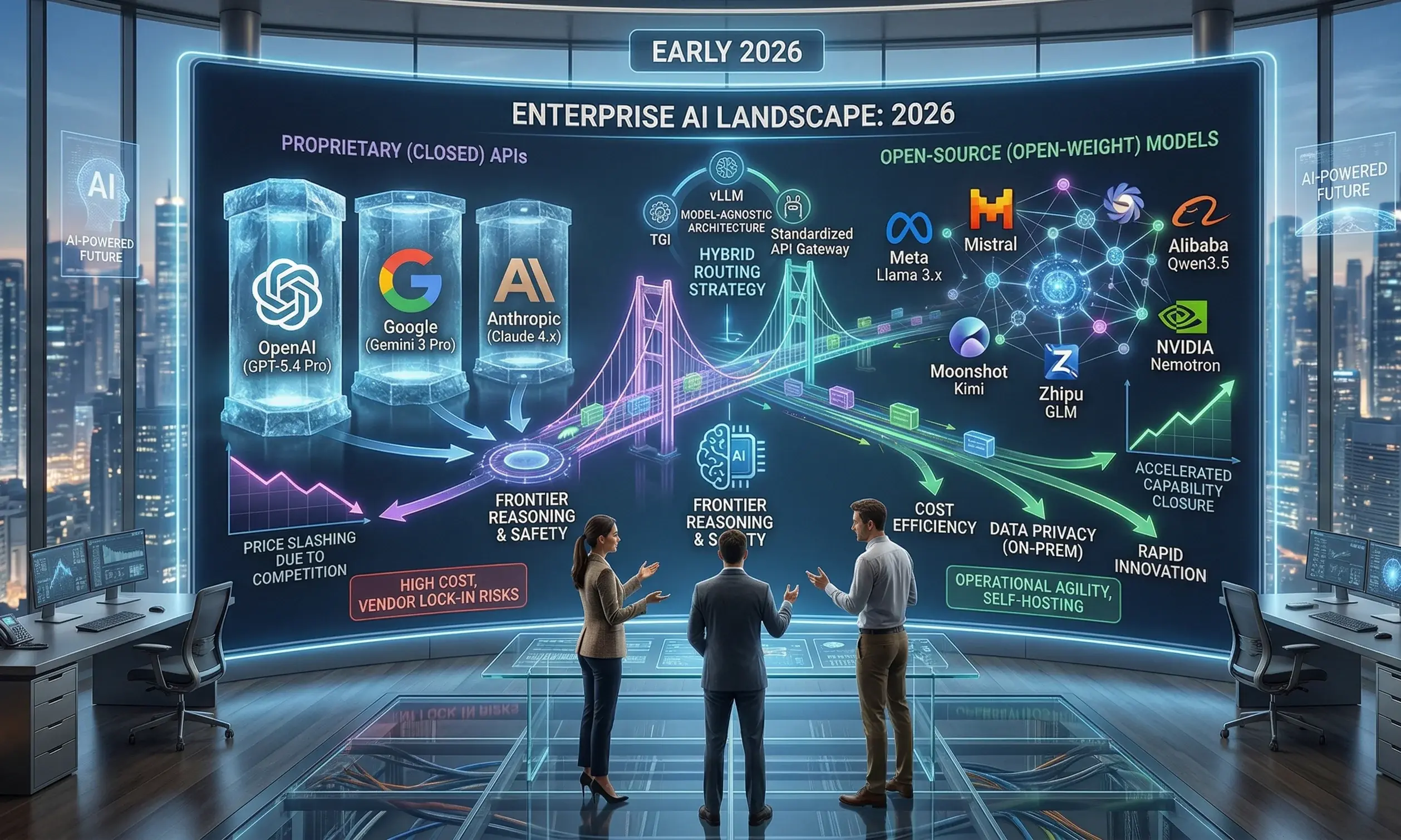
In 2026, the LLM compute race has entered white-hot intensity. While OpenAI's GPT-5.4 demonstrates reasoning peaks approaching human logic, Meta's Llama 3 series and Alibaba's Qwen 3 have also completed stunning transformations in the open-source community, with performance rivaling closed-source flagships. For developers and enterprise architects, technology selection is no longer a simple "performance test" — it's a strategic choice involving cost, data sovereignty, and commercial lifeline: should you pay expensive Token bills monthly in exchange for the strongest brain, or endure the early complexity of private deployment to gain absolute control?
What Is the AI Technology Selection Dilemma Developers Must Face in 2026?
Standing at the 2026 time node, the AI ecosystem presents a curious balance: GPT-5.4 and the closed-source systems behind it (such as Claude 4, Gemini 2.5) still hold the high ground of multimodal understanding and complex long-chain reasoning; however, the open-source camp represented by Llama 3, through distillation technology and efficient fine-tuning architecture, has already achieved "equivalent replacement" of closed-source models in 80% of commercial scenarios.
The pain points developers face are very specific: if you rely on closed-source APIs, your brand's core business logic may invisibly become training fodder for giant models, and API call costs grow exponentially with user scale; if you turn to open-source models, the heavy-asset investment in hardware procurement and the shortage of operations talent is another insurmountable barrier. This anxiety between "ultimate performance" and "data sovereignty" is the biggest obstacle to AI application deployment today.
How to Deeply Compare Open-Source Models and Closed-Source APIs Across Five Dimensions?
Choosing a model is no longer just about benchmark scores — it's more about the long-term layout of commercial deployment. To help developers think clearly, we conducted real-world testing and quantification across five core dimensions: cost, performance, security, flexibility, and operational difficulty.
| Comparison Dimension | Open-Source Models (e.g., Llama 3 / Qwen) | Closed-Source APIs (e.g., GPT-5.4 / Claude 4) |
|---|---|---|
| Inference Cost | High upfront GPU investment; lower long-term TCO at large scale | Zero startup cost; billed per Token; expensive for high-frequency apps |
| Data Privacy | Highest level (100% local deployment; data never leaves) | Moderate to low (data must pass through third-party servers) |
| Response Latency | Depends on proprietary compute density; extremely low on LAN | Limited by network environment and provider concurrency pressure |
| Customization Flexibility | Supports full-parameter fine-tuning; deep vertical behavior definition | Limited to lightweight fine-tuning; model behavior constrained by platform rules |
| Deployment Cycle | Days to weeks (including environment tuning and optimization) | Ready out of the box (API runs in minutes) |
Especially in YMYL (Your Money Your Life) fields such as finance and healthcare, data compliance is an insurmountable red line. According to IDC's 2025 industry report, over 72% of financial institutions prioritize open-source private deployment in core business to ensure sensitive transaction data doesn't enter the "black box" of closed-source models.
Why Do 2026 Developers Lean More Toward Hybrid Architectures?
The era of a single model is over. In real-world practice, smart developers adopt a "closed-source validation + open-source deployment" strategy.
- Choose closed-source APIs in the MVP phase: Leverage GPT-5.4's extremely strong logical ability to rapidly validate product prototypes, saving expensive early compute infrastructure costs.
- Shift to open-source models at scale: When business logic is stable and traffic surges, migrate core tasks to a fine-tuned Llama 3. Through quantization (such as 4-bit quantization), run it on consumer-grade GPUs to significantly optimize operational cost.
- Separate specific tasks: Let GPT handle complex user intent analysis while local open-source models handle specific content generation or data extraction.
How to Boost Brand Visibility in the AI Search Era: The Key Role of AIPO and GEO
Whether you choose to deploy Llama 3 or plug into GPT-5.4, a harsh reality is this: if your brand content can't be "learned" and "cited" by these models, you'll completely disappear from 2026's generative search (Google AIO, Perplexity).
YouFind was first to propose the AIPO (AI-Powered Optimization) dual-core layout, designed precisely to solve this problem. While traditional SEO is still arguing about keyword rankings, GEO (Generative Engine Optimization) has already begun optimizing brand weight inside AI models. Through our proprietary GEO Score™ algorithm, we diagnose the brand's citation rate gap across mainstream AI engines.
Through the AIPO engine's "content intelligent manufacturing" logic, we structurally model brand content. This isn't just so Google's crawlers can understand — it's also to match the citation preferences of Llama or GPT. When AI answers user questions, it preferentially retrieves and tags sources from authoritative sites with high E-E-A-T attributes. YouFind's real-world data shows that enterprises optimized through AIPO see their citation rate in Google AI summaries rise an average of 3.5x, and overseas inquiry volume rise 22% in sync.
Why Is the Maximizer Patented System a Savior for Developers?
For many tech leads, what they fear most about SEO or GEO optimization is touching the architecture. YouFind's Maximizer patented system solves this pain point: clients don't need to rebuild the site — they can efficiently inject structured data markup (such as FAQ Schema) without altering the existing web architecture. This means development teams can focus on model-layer optimization while handing off the complex work of "how to get AI to choose the brand" to a professional AIPO system.
2026 AI Deployment — Practical Recommendations and Technical Paths
For professionals and creators in North America or doing overseas business, we recommend following this technical path: first, build a brand-proprietary knowledge base (RAG enhancement) to ensure AI tools have something to rely on when citing information; second, continuously monitor brand voice gaps across different AI platforms. Remember, the competition in 2026 is not how powerful a model you use, but how many models are using your data.
Check Right Now Whether Your Brand Is “Missing” in the Eyes of AI
Don't become invisible in the era of AI search. Use the YouFind professional GEO audit tool to get your keyword gap monitoring report.
Get Your Free GEO Audit Report NowFrequently Asked Questions About Open-Source Models and Closed-Source APIs (FAQ)
1. Is Maintaining Open-Source Models Really More Expensive Than APIs?
It depends on call volume. For applications with over ten thousand DAU, privately deploying Llama 3 has tens of thousands of dollars in upfront hardware cost, but long-term Token savings typically break even within 6-12 months. For low-frequency small tools, closed-source APIs are the more economical choice.
2. What Is GEO? How Is It Different From Traditional SEO?
SEO targets traditional search engine layouts, while GEO (Generative Engine Optimization) targets AI generative engines (such as ChatGPT, Google SGE). GEO places more emphasis on content extractability, factual accuracy, and whether it can become the "footnote" citation source in AI answers.
3. How Do You Ensure Content Authority After Deploying Open-Source Models?
By importing Google E-E-A-T principles and using YouFind's AIPO engine for structured modeling, you can ensure that whether open-source or closed-source models retrieve information, they can identify your content as professional and credible.
In this rapidly changing AI era, choosing the right model is just the beginning — ensuring your brand isn't forgotten by algorithms is the ultimate goal. Learn About AI Article Writing and more forward-looking strategies to help you seize brand dividends in the AI era.