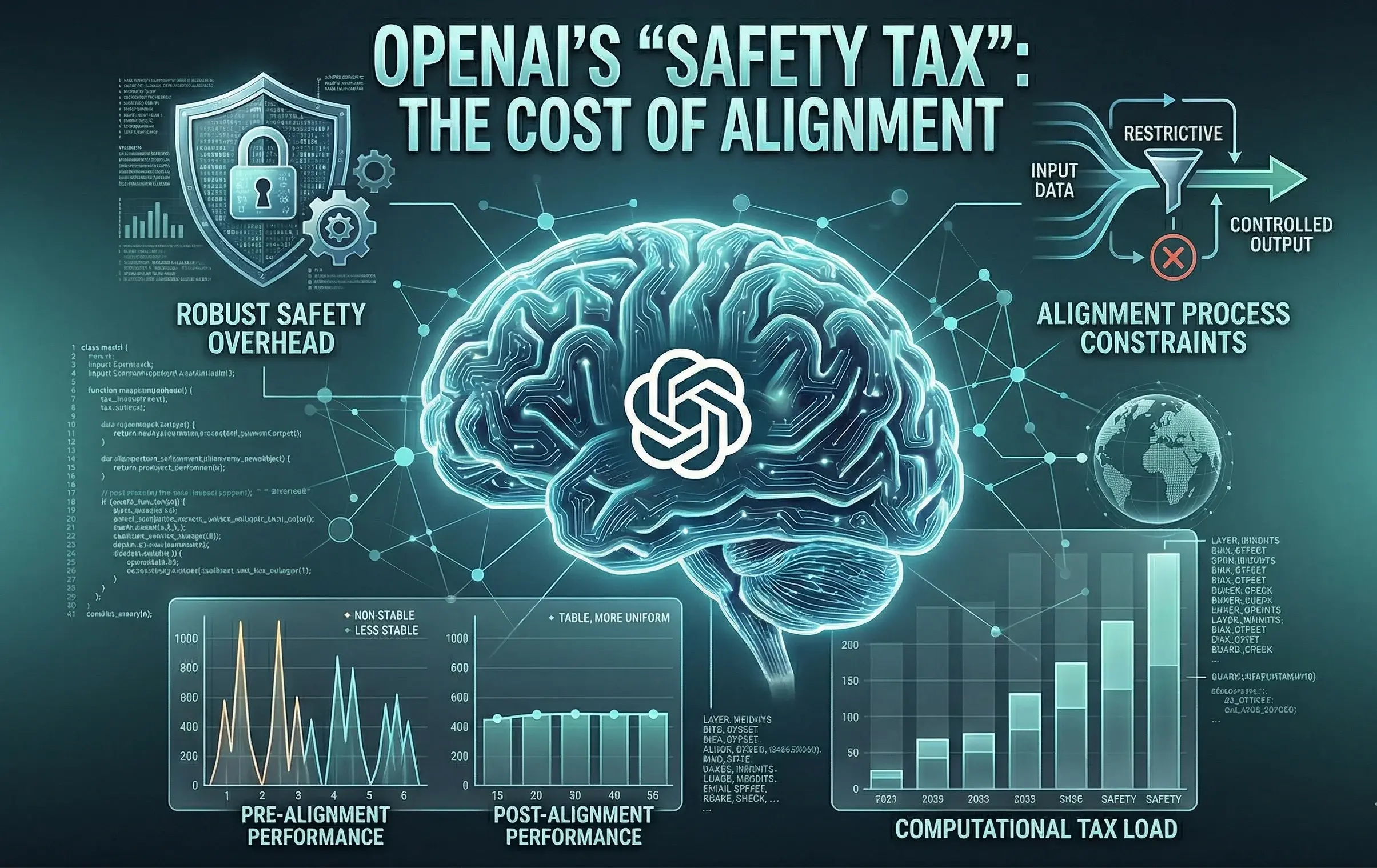
Have you ever felt that the GPT that was once omniscient and even had a touch of "wild" creativity has lately become a bit hesitant? When you try to consult slightly deeper legal advice or discuss complex industry-sensitive topics, it often throws out a mechanical disclaimer and then refuses to answer directly. In tech circles this phenomenon is jokingly called the "Safety Tax" that OpenAI is levying.
The so-called "safety tax" refers to the performance cost paid in pursuit of "AI alignment" — ensuring that AI's values stay consistent with human behavioral norms. This cost manifests as wasted computational resources, degraded response logic, and even declines in the model's "IQ." According to research from Stanford University and UC Berkeley, over just a few months, large language models showed fluctuation — and in some metrics significant decline — in their accuracy on math problems and code generation. For engineers in Silicon Valley, cross-border e-commerce practitioners going global, and professionals who rely on AI for efficiency, this performance sacrifice is becoming an invisible shackle.
What Is AI Alignment? From Protecting Humans to Over-Censorship
Before discussing the "safety tax," we need to clarify what AI alignment is. Simply put, alignment is putting reins on the runaway wild horse of AI, ensuring it doesn't produce racist content, biological weapons suggestions, or spread hate speech. Currently, the mainstream approach is RLHF (Reinforcement Learning from Human Feedback) — using large amounts of human annotation to tell the model which responses are "good" and which are "dangerous."
However, this well-intentioned protection mechanism is evolving into "over-censorship." To avoid PR risk and legal liability, developers often adopt the most conservative alignment strategy. This leads to an awkward situation: AI becomes powerless in some neutral, professional domains. For example, when a cross-border e-commerce operator asks how to handle a compliance-related complaint, AI may refuse to generate recommendations because "legal/controversy" keywords are triggered. This "better to kill a thousand than let one slip" logic essentially castrates AI's native logical ability for the sake of brand reputation.
The Real Cost of the "Safety Tax": Performance Loss and Logic Degradation
The "safety tax" not only makes AI more "polite" — it causes "catastrophic forgetting" at the underlying logic level. When the model is forcibly instilled with massive moral guidelines and safety restrictions, the parameter space originally used for complex reasoning becomes occupied. We can intuitively feel the performance differences before and after alignment in actual commercial applications through the table below:
| Evaluation Dimension | Native Model (Low Alignment / Untaxed) | Over-Aligned Model (High Safety Tax) |
|---|---|---|
| Reasoning Depth | Handles multi-step logical deduction, gives innovative solutions | Tends to give "catch-all" standard answers, logical breaks |
| Creative Boundary | Divergent thinking, dares to break conventional frameworks | Extremely conservative, avoids all potentially controversial metaphors |
| Response Speed | Direct computation path, fast response | Needs multiple layers of internal review and filtering, noticeable latency increase |
| Professional Accuracy | Provides depth and detail in fields like finance and law | Frequently triggers disclaimers, content severely homogenized |
For entrepreneurs in the overseas market, this logic degradation is fatal. What you need is an intelligent assistant that can help you analyze global market fluctuations and predict financial risks — not a parrot that only repeats "investment carries risk." A deeper concern is that this "alignment" often carries developer bias — who has the right to define what content is "safe"? This black-box censorship mechanism is invisibly erasing the openness of information.
Enterprises' Hidden Concerns in Going Global: How to Compete for Content Citation Rights Under AI Censorship?
With the widespread adoption of generative engines like Google Search Generative Experience (SGE/AIO) and Perplexity, search logic has shifted from "showing web pages" to "summarizing answers." This gives rise to a new crisis: if your enterprise's content is deemed "potentially risky" or "insufficient in weight" because AI's "safety filter" is too strict, your brand will completely disappear from AI's recommendation slots.
This is exactly why YouFind proposed the concept of AIPO (AI-Powered Optimization). In the AI era, traditional SEO is no longer sufficient to address the information barriers caused by the "safety tax." You not only need to make search engines crawl you — you need to make AI "trust" you. Our GEO Score™ algorithm can precisely diagnose your brand's citation rate across mainstream AI engines. By analyzing AI's trigger mechanisms, we can discover high-value keyword gaps that competitors have covered but you have lost because your content structure doesn't match AI's appetite.
Structured Modeling: Why Is E-E-A-T the Only Path to Bypass the "Safety Tax"?
Since AI's safety alignment mechanism filters out untrustworthy, unclear content, the only thing enterprises can do is make themselves the "absolutely trustworthy" authoritative source. This returns to Google's emphasized E-E-A-T (Experience, Expertise, Authoritativeness, Trustworthiness) principles. Although AI has been taxed with the "safety tax," it still has extremely high citation preference for tightly structured, data-rich authoritative information.
We assist enterprises in building "resource centers" aligned with AI preferences through the following four steps:
Using YouFind's proprietary Maximizer patented system, clients can achieve this efficient optimization without changing the existing web architecture. For cost-conscious Hong Kong enterprises and brands going global, this is the best practice for building a brand moat in the AI era.
The Future of Balancing Safety and Innovation: Enterprises Should Not Sit and Wait
We cannot deny that AI alignment is an inevitable stage of technological evolution, ensuring baseline safety as human civilization enters the intelligent age. But as business owners and market developers, we cannot let the "safety tax" become a stumbling block to brand growth. When large models become "mediocre" due to over-censorship, enterprise content that continuously outputs high-quality material meeting E-E-A-T standards and optimized through AIPO will stand out like gold in AI's filter.
In an era where algorithms are updated every second, deploying AIPO in advance is not only for current traffic — it's for securing an irreplaceable seat in the future AI recommendation ecosystem. Don't wait until competitors have already taken the top recommendation slots in ChatGPT or Google AIO to realize your brand is blank in AI's eyes.
Check Right Now Whether Your Brand Is “Missing” in the Eyes of AI
Don't become invisible in the era of AI search. Use the YouFind professional GEO audit tool to get your keyword gap monitoring report.
Get Your Free GEO Audit Report NowFAQ Quick Guide
1. What Is AI Alignment? How Does It Affect AI's Answers?
AI alignment is the process of ensuring artificial intelligence goals align with human values. Through methods such as RLHF, it restricts the model from outputting harmful content, but the side effect may be that AI becomes too conservative and even refuses to answer some neutral questions with professional depth.
2. Will the "Safety Tax" Affect My Website's Traditional SEO Ranking?
The "safety tax" mainly affects the citation logic of generative AI tools (such as ChatGPT) and AI search summaries (such as Google AIO). Although it doesn't directly change traditional search blue-link rankings, as AI summaries occupy the top of search results pages, websites that don't meet AI trust standards will see substantial drops in traffic.
3. How Do I Get My Brand Content to Bypass AI Safety Censorship and Be Cited by ChatGPT?
The core is to improve the E-E-A-T weight of content. By providing real measurement data, expert opinions, and using structured data markup, combined with Learn About AI Article Writing's AIPO optimization technology, you can significantly increase a brand's citation probability in AI answers.
4. What's the Difference Between AIPO Optimization and Traditional SEO?
Traditional SEO focuses on keyword rankings and backlinks, while AIPO (Generative Engine Optimization) focuses on "citation rate." By simulating AI's learning logic and optimizing content structure and trust, it makes the brand the preferred authoritative data source when AI generates answers.