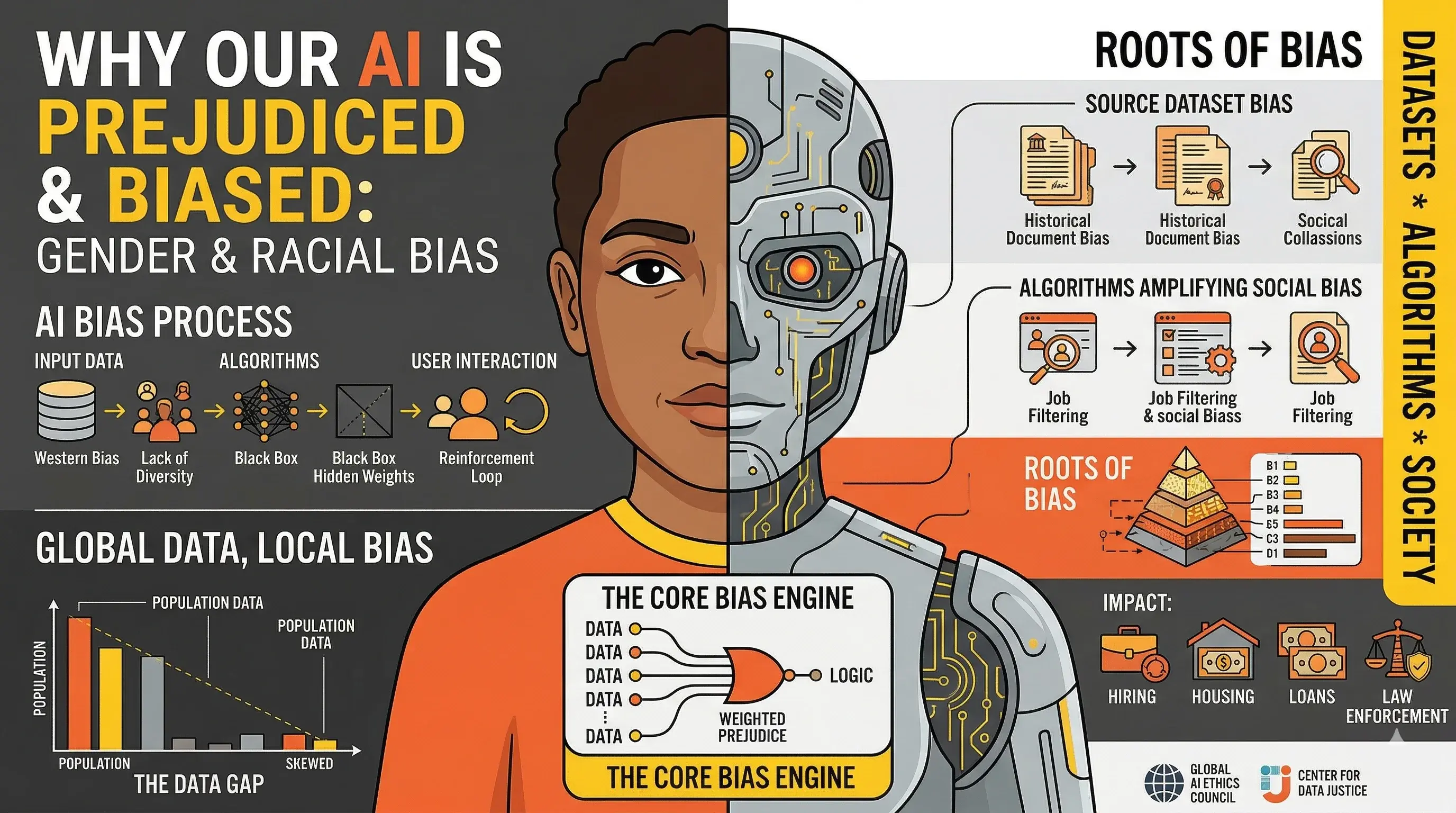
AI is reshaping our work and life, but one disturbing phenomenon appears repeatedly: when you ask AI to generate a photo of a "CEO," it usually shows a white male; when you ask for a credit-approval recommendation, the algorithm may give an unfair score based on the applicant's zip code or ethnic background. This "algorithmic discrimination" is no coincidence — it is becoming the biggest PR and compliance risk that enterprises face in the generative AI era.
For Chinese engineers and professionals striving in North America, or Chinese enterprise decision-makers planning to take their brand global, understanding AI bias is not merely a technical issue — it's a bottom line for fairness and commercial safety. If our brand content is labeled as biased by AI engines (such as Google AIO, ChatGPT), or excluded in critical citations, that's not just a loss of traffic — it's the collapse of brand trust. This article deeply analyzes the roots of AI bias and explores how enterprises, under E-E-A-T principles, can use AIPO technology to build a bias-resistant brand moat.
What Is AI Bias? Exploring the "Tinted Glasses" Behind Algorithms
Simply put, AI bias refers to systematic deviations in an AI system that favor certain groups and discriminate against others. This bias typically originates from unrepresentative training data or from developers' unconscious leanings. Because AI models are essentially "prediction machines" that generate results by recognizing patterns in historical data, if history itself is unequal, AI automates and scales that inequality.
For enterprises going global, AI bias may manifest as search engines disfavoring products from certain regions, or AI chatbots carrying stereotypes when describing Eastern cultures. This "invisible discrimination" directly reduces a brand's visibility on mainstream AI platforms, and may even trigger platform spam filters (SpamBrain), causing the content to be judged as low-quality or biased.
Why Does Our AI Always Carry Gender and Racial Bias?
AI bias doesn't arise out of thin air — its roots are deeply embedded in the data collection, processing, and algorithm design stages. We can understand this complex phenomenon from the following four core dimensions:
- Severe Imbalance in Data Representation: Most mainstream AI models' training data comes from the public internet, where English content dominates and is largely produced by Western groups. This "data unilateralism" means AI lacks deep understanding of Asian contexts, African cultures, or the lifestyles of minority ethnic groups. For example, when processing Cantonese or specific workplace cultural contexts, AI often misinterprets due to a lack of sufficiently high-quality local data.
- The Mirror Effect of Historical Bias: AI learns from decades or even centuries of human records. If historical hiring data shows high-level positions mostly held by men, AI will erroneously build a strong association between "male" and "competence." This "the past determines the future" logic makes AI a parrot of old social rules.
- Algorithmic Black Box and Weight Imbalance: Developers may unintentionally guide bias when setting reward mechanisms. If a recommendation algorithm optimizes only for "click-through rate," it may prioritize inflammatory or even racially biased stereotypical content, because such content generates more user interaction — leading to a vicious cycle.
- Unstructured Source Sampling: Traditional AI scraping is often undiscriminating. Without structured intervention like AIPO (AI Platform Optimization), AI has difficulty distinguishing biased speech from factual authoritative reports, resulting in "mixed-quality" output when generating answers.
Classic Case Analysis: When AI Becomes a Driver of Social Injustice
To more intuitively understand how these biases affect the real world, we've compiled several highly representative industry cases. These cases remind us that ignoring AI ethics carries enormous costs.
| Industry Case | Form of Bias | Commercial / Social Impact |
|---|---|---|
| Recruitment tool at a major e-commerce company | Automatically lowered scores for resumes containing the word "women" | Talent loss; system was eventually shut down and the company faced a PR crisis |
| Mainstream facial recognition systems | Recognition error rate for dark-skinned women as high as 35% | Legal compliance risk, triggered large-scale protests over AI ethics |
| Financial credit algorithms | With similar asset profiles, credit limits given to women were far lower than those given to men | Regulators launched investigations, severely damaging the financial institution's credibility |
| Medical assistive-diagnosis AI | Underestimated the risk of chronic disease for certain ethnic groups | Caused treatment delays, producing serious medical ethics issues |
Finance, Healthcare, and Real Estate: Compliance Challenges in Highly Regulated Industries
For finance, healthcare, and real estate enterprises operating in Hong Kong or North America, AI bias is not just a moral issue — it's a compliance red line. The Hong Kong Monetary Authority (HKMA) and the Securities and Futures Commission (SFC) have strict requirements on algorithmic transparency and fairness. If a bank uses a gender-biased algorithm to approve loans, it may violate the Equal Opportunities Ordinance.
In healthcare, AI-assisted diagnosis must meet extremely high E-E-A-T standards. If training data lacks Asian samples, AI's accuracy in judging certain specific diseases will be reduced. Therefore, when deploying AI solutions, enterprises must conduct a "deep audit." The AIPO logic YouFind advocates — using the GEO Score™ algorithm to monitor brand performance across different AI platforms in real time — identifies information misdirection or bias gaps, ensuring the content your brand puts out is both professional and compliant.
How to Build "Bias-Resistant" AI Assets? Enterprise Response Strategies
Facing the challenge of AI bias, simply avoiding it is not the best strategy — active optimization is the way forward. Through the AIPO (AI-Powered Optimization) dual-core layout, enterprises can guide AI from the source to learn more accurate and fair brand data.
1. Build a Proprietary Structured Knowledge Base (Source Center)
AI produces bias because it doesn't have enough "correct" information. Enterprises should build resource centers that align with AI citation preferences, structurally modeling their core values, real cases, and verified industry data. When AI retrieves relevant questions, it will preferentially crawl this high-weight authoritative information, correcting its original biased logic.
2. Deeply Implement Google E-E-A-T Principles
When generating content, you must emphasize Experience and Expertise. By publishing test reports, deep expert opinions, and real-background case studies, increase your content's "trust score" in AI algorithms. Content based on real data and expert review is far more resistant to algorithmic discrimination than low-density text generated en masse by AI.
3. Use GEO Score™ for Real-Time Visibility and Bias Diagnosis
Enterprises need to know clearly: in the answers of ChatGPT or Google AIO, is my brand being praised, misunderstood, or completely forgotten? Through the AIPO engine's diagnostic features, we can precisely identify a brand's "mention gaps" on AI platforms and strategically cover biased citation sources with content, reclaiming narrative control.
4. Introduce Multi-Dimensional Content Intelligent Manufacturing Logic
The AIPO engine produces high-quality content through four phases — data collection, deep analysis, strategic conception, and structured modeling — content that meets not only SEO standards but also AI algorithm preferences. This approach effectively ensures a brand maintains a unified, positive, and objective image across complex multilingual and multicultural contexts.
Check Right Now Whether Your Brand Is “Missing” in the Eyes of AI
Don't become invisible in the era of AI search. Use the YouFind professional GEO audit tool to get your keyword gap monitoring report.
Get Your Free GEO Audit Report NowFrequently Asked Questions About AI Bias (FAQ)
What Is AI Bias, and How Does It Affect My Overseas Business?
AI bias is systematic unfairness in an AI's decisions or generated content. For overseas business, this may mean AI engines filtering out your brand when recommending products to potential clients, or citing information with negative stereotypes when generating brand summaries — directly impacting conversion rates and brand reputation.
Can AI Bias Be Completely Eliminated?
Current technology can't fully eliminate every subtle bias, but through AIPO (AI Platform Optimization) and structured modeling, enterprises can drastically reduce the risk of their brand being misread by AI. This is an ongoing optimization process that requires continuously providing AI with high-quality, E-E-A-T-authoritative, up-to-date data sources.
Why Can't Traditional SEO Optimization Solve the AI Bias Problem?
Traditional SEO focuses on keyword rankings and backlinks, while AI engines (such as GPT-4, Gemini) understand semantics and logic through deep learning. To correct AI bias, you must start with "structured modeling" at the content layer, teaching AI the specific business context — which is the core value that separates AIPO from traditional optimization.
How Can Enterprises Detect Whether Their Content Carries AI Bias Risk?
Enterprises can use professional GEO audit tools to simulate user queries across different AI platforms and analyze AI's answer paths and citation sources. If brand mention rates are low, or cited content lacks source authority, you need AIPO engine intervention for content reshaping and knowledge-base modeling.
In an era where algorithms determine visibility, eliminating bias is not just about maintaining fairness — it's a strategic choice for brand survival. By mastering AIPO technology, we can not only help AI better understand brands, but also help brands win unprecedented trust and growth in the AI ecosystem. Want to seize the initiative in the AI search era? Learn About AI Article Writing and start your GEO optimization journey.
While others stick to traditional search, leaders are already mastering the AI landscape. Launch your AIPO Audit now to secure your competitive edge in Generative Engine optimization!