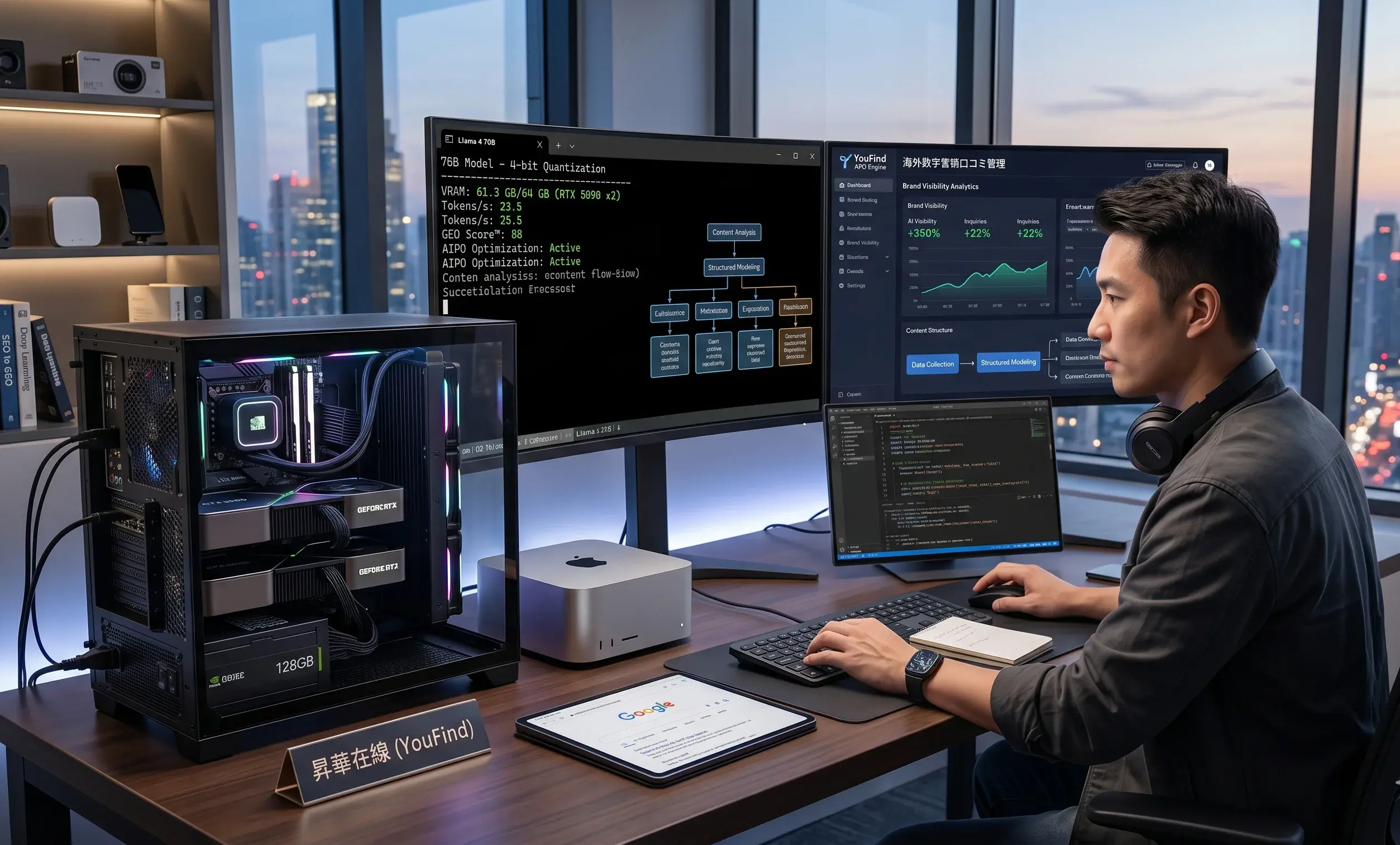
Have you ever faced this dilemma: in order to train a 70B large model involving core business secrets, you had to repeatedly endure expensive cloud API bills while constantly worrying about the risk of sensitive data leaking during transmission? In 2026, as open-source model performance leaps forward, "private deployment" is no longer the exclusive playground of geeks — it has become a necessity for enterprises to protect digital assets and cut long-term operating costs. However, faced with models with 70 billion parameters, can your computer really handle it?
Why in 2026 Do We Prefer "Local AI Hardware Configuration" Over the Cloud?
Although cloud tools like ChatGPT have greatly facilitated daily work, for professionals pursuing ultimate security and customization, the "black box" nature of the cloud remains a Sword of Damocles hanging overhead. According to a 2025 industry survey, over 68% of surveyed enterprises have experienced AI leakage of non-public financial or R&D data. Local deployment, in contrast, means your data always stays on your internal network — eliminating latency and offsetting endless subscription fees through a one-time hardware investment.
As experts who have been deeply involved in overseas digital marketing for nearly 20 years, we have found that many enterprises going global focus only on hardware specs when deploying local compute power. In reality, even if you have top-tier compute, content produced without AI-friendliness still cannot gain recommendations in generative engines like Google AIO or Perplexity. This is why we advocate the synergy of "hardware performance" and "content intelligent manufacturing (AIPO)" — hardware provides the energy, while AIPO determines the soul.
Core Metrics: What Are the Three Major Hardware Thresholds for Running a 70B Model?
To smoothly run a 70B-class model (such as Llama 4 or Mistral Large), you must cross three mountains: VRAM, RAM, and compute bandwidth. Among these, VRAM is the absolute hard threshold determining whether the model can "run at all."
- VRAM: A 70B-parameter model loaded at full precision (FP16) requires about 140GB of VRAM, which obviously exceeds the scope of consumer hardware. Therefore, we usually adopt 4-bit or 8-bit quantization techniques.
- RAM: When GPU VRAM is stretched thin, the system will try to call on RAM, but this causes inference speed to plummet. Unless you're using a Mac device with a "unified memory" architecture, DDR5 speed cannot keep up with AI's throughput demands.
- Compute Performance (TFLOPS): Compute determines how fast AI generates text — that is, the number of tokens generated per second.
To help you more intuitively understand VRAM requirements, refer to the table below, based on real-world data from 2026's mainstream open-source environment:
| Model Size | Quantization Precision | Recommended VRAM | Inference Speed (Tokens/s) |
|---|---|---|---|
| 70B Model | 4-bit (Recommended) | 44GB - 48GB | ~15 - 25 (RTX 5090 x2) |
| 70B Model | 8-bit (High Precision) | 75GB - 80GB | ~8 - 12 (Professional workstation) |
| 70B Model | Full Precision (Lossless) | 140GB+ | Requires A100/H100 GPU cluster |
Deep Showdown of 2026's Mainstream Solutions: Nvidia, AMD, or Mac Studio?
When choosing your local AI hardware configuration, the camp you choose often determines how smoothly your future software will adapt. Currently, the market shows a three-way competition:
Nvidia: Undisputed CUDA Dominance
If you pursue absolute compatibility, Nvidia is still the only answer. The newly released 2026 RTX 5090 features 32GB of VRAM, and via NVLink or dual-card pairing, you can easily get 64GB of total VRAM — more than enough to run a 70B model at 4-bit quantization. Its biggest advantage is deep optimization for AI frameworks such as PyTorch and TensorFlow, allowing almost any newly released open-source project to run "out of the box" on Nvidia GPUs.
Apple Silicon: The Price-Performance King for Large Memory
Mac Studio (equipped with the M4 Ultra chip) offers a different approach. Apple's unified memory architecture allows the GPU to directly tap into up to 192GB or more of memory as VRAM. This means that if you need to run a 70B model at 8-bit or higher precision, the Mac Studio's cost is far lower than building a PC server of equivalent VRAM capacity. For creators who need to balance video editing and AI development, this is extremely attractive.
AMD: The Emerging Value Choice
As the ROCm ecosystem continues to iterate, AMD's RX 8900 XTX — with its large VRAM and lower price — is eating into the mid-range market. Although it still lags slightly behind Nvidia in library support, for users focused on inference rather than training, its value is self-evident.
Recommended Configuration Lists by Budget: How to Build Your AI Workstation?
For audiences with different needs, we recommend the following configuration strategies:
- Entry-Level Explorer (Individual Enthusiast): Two used RTX 3090 (24GB) cards. Although their power efficiency is lower than new cards, the 48GB total VRAM is currently the cheapest ticket for running 70B models.
- Professional Productivity (Chinese Enterprises Going Global for Marketing): RTX 5090 x2 combo paired with 128GB DDR5 memory. This setup ensures smooth handling of large amounts of brand data while running structured content modeling through YouFind's AIPO engine.
- Flagship Premium (Finance/Legal Research): Mac Studio M4 Ultra (192GB Unified Memory). Enough to handle multi-model concurrent execution and even smoothly run ultra-large models with 100B+ parameters.
From Hardware Configuration to "Content Visibility": Why Hardware Alone Isn't Enough
As an engineer or marketer, you might think that having top-tier hardware means you hold the admission ticket to the AI era. But that's not the case. In YouFind's nearly 20 years of marketing experience, we have discovered a harsh truth: having the compute to run AI is only the "internal skill," while making mainstream global AI systems (such as Google Gemini and ChatGPT) actively cite your brand is the true "external skill."
This is exactly the original intention behind developing AIPO (AI-Powered Optimization) technology. While you run a 70B model locally to optimize your business workflow, we use our proprietary GEO Score™ algorithm to diagnose your brand's visibility in the AI environment. We not only help enterprises build hardware — through "structured modeling" we also embed your business context into AI's Source Center. When overseas users seek industry advice, AI can accurately extract your brand from a sea of information sources, achieving more than a 3.5x increase in citation rate. This "dual-core layout" — local high-performance compute plus global AIPO optimization — is the true moat for enterprises in 2026.
Check Right Now Whether Your Brand Is “Missing” in the Eyes of AI
Don't become invisible in the era of AI search. Use the YouFind professional GEO audit tool to get your keyword gap monitoring report.
Get Your Free GEO Audit Report NowHow to Solve Common Problems When Deploying 70B Large Models Locally
Can a Laptop Run a 70B Model?
Strictly speaking, a very small number of top-tier laptops (such as a fully loaded MacBook Pro with M4 Max and max RAM) can just barely run one, but due to thermal and power constraints, inference speed is usually unsatisfactory. For professionals needing frequent access, we still recommend desktop workstations or a Mac Studio.
Why Is My Model Inference So Slow?
Please check your VRAM usage. If VRAM is full, the system will automatically fall back to RAM, which creates a serious bottleneck. In addition, VRAM frequency and PCIe bandwidth are equally critical. Make sure your motherboard supports PCIe 5.0 to significantly optimize multi-card communication efficiency.
How Can Local AI Help Boost a Brand's Competitiveness Overseas?
Use a local 70B model to deeply analyze competitors' content structures, then combine it with YouFind's AIPO technology to generate authoritative summaries that meet Google E-E-A-T principles. This not only saves significant polishing costs but also ensures your content carries high weight in the AI era. You can further Learn About AI Article Writing and its underlying logic, turning local compute into real order growth.
In 2026, compute has become a new kind of "infrastructure." Whether you're a tech expert in North America or an entrepreneur committed to taking a Chinese brand global, reasonably configuring your local AI hardware and combining it with a forward-looking AIPO strategy will give you the edge in fierce global competition.
Want to instantly boost your website's AI search visibility? Try our automated AIPO Audit now and unlock key GEO optimization insights!