Last week, while reading through the release materials for GPT-6 Astra, what kept me engaged the longest wasn't the benchmark scores, nor how much more model capability had improved.
What truly made me stop and take notice was how computer use, browsing, professional work, and complex multi-step tasks—previously relatively scattered capabilities—are increasingly converging together.
In the GPT-6 Astra release materials, OpenAI highlighted computer use, browsing, and complex professional work. A few days later, on September 10, the Agents API entered public beta, supporting persistent sessions, tools and MCP, and hosted execution environments. Looking at these two developments together, I believe the signal is more worthy of marketers' attention than simply "the model got stronger again."
Because it raises a very practical question:
If AI can ultimately gather information, compare options, operate software, and even continue completing tasks for you, how many times will you still need to "search" on your own?
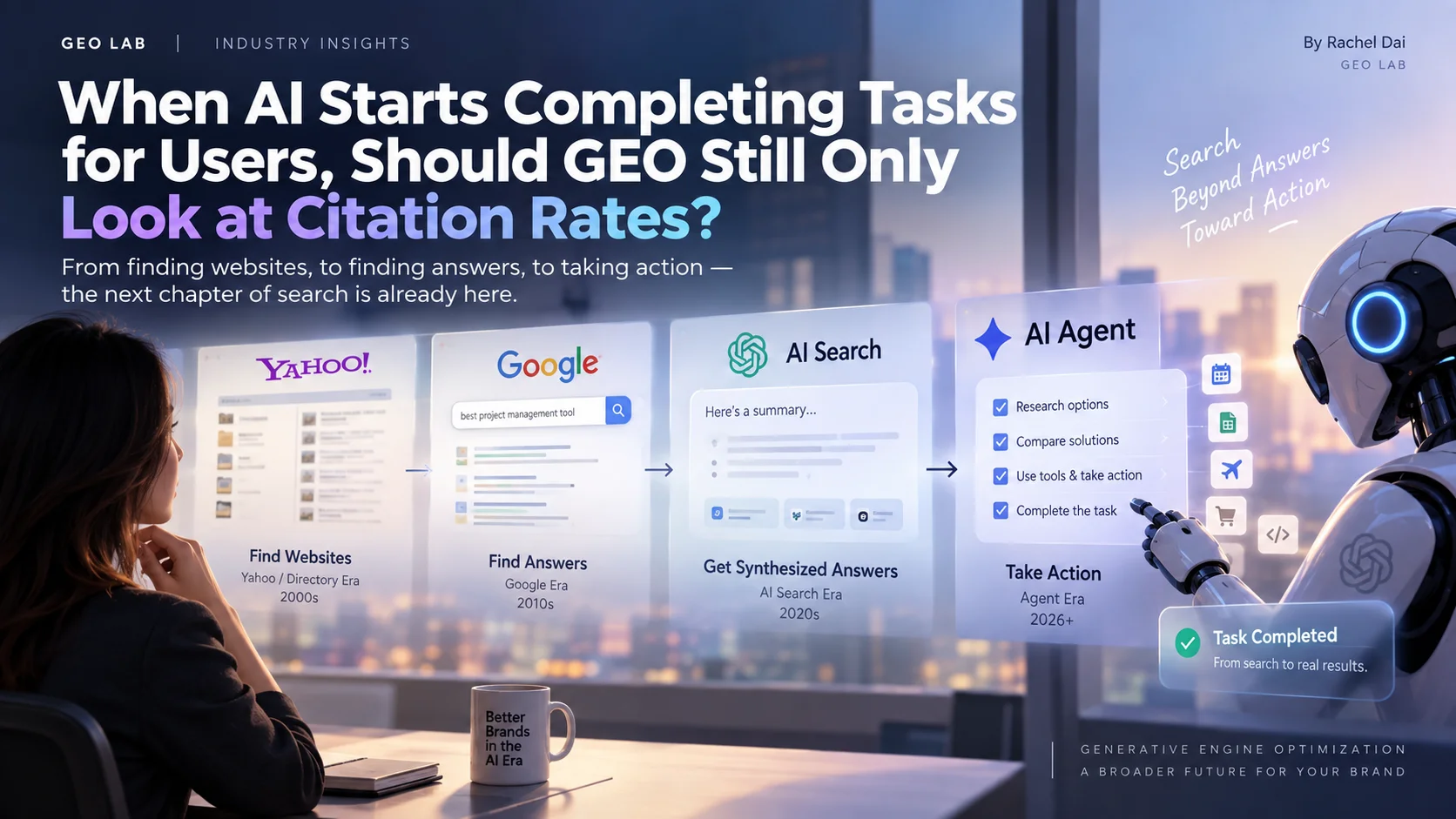
Yahoo helped us find websites, Google helped us find answers
I started doing SEO in 2005 at a digital marketing company in Hong Kong. Looking back over these twenty-plus years, the search entry point has been constantly changing, but what truly impacted business marketing each time wasn't just what the page looked like.
In the Yahoo era, the core question we faced was closer to "where is the website." Users entered a directory or search box, found a website, and went in to look at it themselves.
In the Google era, this took a big step forward. Search engines didn't just help you find websites—they became increasingly good at judging: for this question, which pages and answers are more relevant.
So over the past two decades, SEO went through many changes. From keywords to content quality, links, technical experience, and brand signals, businesses continuously adapted to new ranking methods.
But one thing actually hasn't changed much.
Searching, comparing, judging, clicking, and then acting were still primarily done by humans.
This is why when I looked at GPT-6 Astra, I felt this change deserved its own discussion. It didn't make me think about "whether Google will be replaced by someone," but rather whether search itself will continue to recede in its position within human-computer interaction.
The third shift brought by GPT-6: AI begins to cross beyond "answers" to do things
In the past, completing a task online roughly followed this process:
- A need arises;
- Open a search engine;
- Enter keywords;
- Browse multiple results;
- Compare websites and options;
- Make a judgment;
- Enter a website to complete the next step.
By the AI Search stage, the middle steps have already begun to be compressed. Users ask a question, and AI like ChatGPT, Gemini, and Perplexity can first search, organize, and structure information. What users receive is no longer just a row of links, but an organized answer.
The Agent stage may continue further:
User expresses goal → AI gathers information → evaluates options → calls tools → user authorizes key steps → AI continues executing the task.
This is also why the Agents API is worth watching. The capabilities OpenAI has announced so far already include sessions that work continuously over extended periods, tool and MCP connections, and hosted environments that can run code and process files.
So when I say "search is changing," I don't mean information retrieval will disappear.
What's changing is that the importance of humans personally performing the act of "searching" may decline.
"Isn't that still search?" — Half right, half wrong
A few days ago, I discussed this with a business owner doing overseas markets.
He said: "Isn't AI just going online to find information? What's the essential difference from search?"
That's a fair challenge.
I told him: "If you look at it from the perspective of information retrieval, of course it's still retrieval. The difference is that before, you searched and then did the next step yourself; in the future, AI may search and then continue to do the next step for you."
After I said that, he paused for half a second, then asked: "So businesses will be competing for more than just rankings?"
Exactly.
In the past, brands competed for "can users see me when they search." With AI Search, we started caring about "will AI understand me, mention me, and cite me when answering questions." If Agents continue to develop, businesses will also face a third question:
When AI completes tasks for users, will it include me as a candidate?
What truly changes across three generations of search is "who completes the next step"
| Stage | What users ask | What the system mainly does | What users still need to do | What brands compete for |
|---|---|---|---|---|
| Yahoo / Directory era | Where do I find it | Find websites | Browse and judge themselves | Entry point |
| Google era | Which answer is more relevant | Rank information and answers | Click, compare, act | Rankings and clicks |
| AI Search | How to solve this problem | Synthesize and generate answers | Judge, continue executing | Being understood, being cited |
| Agent stage | Help me complete this goal | Retrieve, judge, call tools, execute | Authorize and final decision | Being included in decision and action candidates |
One important point here: the emergence of a new entry point doesn't mean the previous generation's entry point disappears.
From Yahoo to Google, websites didn't disappear; from Google to AI Search, web pages and SEO don't become unimportant either. The future will likely be the same: traditional search, AI Search, and AI Agents coexisting long-term, with only the attention users allocate to them across different tasks shifting.
What this means for GEO: citation rates may just be an intermediate metric
Today, businesses doing Generative Engine Optimization, or GEO, naturally focus on several metrics: whether the brand appears, whether AI cites the official website, what sources the citations come from, and how AI visibility looks across different models.
These metrics are certainly valuable, and I don't think they should be overturned just because Agents have appeared.
But if AI begins to take on more judgment and execution work, we need to keep asking further:
- Has AI included this brand as a candidate?
- How does AI understand what scenarios this brand is suited for?
- When comparing several options simultaneously, at which step does this brand enter?
- If conditions change, will the brand still remain a candidate?
- When moving from information judgment to the next action, does this brand still exist?
"Being cited" and "being chosen" are becoming two different questions.
This is also why my team and I have consistently emphasized "performance monitoring" and "data analysis" in the AIPO Five Rings framework. Detection isn't about getting a pretty score—it's about knowing where in the AI decision chain the brand appears, why it appears, and at which step it disappears.
In the past, we observed answers; in the next stage, we may also need to start observing tasks.
Next-stage GEO: monitoring targets may need to extend from "answers" to "tasks"
Here's a simple example.
In the past, when doing GEO monitoring, we might test:
"Recommend a few XX SaaS suitable for enterprise use."
Then observe which brands ChatGPT, Gemini, Perplexity, and other platforms mention, whether our own brand appears, at what position, and whether the official website is cited.
These tests should still be retained.
But next, I would suggest adding another type of question:
"Help me compare a few options suitable for a 50-person team, considering budget, deployment difficulty, and use cases, and tell me what I should base my next-step decision on."
The two types of questions look similar, but the observation targets are actually different.
The former is closer to answer-based monitoring: is your brand in the AI's answer?
The latter is closer to task-based visibility: when AI begins to understand goals, add conditions, compare options, and drive users toward next-step decisions, can you still stay on the candidate list?
So I believe a direction worth researching for GEO monitoring going forward isn't simply adding more keywords or more prompts, but redesigning the monitoring questions.
From "does the brand appear," gradually observe "why does the brand enter the candidate list," "under what conditions will it exit the candidate list," and "does it still exist after entering the action stage."
This is actually where the AIPO Five Rings—detection, optimization, content and distribution, performance monitoring, and data analysis—need to interconnect. Businesses first establish a baseline for AI visibility, then adjust content and brand information based on real decision scenarios, and finally continuously observe changes, rather than treating a single AI answer as the result.
GEO's next stop may not be more exposure, but entering AI's judgment earlier
I don't think Google Search will disappear after the GPT-6 Astra release; nor do I think businesses should stop SEO and shift all budget to GEO.
Quite the opposite.
Having experienced Yahoo, Google, and today's AI Search, one thing has become increasingly clear: new entry points usually don't take away old ones overnight—they add new user behaviors on top of the old system.
SEO and GEO are also additive, not replacement.
As search moves from "giving people answers" to "acting on people's behalf," the position of brand competition will also continue shifting from answer pages toward the decision process.
What's truly worth continuous observation isn't which model will win, but how much judgment and execution authority users are willing to hand over to AI.
If AI is only responsible for answering, businesses compete for being understood, mentioned, and cited.
If AI begins to handle comparison and judgment, businesses also need to compete for entering the candidate list.
If AI further takes on task execution, then brand information, product data, third-party reviews, website content, and information structures that can be understood and invoked by machines will all face new requirements.
GEO's boundary may then extend from "does AI know me" to "under what circumstances will AI consider me."
What should different roles be observing now?
If you're a CMO or marketing director, I'd suggest not redefining marketing KPIs entirely just because of one GPT-6 Astra release. A more realistic approach is to add a set of Agent scenario tests on top of your existing AI visibility and AI citation monitoring. See whether the brand can persist from answers and comparisons through to the decision process.
If you're the head of an overseas-expanding business, I'd suggest taking another look at your official website, product data, and third-party information. In the past, when writing content, we first considered "can users understand it"; now we need to ask one more question: can AI clearly understand who my product is for, what problems it solves, how it differs from other options, and under what circumstances it should be considered.
If you're an SEO or GEO practitioner, I'd suggest continuing to monitor AI citation rates—there's no need to reject current metrics just because Agentic Search has appeared. But you can start building test samples for task-based AI search, extending the observation scope from prompt visibility toward real decision scenarios.
Yahoo taught us to find websites, Google taught us to find answers.
AI Agents are now raising a third question: if the system already knows what you want to do, does it still need to hand the "search" step back to you?
If you're already doing GEO, you can start by establishing a baseline for your current AI visibility, then gradually add task-based prompts to observe how the brand changes from "being discovered" to "being understood, compared, and entering action candidates." Having data first before deciding which metrics are worth adding is more practical than rebuilding an entire KPI system.
Related Questions
Will GPT-6 Astra replace Google Search?
There is currently no basis for judging that GPT-6 Astra will replace Google. What's more worth observing is that AI Agents are putting retrieval, judgment, and tool operation into a single task process, and the necessity for users to personally complete part of the search behavior may decline in the future.
What's the difference between AI Agents and AI search?
AI search mainly helps users obtain, organize, and understand information; AI Agents go further by continuously completing multi-step tasks around a goal, such as retrieving information, using tools, processing files, or operating software. As capabilities continue to develop, the boundary between the two may become increasingly blurred.
Why does GPT-6 Astra affect GEO?
What GEO practitioners should pay attention to isn't just Astra's answering capability, but that browsing, computer use, and complex multi-step work are combining. As AI moves from "answering questions" to "executing tasks," brand competition may also extend from visibility in AI answers to AI's judgment and task processes.
Will GEO still need to monitor AI citation rates in the future?
Yes. AI citation rates still help businesses understand the visibility of their brand and official website in AI answers. As Agent scenarios increase, observation dimensions such as candidate appearance, task scenario coverage, and decision-stage performance can gradually be added.
What is Agentic Search?
You can think of Agentic Search as: retrieval no longer necessarily being a step completed by the user alone, but becoming a capability that AI can invoke during task completion. After the user gives a goal, AI retrieves, analyzes, and compares as needed for the task, then connects with tools to complete subsequent steps.
What should businesses do now to prepare for AI Agents?
At this stage, there's no need to overhaul the entire marketing system because of a single model release. More practically, first establish a GEO visibility baseline, continue doing SEO and brand information development well, then gradually add real task-based prompts to observe how the brand performs across the stages of "being discovered—being understood—being compared—entering action candidates."