

Brand keywords from your DTC site being hijacked by third-party platforms? Here’s how cross‑border e‑commerce brands can build AI‑citable brand assets
When AI introduces your brand, it doesn’t cite your website
If you run a DTC brand in home & living, outdoor gear, beauty & personal care, or consumer electronics accessories, chances are your site is built on Shopify, WooCommerce, or a custom system. You’re also likely present on Amazon, Reddit, review sites, media articles, and overseas directories.
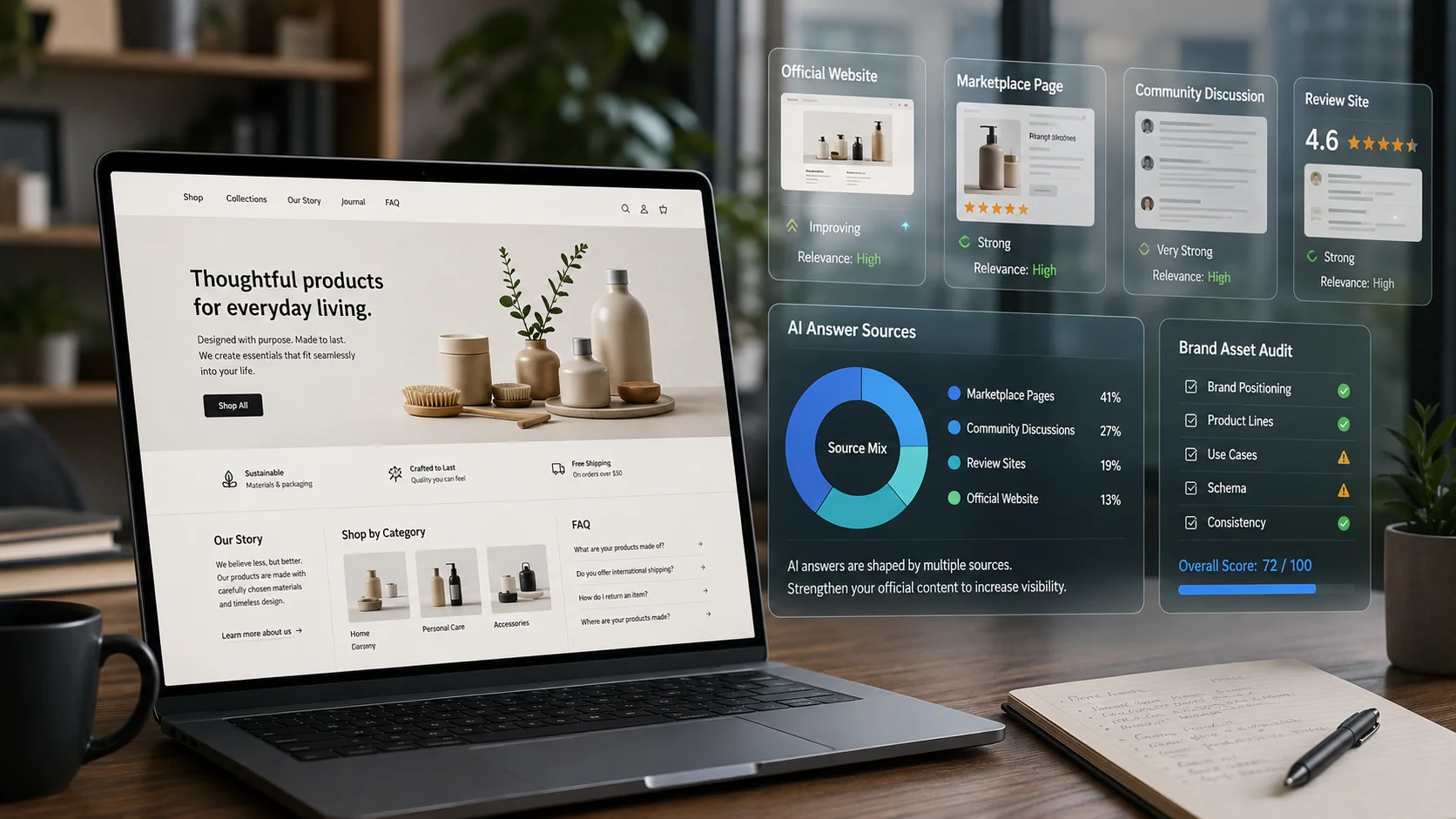
At first glance, your brand has multiple touchpoints globally. But when users ask ChatGPT, Gemini, or Perplexity “Is this brand any good?”, “Who is this brand for?”, or “What’s the difference between this brand and X?”, the AI’s answer often draws from Amazon pages, Reddit threads, or third-party reviews — not your official site.
This isn’t just a traffic issue. The deeper problem is that even though your brand has its own site, AI’s understanding of it comes from third-party pages. For DTC brands, the goal of Brand Keyword GEO isn’t just to rank for a search — it’s to build brand assets that are citable, verifiable, and consistently recognized by AI.
Why does AI rely on third-party pages when answering brand questions?
Thin website content leaves AI with few facts to extract
Many DTC sites have About Us, Brand Story, and Why Choose Us pages that read more like brand ads. They feature a vision, values, and emotional language, but don’t clearly state who the brand is, what products it makes, who it serves, what use cases it fits, or how it differs from competitors.
Human visitors might grasp the brand vibe through visuals, product imagery, and tone, but AI relies on extractable information. When the official site lacks stable facts, AI turns to other sources to fill in the gaps.
Third-party pages are easier for AI to cite
Amazon pages typically include product specs, customer reviews, Q&As, category info, and price ranges. Reddit threads contain real-world usage contexts. Review sites explicitly state “Best for X budget”, “Ideal for Y scenario”, and “How this compares to Z”. This content may not perfectly match the brand’s intended positioning, but it’s perfectly structured for AI to extract and paraphrase.
So, when a brand site says “We focus on quality and experience” while a review page says “Great for beginners” or “Perfect for small spaces”, AI is far more likely to cite the latter.
Inconsistent brand descriptions lead AI to form mixed judgments
A more subtle issue: the brand site, Amazon, Reddit, review sites, and media articles all mention the brand, but they describe it differently. The site positions it as professional-grade, the platform page highlights its low price, the review says it’s for beginners, and Reddit focuses on customer service experiences.
When combined, AI produces a mixed understanding. It can name the brand but struggles to consistently describe its positioning, product lines, target users, and use cases. For brand owners, this “unstable introduction” is more dangerous than not appearing at all.
I start by checking who AI cites before asking brands to publish more content
For this type of DTC brand, I always look at three things first: Who is AI citing? How is AI describing the brand? Are different sources talking about the same brand?
If brand keyword responses primarily come from Amazon, Reddit, and review sites, it signals a gap in the brand’s AI-citable content assets. If AI mentions the brand but with an unstable description, it means the brand entity info, product lines, use cases, and differentiators aren’t being expressed consistently. If the site, media articles, review sites, and platform pages don’t agree, AI will tend to favor whichever source is easiest to extract and most frequently cited.
Brand Keyword GEO isn’t about pushing your brand name to more places. It’s about giving AI a stable set of information sources to understand your brand.
The typical path for this scenario: first diagnose AI’s current citation sources, then fill the gaps in the brand’s site assets, then align the brand’s messaging across external sources, and finally monitor whether AI’s responses become more stable over time.
How should a DTC brand build AI-citable brand assets?
1. Audit your brand keyword responses across major AI engines
Start by running queries around your brand name, plus terms like “brand + review”, “brand + alternatives”, “brand + product category”, and “brand + is it worth it”. Record the results from ChatGPT, Gemini, Google AI Mode, Perplexity, and Google AI Overview.
Don’t just note whether the brand is mentioned — track which sources AI uses to explain the brand. Is it citing your site, Amazon, Reddit, review sites, media articles, or overseas directories? If the answer has consistently relied on third-party pages, your brand site content lacks citability in AI responses.
This step corresponds to a GEO Audit and performance monitoring. The goal isn’t to immediately edit pages but to identify which sources are capturing your brand keyword answers.
2. Compare brand descriptions across your site, platform pages, and reviews
Next, create a brand information comparison chart. Place the brand descriptions from your About Us page, Amazon brand page, popular Reddit discussions, review articles, and media pieces side-by-side. Compare brand positioning, main products, target users, price range, use cases, product advantages, and common objections.
When AI answers brand questions, it synthesizes multiple public sources. If these sources describe the brand inconsistently, AI will produce a fuzzy or even skewed brand perception.
This exercise helps you spot the differences between your site’s claims and external descriptions. For example, your site emphasizes professional use, but external reviews focus on beginners; your site highlights a complete product line, but Amazon only features one hero product. The more discrepancies, the more likely AI will interpret your brand as it appears on third-party pages.
3. Rewrite your About Us, Brand Story, and Why Choose Us pages
Many brand pages need to transition from “brand image pages” to “brand information sources”. Your About Us shouldn’t just state a vision — it should answer who the brand is, who it serves, what products it makes, and what scenarios it’s for. Your Brand Story shouldn’t just tell your founding story — it should also include brand background, product selection logic, and service scope.
Your Why Choose Us page shouldn’t just say “great quality” and “great experience”. A better approach is to support claims with factual information: materials, craftsmanship, use cases, shipping regions, return policies, and common purchase reasons.
Consider adding sections like “Who we serve”, “What we make”, “Where our products are used”, and “How to choose the right product”. This makes it easier for AI to extract relationships between the brand, its users, products, and scenarios.
4. Add brand entity information, product lines, and use cases
Your website also needs clear brand entity information, including Organization Schema, Brand Schema, Product Schema, and FAQPage Schema. Organization Schema can specify the brand name, official URL, logo, social accounts, and contact info. Product Schema can include product names, SKUs, images, categories, materials, specs, and use cases.
Meanwhile, create collection pages or industry pages for your main product lines. For example, an outdoor brand could build a page for “Outdoor Storage Solutions”, a beauty brand for “Skincare Tools for Sensitive Skin”, and a consumer electronics brand for “USB-C Accessories for Remote Work”.
AI doesn’t just need to know your brand name. It needs to understand the relationship between your brand and its category, product lines, and use cases. The clearer these relationships, the higher the chance AI will form a stable association when answering brand-related questions.
5. Align brand messaging across overseas directories, media articles, and review content
Just because you’ve updated your site doesn’t mean external signals are aligned. AI doesn’t look only at your website. For DTC brands, third-party pages often play a significant role in AI responses.
So, you need to synchronize the brand descriptions confirmed on your site with overseas directories, media articles, review content, partner pages, and brand introduction materials. Synchronization doesn’t mean exact duplication, but ensuring the brand positioning, product lines, target users, and key scenarios are consistent.
I recommend starting with 5-10 sources that AI is already citing in its answers — such as key review pages, media articles, brand directories, and partner pages — then gradually expand to other external assets.
Brand Keyword GEO requires continuous calibration, not a one-time site update
Brand Keyword GEO monitoring can be done weekly or bi-weekly. Your query set can include the brand name, plus “brand + review”, “brand + alternatives”, “brand + category”, and “brand + problem/solution”. Record changes in the citation sources from ChatGPT, Gemini, Perplexity, Google AI Mode, and Google AI Overview each time.
- Check if AI is starting to cite your site, brand pages, media articles, or directories instead of relying solely on Amazon, Reddit, and review sites.
- Check if AI’s description of brand positioning, product lines, target users, and use cases is becoming more consistent.
- Check what information third-party pages are providing that your site still hasn’t covered.
If AI continues to cite third-party pages, analyze what specific information those pages offer. If AI’s brand description remains unstable, go back to your site’s brand pages and external materials to unify expressions of product lines, use cases, and brand positioning.
The iteration here isn’t about endlessly tweaking slogans. It’s about continuously supplementing brand facts that AI can verify and cite.
What changes can you expect from this type of optimization?
Brand Keyword GEO shouldn’t be measured by a single metric. A more reasonable approach is to track whether your site citation frequency, brand keyword response accuracy, third-party information consistency, AI citation source structure, and brand asset completeness all improve together.
| Observation Dimension | Common State Before Optimization | 8-12 Week Observation Period | 3-6 Month Observation Period |
|---|---|---|---|
| Site Citation Frequency | Brand keyword responses rarely cite your site, more often citing Amazon, Reddit, review sites | Some brand keyword queries begin to include your site or brand pages as a reference source | Your site, brand pages, media articles, and directories form a more stable combination of reference sources |
| Brand Keyword Answer Accuracy | AI can mention the brand, but descriptions of its positioning, product lines, and use cases are unstable | Descriptions of the brand intro, main products, and use cases begin to converge | In most brand-related queries, AI’s description is closer to your site’s definition |
| Third-Party Info Consistency | Descriptions of the brand differ between your site, platform pages, review sites, and media articles | Key external pages that have been addressed begin to unify brand positioning and product line descriptions | Descriptions across major external sources largely align, reducing contradictions |
| AI Citation Source Structure | Platform pages, Reddit, and review sites are dominant; your site has a weak presence | Your site is starting to be mentioned or cited in some brand queries and long-tail questions | AI citation sources are more balanced, with your site and external materials jointly supporting brand perception |
| Brand Asset Completeness | About Us, Brand Story, Why Choose Us are thin on content, lacking factual information | Brand entity info, product lines, use cases, and FAQs are initially filled in | Your site forms a sustainably expandable library of brand content assets |
A checklist you can take back to your team
- Choose 20-30 brand-related queries. Don’t just search the brand name — include terms like review, alternatives, category, and use-case questions.
- Record the answer sources from ChatGPT, Gemini, Perplexity, Google AI Mode, and Google AI Overview. Note whether AI primarily cites your site or third-party pages.
- Create a comparison chart of brand descriptions from your site, Amazon, Reddit, review sites, and media articles. Identify differences in positioning, product lines, target users, and scenarios.
- Rewrite the About Us page so it answers “Who is the brand, who does it serve, what products does it make, and what scenarios is it for”.
- Rewrite the Brand Story page. Reduce vague expressions and add brand background, product selection logic, and service scope.
- Rewrite the Why Choose Us page. Support brand judgments with factual info like materials, scenarios, services, shipping, and return policies.
- Add Organization Schema, Brand Schema, Product Schema, and FAQPage Schema to your site.
- Prioritize syncing external sources that are already being cited by AI, including review pages, media articles, directories, and platform brand pages.
- Re-test brand keyword responses every 2-4 weeks. Check for changes in site citation rates, brand description accuracy, and third-party information consistency.
- Reverse-incorporate aspects that AI still misunderstands into your site’s FAQ, product line pages, or brand description pages.
If your DTC brand keywords are frequently being hijacked by Amazon, Reddit, or review sites in AI answers, I recommend starting with a GEO Audit. First, get a clear picture of who AI is citing now, how it describes your brand, and the inconsistencies between your site and third-party sources. Only then decide whether to prioritize updating your brand pages, fixing Schema, or syncing external content assets.
Related Questions
How is Brand Keyword GEO different from traditional SEO?
Traditional SEO focuses on search rankings and clicks. Brand Keyword GEO focuses on how AI understands, describes, and cites your brand. For DTC brands, the key isn’t just to be present — it’s for AI to introduce your brand in a way that closely matches your official definition.
Why does AI always cite Amazon or review sites when answering brand questions?
Because these pages typically contain more specific product specs, user feedback, comparison info, and use-case descriptions. Many brand sites only state a vision, lacking the factual content that AI can directly cite.
Does the About Us page help with GEO?
Yes, but only if it’s more than just a slogan. Your About Us should clearly state who the brand is, what products it makes, who it serves, what scenarios it’s for, and what verifiable information exists.
Why should third-party platform descriptions match your site?
AI synthesizes multiple public sources. If your site, platform pages, review sites, and media articles describe the brand’s positioning and product lines differently, AI will output a mixed or even skewed answer.
Should a DTC brand prioritize website content or external media placements?
The general recommendation is to build up your brand’s site assets first, then synchronize external materials. Your site is the benchmark. If your site itself is unclear, more external content will only send more fragmented signals to AI.
How long does it take to see changes from Brand Keyword GEO?
It depends on your site’s foundation, the volume of external sources, AI’s crawl frequency, and the query type. For this scenario, you can typically observe changes in citation sources for some brand queries within 8-12 weeks, and a more stable citation source combination may form within 3-6 months.