

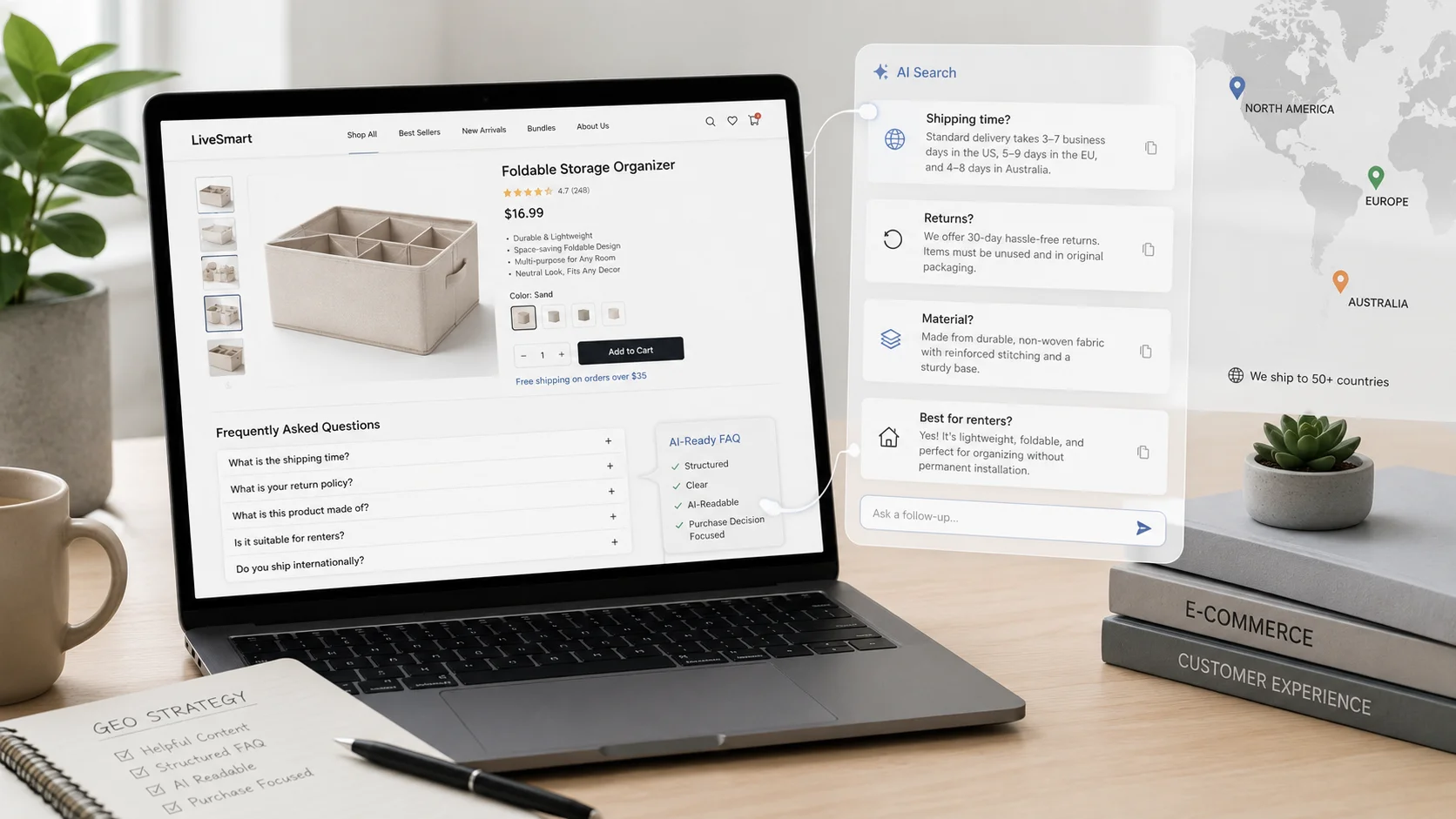
Why Low-ATO Shopify Stores Should Turn FAQ Pages into AI Q&A Entry Points First
If you run a low-ATO Shopify DTC store selling small-ticket items to users across North America, Europe, and Australia, your products are inexpensive, you have many SKUs, and the time from product discovery to purchase is short. However, right before paying, customers often ask numerous specific questions: Is this material suitable for outdoor use? How long is delivery to Europe? Can renters install this? Can I return it if the size is wrong? Are shipping costs different for two items?
These are exactly the types of questions that are well-suited for AI search citations. When users ask questions in ChatGPT, Gemini, Google AI Mode, Perplexity, or Google AI Overview, they often don't search for a brand name. Instead, they describe a purchase scenario: "What are some foldable home items suitable for a small balcony?" "What should budget-conscious users look for when buying this type of product?" "Is shipping and returns to Australia convenient?"
However, I see many low-ATO stores jumping straight to writing more blog posts when starting with GEO. For this scenario, my logic suggests a different approach: don't rush to write long articles first; the real place to start might be the FAQ.
This isn't about a specific client story, but a typical industry scenario for cross-border e-commerce Shopify stores. The issue isn't that product pages fail to convert, but that product page content is short, FAQs are scattered, and pre-sales information isn't organized into a Q&A structure that AI can easily parse. AI wants to answer users' purchase decision questions but struggles to extract complete information from within the site.
Why Low-ATO Shopify Stores Often Have Incomplete Information in AI Search
Product Pages Are Too Short: AI Lacks Key Decision Factors
Traditional Shopify product pages are typically well-optimized for conversions. Titles, prices, images, variants, short selling points, and user reviews are all front and center, allowing users to quickly decide whether to buy. However, for AI, this information is often insufficient.
When AI answers purchase decision questions, it needs more than a statement like "suitable for daily use." It needs more concrete factors: whether the material is waterproof, if the size fits small spaces, if tools are needed for installation, whether it's suitable for renters or homeowners, if there's a difference between winter and summer use, if shipping ranges are consistent for Europe and Australia, and if return policies have regional restrictions.
If a product page only has a few short selling points, AI can easily capture only superficial information. It might know what you sell, but not who it's for, who it isn't for, or what needs to be confirmed before purchase.
FAQs Are Too Scattered: AI Can't Find Stable Answers
Pre-sales questions for low-ATO stores are typically very real and numerous. They are often scattered across customer service chat logs, product reviews, social media comments, email inquiries, and return/exchange communications. Users ask these questions repeatedly, but these questions haven't been consolidated into indexable on-site content.
Many Shopify stores have an FAQ page, but the content is often limited to generic questions like "How long is shipping?" "Can I return items?" "How to contact us?" While this serves some customer service needs, it hasn't been restructured around real purchase decisions.
When AI answers questions like "Who is this product for?" "What are the differences from similar products?" or "Are returns convenient?", it needs structured, context-rich, and citable information. If the FAQ is just a list of general questions, AI will struggle to determine which answer corresponds to which product, market, or user scenario.
Questions Aren't Categorized: AI Struggles to Match User Intent
User questions for low-ATO cross-border e-commerce stores may seem fragmented, but they can typically be grouped into categories: price concerns, material concerns, logistics concerns, return/exchange concerns, use case concerns, and after-sales concerns.
If these questions aren't categorized, AI has difficulty matching natural language user queries with on-site answers. For example, if a user asks, "Is this product suitable for renters?", the site might have installation instructions, return policies, and size information, but they are scattered in different places, lacking a clear Q&A entry point. The result is that AI might cite platform pages, review pages, or general industry information instead of the brand's own explanations.
So when doing a GEO audit report, I typically look at three things first: how users actually ask questions in AI search, whether the brand is correctly mentioned, and whether the AI answer cites in-site FAQs or product descriptions. If these aren't clear, optimizing content later becomes a matter of guessing what to add.
Why FAQ is a Prime Candidate as a First GEO Content Asset
For low-ATO Shopify stores, my logic isn't "how much content to write first," but to first identify existing but unstructured pre-sales information and turn them into Q&A assets understandable by AI.
Logic 1: Identify high-frequency pre-sales questions first, then determine which ones will appear in AI search. Not all customer service questions deserve a high priority in GEO. For example, "Where can I find my order number?" is more of a post-sales process question, while "Is this material suitable for long-term outdoor use?" is closer to a purchase decision. The former can remain in the help center, while the latter is better suited for the FAQ module on product and category pages.
Logic 2: FAQs are closer to the purchase decision. Users on low-ATO sites won't spend a long time reading white papers; they are more likely to quickly confirm a few questions before ordering. FAQs have high information density, are relatively low-cost to optimize, and are easier to integrate contextually with product and category pages.
Logic 3: FAQ is not just a single page, but a set of Q&A assets. General questions can go on a standalone FAQ page, product-specific questions should be embedded within product pages, and purchase-decision questions should be embedded into category pages. This way, AI doesn't just see isolated Q&As; it understands the answers within the context of specific products and categories.
In our methodology, this type of issue is typically solved not by "writing more FAQs," but by restructuring FAQs along the user decision path: price, material, logistics, returns/exchanges, use cases, and after-sales concerns. Each category needs to clearly answer why the user hesitates, what conditions are needed, and which regions or products apply.
How to Break Down FAQ GEO into Actionable Steps
Step 1: Collect High-Frequency Pre-Sales Questions from Customer Service and User Reviews
The first step isn't writing, but organizing. Extract recurring questions from customer service chat logs, product reviews, social media comments, and email inquiries. Filter for "pre-purchase concerns" rather than just post-sales issues.
For example, regarding logistics, "Why hasn't my order arrived yet?" is a post-sales issue, whereas "How long does standard delivery to Europe typically take, and are there extra charges for remote areas?" is better suited for FAQ GEO. The former helps users track an order; the latter helps AI answer pre-purchase decision questions.
When organizing, assign three tags to each question: the corresponding product or category, the target market region, and the user's underlying concern. This way, when embedding them into product or category pages later, you won't end up stacking all questions onto a single page.
Step 2: Categorize FAQs by Price, Material, Logistics, Returns/Exchanges, and Use Cases
The second step is categorization. The FAQ for a low-ATO Shopify store shouldn't be a long list of dozens of questions. Instead, break them down into 5 to 6 user decision categories. Common categories include Price, Material, Logistics, Returns/Exchanges, Use Cases, and After-Sales Concerns.
Keep 3 to 8 high-frequency questions under each category. Answers shouldn't be too short, nor should they read like customer service scripts. An answer suitable for AI reading typically includes conditions, scope, and limitations. For example, "We support returns" is too vague, while "Items that are unused and in original packaging can typically be returned within the specified period. Return addresses and shipping fee rules may vary by region; please check the corresponding market instructions before ordering" is much clearer.
This approach addresses the issue of semantic relationships. AI isn't just looking for a single answer; it needs to understand the relationships between these questions: why price affects decisions, why material affects use cases, and why logistics affects purchase confidence.
Step 3: Embed Relevant FAQ Modules on Product and Category Pages
The third step is placement. FAQs shouldn't just live on a standalone page. For Shopify stores, product and category pages are crucial locations for AI to understand the product's context.
Product pages can embed questions about material, size, installation, suitability, and returns/exchanges. For example, for a small home product, the product page FAQ could answer: "Is it suitable for renters?" "Does it require drilling?" "Can it be used in semi-outdoor spaces?" "Can I return it if the size doesn't fit?" These questions are directly related to the specific product and shouldn't only be on a general FAQ page.
Category pages can embed questions about purchase logic, target audience, price range, and delivery regions. For example, a storage category page could answer: "How to choose on a budget?" "Which sizes should small-space users look at?" "Is the delivery range the same for North America and Europe?" This way, when AI answers category-level questions, it can more easily connect brand information with user scenarios.
Step 4: Add FAQPage Schema
The fourth step is to make the structure clearer. When adding schema.org/FAQPage markup to FAQ modules, ensure one Question corresponds to one Answer. Avoid mixing multiple questions into a single answer.
For example, "How long is shipping? Can I return items? Is shipping free?" should be three separate questions, not one long paragraph answer. Each question needs an independent answer that clearly states the applicable regions, product scope, and any limitations.
FAQPage Schema doesn't guarantee AI citation, but it helps search engines and AI systems more clearly identify the question-answer relationships. For Shopify stores, this is a foundational action worth prioritizing in FAQ GEO.
Step 5: Monitor Whether AI is Citing Answers from Your FAQ
The fifth step is monitoring. After your FAQ goes live, don't just check if the page is indexed or ranking for organic search. In GEO, you need to observe whether AI is absorbing, citing, or rewriting this information.
Design fixed prompts around the questions in your FAQ and check weekly for changes in answers from ChatGPT, Gemini, Google AI Mode, Perplexity, and Google AI Overview. For example: "How to choose budget-friendly outdoor furniture for a small balcony?" "What delivery and return issues should European users be aware of when buying from this type of Shopify brand?"
The goal isn't to see your brand every time, but to observe three changes: whether answers have started aligning with your on-site descriptions, whether errors about material or delivery range have decreased, and whether the brand or on-site information is mentioned in long-tail pre-sales questions.
How to Monitor and Iterate After FAQ Goes Live
GEO doesn't end once the FAQ is live. It usually takes sustained observation to see if AI has actually absorbed the information. This is especially true for low-ATO Shopify stores with many SKUs, multiple markets, and policies that change frequently. A one-time FAQ creation can quickly lead to information gaps.
I recommend monitoring at least three types of changes. First, FAQ citation frequency. Check if AI is directly citing or indirectly absorbing FAQ answers. Direct citation may not happen every time, but indirect absorption is also valuable—for example, when the material, usage conditions, and delivery range in the answer start to match your on-site descriptions.
Second, AI answer accuracy. Common errors for low-ATO cross-border stores include applying one region's delivery policy to all regions, stating the wrong material, describing return conditions too broadly, or using information from third-party platform pages as brand information.
Third, coverage of long-tail questions. Check if questions about price, material, logistics, returns/exchanges, and use cases are gradually being covered. If a certain category of questions is consistently not recognized, consider expanding it from a FAQ into a category description, buying guide, or creating external distribution content to provide AI with more cross-referencing information.
- If AI answers are inaccurate, go back to the FAQ answer itself and add specific limitations, applicable scope, delivery regions, and return rules.
- If AI only cites platform pages, check if your website's FAQ is too generic and lacks product page context.
- If AI doesn't react to certain categories of questions, move those questions to category pages or buying guides, addressing them with more complete scenario explanations.
What Changes Can Typically Be Observed from FAQ GEO?
The table below is not a client result or a promised outcome. It is a projection for the industry scenario based on the logic of content restructuring for low-ATO Shopify stores. Observation periods can vary depending on the brand's baseline, indexation status, external content distribution, and AI platform performance.
| Observation Dimension | Common Status Before Optimization | Observable Change in 6-10 Weeks | Observable Change in ~3 Months |
|---|---|---|---|
| FAQ Citation Frequency | On-site FAQ information rarely appears in AI answers | Some long-tail pre-sales questions start being recognized or indirectly absorbed | More stable answer citations emerge around price, material, logistics, and returns/exchanges |
| AI Answer Accuracy | Incomplete information on delivery range, material, and return rules is common | Obvious errors decrease; some answers start to align with on-site descriptions | Answers to core pre-sales questions are closer to brand-controlled information |
| Long-Tail Question Coverage | Questions are scattered; lacks systematic coverage | Forms coverage across 4-6 FAQ topic categories | Can be further expanded to category pages, buying guides, and external content based on monitoring results |
| On-Site Content Readability | FAQ exists in isolation; weak connection to product pages | Product and category pages begin to host specific Q&As | FAQ becomes a key entry point for AI to understand products, services, and purchase conditions |
For this type of site, I care more about the change from "nonexistent to existent." For example, AI previously couldn't see the on-site FAQ at all, but later started absorbing FAQ answers in some long-tail pre-sales questions; AI used to frequently get the delivery range wrong, but now errors have visibly decreased; previously only vague product descriptions existed, but now questions about price, material, logistics, and returns/exchanges are forming a monitorable content coverage.
The value of FAQ isn't to make the customer service page longer, but to organize the real questions users ask before buying into content assets that AI can identify, understand, and cite in specific scenarios.
Action Checklist for Low-ATO Shopify Stores
If you're deciding whether to implement FAQ GEO, start with this self-check sequence. It doesn't require a massive site-wide overhaul initially. It's better suited for a baseline diagnosis first, followed by iterative small steps.
- Collect real pre-sales questions from customer service logs, product reviews, social media comments, and email inquiries. Don't just write FAQs based on your internal team's assumptions.
- Group questions into categories like Price, Material, Logistics, Returns/Exchanges, Use Cases, and After-Sales Concerns. Keep high-frequency questions in each category.
- Write each FAQ answer with clear applicability conditions, such as applicable region, product scope, time frame, and return limitations. Don't just write a single vague sentence.
- Embed FAQs directly related to a specific product on its product page, covering material, size, installation, suitability, and returns.
- Embed purchase-decision FAQs on category pages, covering target audience, material differences, price range, delivery regions, and use cases.
- Add FAQPage Schema to your FAQ modules to make question-answer relationships easier to identify.
- Use fixed prompts weekly to check answer variations in ChatGPT, Gemini, Google AI Mode, Perplexity, and Google AI Overview.
- Based on errors found in AI answers, go back and supplement your FAQs with specific limitations, regional differences, and product details.
Based on our team's years of hands-on experience in the GEO field, low-ATO Shopify stores don't have to start with a massive content engineering project when doing GEO. FAQ is often an easier starting point where changes are more visible. It connects real user questions, indexable on-site content, and purchase decision scenarios in AI search.
Related Questions
Why are low-ATO Shopify stores well-suited to start with FAQ GEO first?
Because the purchase decision for these types of stores is usually fast, but users are highly focused on price, logistics, returns/exchanges, material, and use cases. FAQ can organize these high-frequency questions into a Q&A structure that AI can easily read, which is closer to the purchase decision than starting with a large number of blog posts.
Is it true that the more FAQs a page has, the more likely it is to be cited by AI?
No. The key to FAQ is not quantity, but whether the questions are real, the categorization is clear, the answers are complete, and whether it has contextual relevance to product and category pages. Many FAQ pages have many questions, but AI still struggles to determine which answers are relevant to which specific product.
My Shopify product page already has descriptions. Do I still need a FAQ?
Yes. Product descriptions usually focus on selling points, while FAQs are closer to real user questions, such as "Can I return it?" "How long to deliver to Europe?" "Is this material suitable for outdoors?" When AI answers natural language questions, it often needs this type of Q&A information.
What role does FAQPage Schema play in GEO?
FAQPage Schema helps search engines and AI systems more clearly identify the question-answer relationships on a page. It doesn't guarantee citation results, but it improves the readability of the content structure and is a foundational action worth prioritizing for Shopify stores doing FAQ GEO.
Should FAQ be on a standalone page or within product pages?
Both is ideal, but not just a standalone FAQ page. For Shopify stores, it's better to put general questions on a FAQ page, embed product-specific questions on product pages, and place purchase-decision questions on category pages. This way, AI can more easily understand the specific context for each question.
After doing FAQ GEO, how do I determine if it's working?
Use fixed prompts weekly to check answer variations in ChatGPT, Gemini, Google AI Mode, Perplexity, and Google AI Overview. Focus on whether the FAQ is being directly cited, whether the answers are more accurate, and whether more long-tail pre-sales questions are being covered, rather than just checking if the page is live.
If you're deciding whether to implement GEO, we recommend starting with a baseline diagnosis. You can manually test it, or use our free Audit to see if AI can find your FAQ, correctly understand your product information, and mention your brand in long-tail pre-sales questions.