

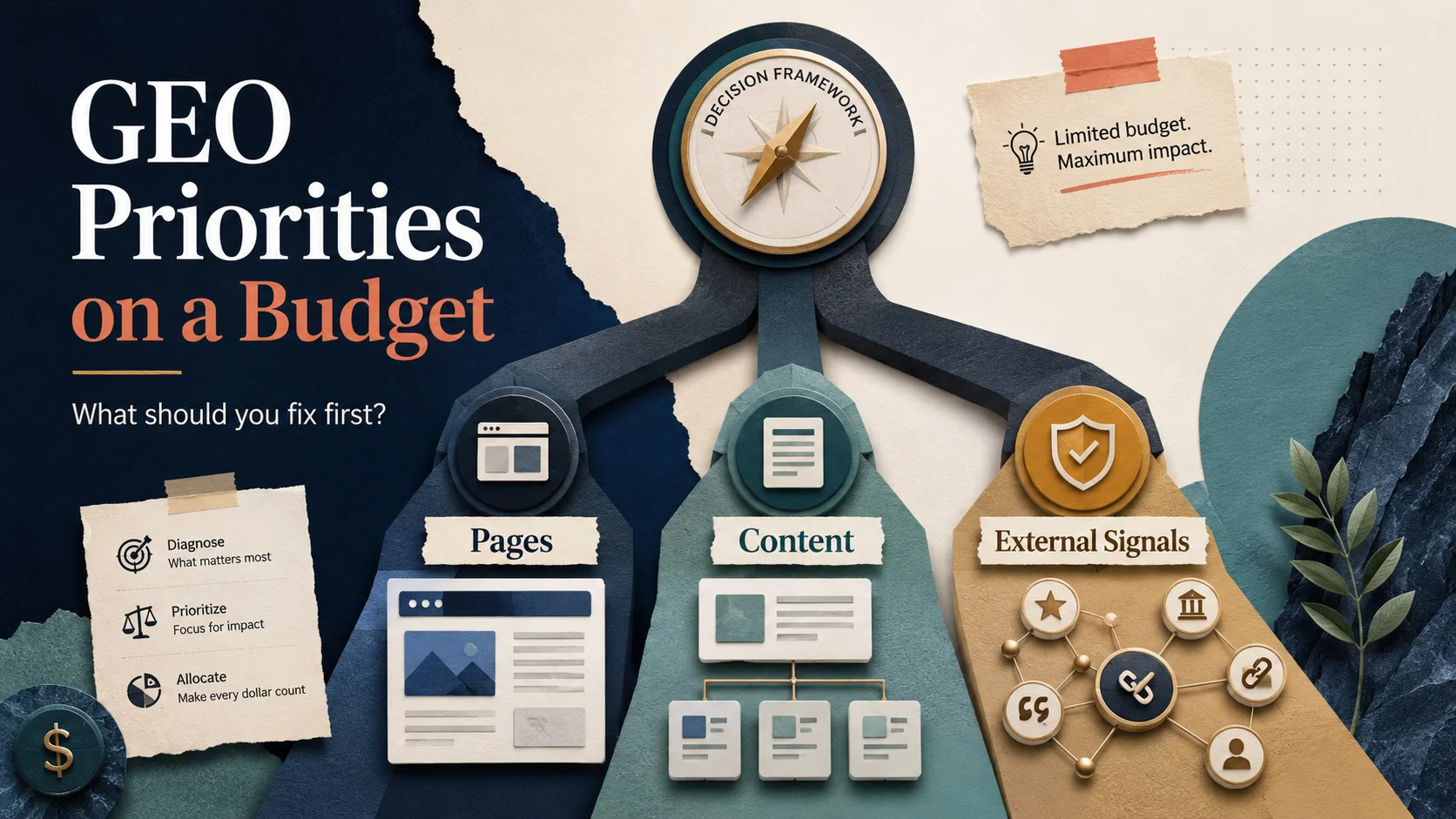
If you run a B2B company targeting North American, European, or Australian markets, your website likely already has service pages, product pages, and several industry articles. Your team knows GEO is necessary, but when it comes to execution, a practical question quickly emerges: with limited budget, should you prioritize revamping your website pages, producing more content, or supplementing external assets like LinkedIn, industry directories, and third-party profiles?
Marketing teams often favor increasing posting frequency, SEO teams focus on page structure, crawlability, and Schema, while sales teams lean towards adding case studies, testimonials, and industry endorsements. All three directions have value, but management often struggles to identify which one addresses the most critical current gap.
For this scenario, my assessment is that there is no fixed execution order for pages, content, and external assets. What truly needs priority is determining whether AI currently lacks a comprehensible website foundation, quotable problem-solving content, or verifiable external trust signals.
Why Does AI Still Struggle to Identify Your Business Despite Having Ample Content?
For professional service-oriented B2B companies going global and cross-border B2B SaaS enterprises, brand visibility issues in AI search are rarely caused by a single article or technical tag. Instead, they stem from a lack of consistent information across your website pages, problem-focused content, and external assets.
Information Comprehension Barriers on Core Pages
Suppose your company uses WordPress, a proprietary standalone site, React, Vue, or a Headless CMS. The visual design might be complete, but your scope of services, target audience, and business boundaries may not be included in crawlable text. Some information might be hidden in images, carousels, pop-ups, videos, or complex interactions. AI may discover your brand name but struggle to accurately determine what services you offer or which clients you serve.
Another common issue is confusing page title hierarchy. The homepage might only have a slogan, service pages lack clear H1 and H2 tags, and FAQ, internal links, and structured data are incomplete. Users can understand the page through experience, but machines struggle to quickly extract your business category, service scope, and applicable conditions.
Articles Exist, But Don't Address Decision-Making Questions
I see many B2B companies consistently publishing company news, product updates, and general industry information. However, questions potential buyers actually ask—like "Which companies is this service suitable for?", "What are the differences between options?", "What preparations are needed before implementation?", "When is this not the right choice?"—are often not directly answered on the website.
If your content isn't structured around problem recognition, solution comparison, service selection, and vendor evaluation, AI will struggle to connect your brand with specific purchasing scenarios, even after crawling many pages. A lack of internal links between articles also scatters topical information unnecessarily.
External Assets Exist, But Brand Descriptions Contradict Each Other
LinkedIn, industry directories, partner pages, review platforms, and event profiles are sources AI uses to cross-validate brand information. If the business category, service names, target regions, and website links across these sources are inconsistent, AI may form a fuzzy or even incorrect brand perception.
For instance, your website might define your company as a data analysis platform for large enterprises, while LinkedIn lists you only as a software development company, and some directory categorizes you as a marketing tool. Each description alone might not be wrong, but together, they create an unclear business entity.
Teams Lack a Unified Budget Decision Framework
Marketing, SEO, and sales usually operate from their own metrics: marketing focuses on content output, SEO on indexing and structure, and sales on case studies and trust signals. If the team doesn't use a consistent set of GEO queries for baseline testing, budget is easily spread evenly—a page tweak here, a few articles there, some external platform posts elsewhere. The result is not improvement in all three areas, but each remains in a foundational stage, making it hard to attribute any changes.
How to Decide What to Prioritize: Pages, Content, or External Assets?
In my methodology, this problem is diagnosed across five dimensions. They aren't five projects to start simultaneously, but a diagnostic chart to identify the primary limiting factor.
Dimension 1: Page Crawlability
First, check if core service information appears directly in HTML body text. Does the page have a clear heading hierarchy? Is important content overly reliant on images, PDFs, carousels, or front-end interactions? Can search engines and AI crawlers access core pages?
For React, Vue, or Headless CMS sites, inspect the server-returned page source code, not just the browser-rendered view. If the source code lacks full body text, AI may receive far less information than the user sees.
If AI cannot even fully read what services your company offers, budget should first go towards page restructuring.
Dimension 2: Brand Entity Clarity
Check if your homepage, About Us, service pages, and industry solution pages use consistent brand names and business positioning, clearly stating target customers, geographic regions, core industries, business scope, and limitations.
On the technical side, verify if schema.org/Organization, WebSite, and Service are deployed, and ensure no conflicting company descriptions exist across different pages.
If the brand can be found, but AI frequently categorizes it incorrectly or cannot explain which customers it suits, prioritize improving entity information and trust pages.
Dimension 3: Content Coverage Depth
Check if the website covers various customer questions—from problem recognition and solution comparison to vendor selection—including industry problems, selection criteria, service comparisons, application scenarios, and common misconceptions.
Core articles should have a clear question, direct conclusion, judgment criteria, applicable conditions, and internal links. A few unrelated articles struggle to form stable topical context. Content clusters built around a specific service make it easier for AI to understand the relationship between your brand and customer problems.
If the page foundation is usable but the brand is consistently absent from long-tail and comparative queries, budget should shift towards building a content matrix.
Dimension 4: Third-Party Trust Signals
Verify the existence and consistency of your LinkedIn company page, industry association or directory listings, partner pages, professional review platforms, press materials, and event profiles. Are the name, business category, service description, target market, and website link consistent?
The role of external assets isn't to repeat slogans, but for different sources to collectively support the same brand positioning. Verifiable partnerships, credentials, industry participation records, and professional evaluations are often more valuable than generic brand introductions.
If website pages and content are relatively complete, but AI consistently cites other companies or industry platforms for vendor recommendation queries, check if external validation is insufficient.
Dimension 5: Current AI Mention Status
Test using a consistent set of core GEO queries across ChatGPT, Gemini, Perplexity, Google AI Overview, and Google AI Mode. Record whether the brand appears, how AI describes the company, whether the answer cites the website or third-party sources, and whether the brand positioning is consistent across different platforms.
Don't just record "brand found". A brand mentioned but with wrong positioning versus a brand completely absent are two different problems. Website cited without entering recommendation lists versus answers citing only third-party sources require different adjustment strategies.
After completing the five dimensions, you can form three types of judgments:
- Pages cannot be fully read, or business positioning is unclear: Prioritize pages.
- Page foundation is usable, but coverage of customer questions is insufficient: Prioritize content.
- Pages and content are relatively complete, but external validation is lacking: Prioritize external assets.
Some companies may have multiple issues simultaneously, but budget should still be invested in phases targeting the primary bottleneck affecting core queries, rather than being evenly distributed.
How Should Budget Priorities Translate into Specific Execution?
Establish a GEO Budget Priority Diagnostic Table
First, define a fixed set of queries covering brand recognition, industry problems, solution comparisons, application scenarios, and vendor selection. Test the same queries across multiple AI platforms, recording brand mentions, cited pages, answer positioning, and competing brands present.
Each diagnostic dimension can be marked as "usable", "gap exists", or "needs priority". The goal isn't to create a complex score, but for marketing, SEO, sales, and management to discuss budgets using the same evidence.
Looking solely at article count, organic traffic, or backlink numbers doesn't directly reveal the main limiting factor for GEO. Unified diagnostics reduce judgment discrepancies between departments and prevent multiple unprioritized projects from starting simultaneously.
Check if Core Pages Are Eligible for AI Comprehension
Prioritize checking the homepage, About Us, service pages, product pages, industry solution pages, contact page, and credentials page. Each core page should answer a few basic questions: What services does the company offer? Which customers does it target? Which regions and industries does it serve? What business problems does it solve? What are the applicable conditions or limitations? What related pages can the user explore next?
Technical checks include H1, H2 hierarchy, body text, internal links, Canonical tags, index status, and structured data like Organization, WebSite, Service, and FAQPage.
Schema helps systems identify page types and entity relationships but cannot replace body text. Target customers, service scope, and business boundaries still need to be written directly into the page, not just placed in structured data.
When the Page Foundation is Weak, Prioritize Core Page Revamps
If you are a B2B company with a more complex service structure, don't rush to increase article count. First, rewrite service pages, product positioning pages, About Us, and industry solution pages. Ensure each page clearly expresses target customers, business scenarios, service processes, applicable company types, common questions, and relevant credentials.
Establish internal links between service pages. For example, an industry solution page can link to the corresponding service page, which then links to implementation processes, comparison articles, and FAQ pages. This allows AI to continue from a question page to find your company's formal service description.
For front-end rendered sites, confirm that server-side rendering or pre-rendered results contain the complete body text. Even if external assets bring brand exposure, they ultimately need to point to a clear, crawlable, and verifiable website page.
When Pages are Usable but Query Coverage is Insufficient, Build a Content Matrix
Content planning can revolve around five types of questions: industry issues, selection criteria, service comparisons, application scenarios, and common misconceptions.
Suppose your company offers a B2B SaaS service. You could plan content like "Which companies need this type of software?", "How do different deployment methods compare?", "What data is needed before implementation?", "What are the differences in purchasing decisions across regions?", "When is this solution not the right choice?".
Each article should include a clear question, a direct conclusion, judgment criteria, applicable scenarios, and common inquiries, linking internally to the corresponding service page. Key articles can include Article or FAQPage markup, but structured data should match the page's actual content.
AI answers typically organize information around specific questions. Without question-focused content in addition to company introduction pages, it's hard for your brand to enter more decision-making scenarios.
When the Website is Complete but Credibility is Lacking, Supplement External Assets
External assets can include LinkedIn company pages, industry association or directory listings, partner pages, software review platforms, press materials, guest speaker profiles, event pages, and industry content platforms.
Strive for consistency in brand name, website link, business category, service description, target market, core industries, and contact information across all assets. External content shouldn't just copy the website slogan but should provide clear industry positioning, service scope, and verifiable facts.
Based on my team's years of practical observation in the GEO field, when a website's self-description is relatively complete but external validation is lacking, companies with more consistent third-party assets are generally easier for systems to cross-validate. The goal here isn't platform quantity, but consistency among a few highly relevant sources.
How Should You Monitor and Adjust After Completing One Round of Optimization?
GEO isn't about waiting for results after finishing a round of page edits or content publishing. It's about continuously assessing whether AI's understanding of your brand has changed using fixed queries.
Establish a Fixed Query Set
Queries should cover brand and service recognition, industry issues, service comparisons, application scenarios, vendor selection, and pre-purchase decision questions. Avoid changing core queries frequently during the monitoring period, or results will be hard to compare.
Record Five Types of Information Each Time
- Is the brand mentioned?
- How does AI describe the brand?
- In which types of queries does the brand appear?
- Does the answer cite the website or third-party sources?
- Have the competing brands in the responses changed?
Determine Adjustment Direction Based on Performance
Brand completely absent: Check page crawlability and relevant question coverage. Brand present but positioned incorrectly: Check entity descriptions and page consistency. Website cited but brand not in recommendations: Strengthen the connection between content and the target question. Answers mainly cite third-party sources but not the website: Strengthen core page information and internal links. Website complete but consistently lacks external validation: Supplement highly relevant third-party assets.
Maintain a Stable Monitoring Cadence
Conduct basic query recording weekly, a phase review every four weeks, and correlate changes with page edits, content publishing, and external asset launches. A single appearance of your brand doesn't mean optimization is stable. Consistent positioning across multiple rounds of the same type of query is a better indicator of whether the direction is effective. After each review, decide the next phase's budget allocation for page strengthening, content expansion, external assets, technical fixes, or existing content updates.
What Phased Changes Are Typical Under Different Baseline Conditions?
The following ranges are industry scenario projections. Actual progress depends on website foundation, page crawlability, content quality, existing brand awareness, and third-party asset accumulation.
| Observation Dimension | Typical Starting State | Phased Change | Reference Timeline |
|---|---|---|---|
| Priority Judgment Efficiency | Marketing, SEO, and sales advance projects separately, budget dispersed | Able to form a phased execution sequence based on the three types of gaps (page, content, external assets) | Typically 1—2 weeks for diagnosis |
| AI Understanding of Brand Positioning | Occasionally identifies brand name, but service scope, target clients, and application scenarios are unclear | Descriptions of company positioning and service scope gradually become consistent in some core queries | Typically 4—8 weeks to observe change |
| Core GEO Query Coverage | Brand largely invisible or mentions unstable in some core questions | Brand mentions, website citations, or third-party asset citations start appearing for some highly relevant questions | Typically 8—12 weeks or longer |
| Resource Allocation Stability | Pages, content, and external assets all advanced simultaneously, difficult to assess individual impact | Investment allocated in phases based on diagnostic results, with next cycle's focus adjusted per monitoring outcomes | Typically 3—6 months to form synergy |
These timelines are not a commitment to AI mentions or citation results. Actual progression speed varies based on website crawl conditions, content accumulation, and external asset quality.
Which GEO Budget Checklist Can Your Team Use Directly?
- Define a set of core GEO queries covering brand, industry, comparison, and decision scenarios.
- Test the same set of queries on ChatGPT, Gemini, Perplexity, Google AI Overview, and Google AI Mode.
- Check if the homepage, About Us, service pages, and solution pages contain crawlable body text.
- Verify consistency in brand name, target customers, service scope, and target regions.
- Deploy or check Organization, WebSite, Service, and FAQPage structured data.
- Assess if existing content covers industry issues, selection criteria, service comparisons, and application scenarios.
- Standardize company information across LinkedIn, industry directories, partner pages, and press materials.
- Record brand mentions, citation sources, and positioning accuracy weekly, adjust budget by phase.
The judgment principle can be further condensed into five sentences: If the website cannot be fully read, fix pages first. If AI cannot accurately understand the company, improve entity and trust pages first. If AI lacks context to answer questions, build a content matrix first. If the website is complete but lacks external validation, supplement third-party assets first. If multiple issues exist simultaneously, address the main bottleneck impacting core queries first, then proceed to the next phase.
When your team is still debating whether to fix pages first, write content, or supplement external assets, start with a baseline diagnosis. You can test manually or use our free GEO Audit—the key is to first see how AI understands your brand and where the most obvious current gaps lie.
Related Questions
With a limited GEO budget, should I fix the website or write articles first?
First, check if core pages are crawlable and if AI can accurately understand your company's service scope. If pages are thin, poorly structured, or key information is in images and interactive elements, complete the page foundation first. If pages are usable but question coverage is lacking, then expand content.
Our company website has many articles. Why does AI search still rarely mention our brand?
Article quantity doesn't directly represent query coverage. Check if the content answers genuine customer questions about industry, comparison, and selection. Also, confirm that articles form topical connections and clearly link back to your brand's services.
Is deploying Schema necessary for GEO?
Schema helps search engines and some AI systems identify your business, services, and page types, but it cannot replace body content, brand entity information, and external trust signals. A better approach is to handle Schema, page content, internal links, and entity consistency together.
Can we publish articles on external platforms if our website isn't perfect yet?
You can, but it's not recommended to put the primary budget into external content first. If the website page the external asset points to lacks clear positioning and crawlable information, AI may still struggle to confirm what exactly your company offers, even after finding the external content.
How do we know if our company lacks content or external trust signals?
Observe AI's citation sources. If AI can accurately read your website but consistently cites other companies or industry platforms for vendor recommendations and brand comparisons, external trust signals may be insufficient. If company content is simply absent from relevant questions, prioritize filling query coverage gaps.
How long does it usually take to see results from GEO optimization?
Typically, diagnosis and priority assessment take 1—2 weeks. Changes in brand positioning understanding can be observed in 4—8 weeks. Mentions and citations in some highly relevant queries may take 8—12 weeks or longer. Actual timelines depend on the website foundation, content quality, crawlability, and third-party asset accumulation.