If you're a B2B SaaS company targeting the North American, European, or Australian markets, and your website already has Organization, Service, and FAQPage Schema deployed with no obvious syntax errors detected, yet when potential customers ask questions like "What are some service providers suitable for mid-sized enterprises?" or "Which tools can solve a specific business problem?", ChatGPT, Gemini, and Perplexity still rarely mention your brand – then adding more Schema is usually not the direct solution.
These websites often have already done basic SEO. Pages are indexed by search engines, and titles, descriptions, and canonical URLs are generally complete. What truly confuses marketing teams is this: the code looks fine, but AI descriptions of the company's category, target customers, and business scope are unstable. Sometimes it labels a SaaS platform a consulting firm, other times it only cites LinkedIn or industry directories, and sometimes it can't even find the core service pages on your website.
I see many B2B international marketing teams stuck here. Not because they didn't implement Schema, but because they mistook "valid code" for "semantic understanding."
Why Does AI Still Not Understand Your Company Accurately Even When Schema Passes Validation?
Schema is Syntactically Valid, But Page Copy is Inconsistent
Imagine a company defines itself as a B2B SaaS provider in JSON-LD, but the homepage body copy uses multiple terms like "consulting firm," "technology platform," and "digital solution provider" interchangeably. The About Us page might describe the business as professional services. Individually, these words seem fine, but together, the brand category becomes unclear.
Similar issues occur in specific fields. The Schema 'name' uses the full brand name, but the page title uses an abbreviation. The 'description' emphasizes software capabilities, but the body copy primarily discusses manual delivery. The 'provider' and 'brand' fields don't match the main entity name on the page. Machines can read these fields, but that doesn't mean they can determine which description represents the company's stable, long-term positioning.
When different pages on your website and external sources repeatedly use varying classifications, AI may downplay your brand in its answers or use vaguer labels to describe your company.
Pages Have Machine Markup, But Lack Directly Citable Body Text
Schema is structured expression, not a substitute for body copy. Many B2B service pages only have a marketing slogan, a few feature names, and a contact form. They lack answers to the questions users actually ask: What is this service? Who is it for? What problem does it solve? What does it include? What are its limitations?
For AI, whether a page is citable largely depends on whether it can extract relatively complete answer units from the visible body text. For example, specific phrasings like "suitable for mid-sized manufacturing companies entering the North American market," "does not include local legal advice," or "typically completes data assessment before entering system configuration" are more likely to support user questions than generic statements like "helping enterprises grow efficiently."
If a page lacks definitions, scenarios, boundaries, and processes, even adding Service or FAQPage markup only tells the machine that a structure exists. It won't have enough content to answer more specific questions.
Brand Entity Information is Scattered, Lacking External Cross-Verification
Suppose your website describes the company as a SaaS platform, but your LinkedIn company page still says "IT Consulting Services" from years ago, an industry directory uses a different brand name, and your partners page links to an old domain. For this scenario, my logical deduction is: the problem isn't isolated to one page anymore; the brand entity's expression across the public web is inconsistent.
'sameAs' is also often misused. Some websites link it to search results pages, inactive social accounts, unofficial directories, or inaccessible pages. Doing this doesn't automatically increase credibility; it can actually make entity relationships even more ambiguous.
For AI, Schema is more like a structured instruction manual. A correctly formatted manual only proves it can be read. It's the combination of the page's body copy supporting this manual, other pages on the site using the same descriptions, and external sources providing cross-validation that affects whether the brand perception is clear.
Facing Weak Citations, Which Layer Should You Troubleshoot First?
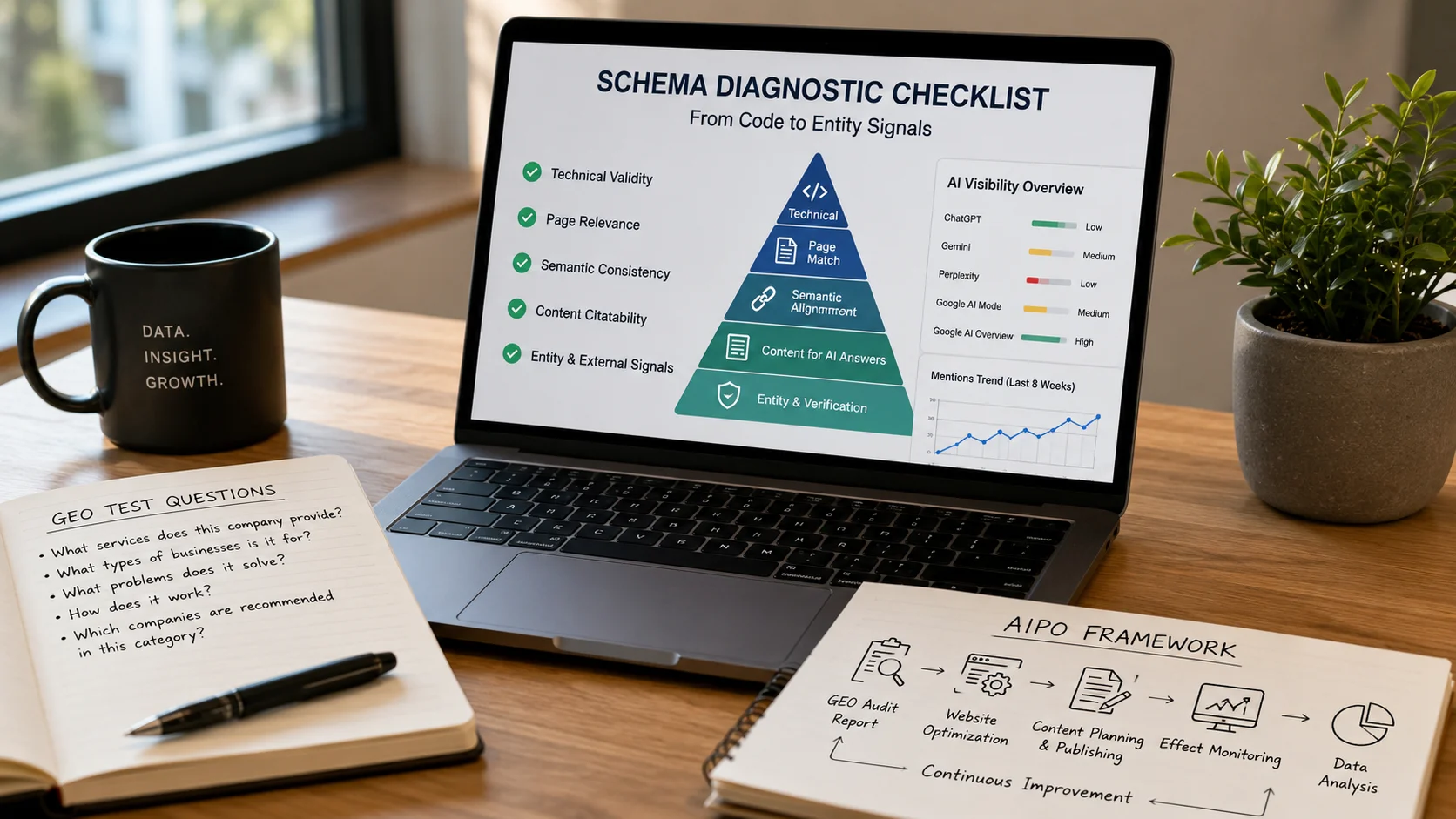
In my methodology, this type of problem usually doesn't start with "adding another Schema." Instead, I diagnose it using a five-layer sequence. Don't move to the next layer without confirming the previous one, and don't rewrite pages, modify fields, and update external sources all at once, or it will be difficult to determine which change caused the effect.
Technical Validity: Can the Machine Read the Structured Information?
First, check if the JSON syntax is complete, the Schema types are valid, the nesting hierarchy is logical, and the URLs are accessible. Also, confirm that markup hasn't been injected multiple times by plugins, overwritten during rendering, or blocked by robots.txt, page permissions, or script loading issues.
This layer answers only one question: Can the machine read this structured data? Passing this layer doesn't mean the content is accurate; it only means there's a technical foundation for subsequent diagnosis.
Page Alignment: Does the Schema Describe the Page's Actual Purpose?
Company homepages typically use Organization. Service detail pages can use Service based on actual content. Software or physical product pages should consider Product. FAQPage is appropriate only when the page genuinely displays complete questions and answers.
If a service page includes irrelevant Product properties, or every page repeats the same Organization markup, the number of types increases, but the page semantics become more confusing. This layer's goal is to determine if the markup accurately describes the current page, not if you have enough markup.
Semantic Consistency: Does the User-Facing Content Support the Machine Markup?
Next, cross-reference the 'name', 'description', 'url', 'sameAs', 'provider', and 'brand' fields against the page title, first-screen definition, About Us copy, footer entity info, and service descriptions.
Beyond name and URL, check target customers, service regions, business scope, and delivery methods. For example, Schema says "serving global enterprises," but the copy only offers services locally in Australia. Schema says "software platform," but the page focuses on consulting services. These inconsistencies affect the machine's judgment of your business boundaries.
Content Citability: Does the Page Contain Complete Answer Units?
A citable service page should at least clearly state: the service definition, target audience, typical scenarios, deliverables, limitations, implementation process, and FAQs. Each information module doesn't need to be long, but it should be understandable without context.
For example, don't just say "flexible deployment"; specify which deployment methods are supported. Don't just say "suitable for growing enterprises"; mention common industries, team sizes, or stages of use. Don't just say "end-to-end services"; list what's included in assessment, preparation, execution, delivery, and review phases.
Entity & External Validation: Are Consistent Materials Available Outside Your Website?
Finally, cross-check the name, category, region, and service description across your homepage, About Us page, LinkedIn, industry directories, partners page, and other public company information. The goal isn't to have identical copy everywhere, but to ensure core facts don't conflict with each other.
For international markets, ChatGPT, Gemini, Perplexity, Google AI Mode, and Google AI Overview don't all use the same information sources or answer contexts. Therefore, you cannot use results from one platform to represent overall performance. Establish a separate test baseline for each platform and observe the roles played by your website and third-party sources.
From Test Question Sets to Entity Consistency, What Actions Can You Take?
Action 1: Establish a Fixed GEO Test Question Set
First, create a fixed set of about 15-25 questions covering five intents: brand identification, category understanding, target customer, scenario solution, and vendor recommendation. Questions should be as close as possible to the natural language of potential customers, e.g., "What main services does this company provide?" "Which tools are suitable for mid-sized enterprises entering the North American market?" "What vendors could be considered in a specific niche?"
For ChatGPT, Gemini, Perplexity, and Google AI-related scenarios, record: whether the brand appears, if the category description is accurate, if the website is cited, which page is cited, which third-party sources are cited, and whether the answer confuses business boundaries.
The reason for this is simple: checking code alone can't tell you how AI currently describes your brand. A fixed question set turns the feeling of "it's not working" into a repeatable baseline, solving the problem of teams only looking at Schema and not actual AI responses.
Action 2: Check JSON-LD Technical Validity and Field Consistency
Cross-check using Schema Markup Validator, Google Rich Results Test, and a website crawler. Technically, focus on types, nesting, properties, duplicate injection, and page accessibility. Semantically, focus on whether the canonical URL matches the Schema URL, if the official brand name is consistent, and if the description aligns with the page's positioning.
Only link 'sameAs' to real, accessible, and company-maintained official materials. Ensure 'provider', 'brand', 'offers', and other fields also match the visible body text. For multilingual or multi-region sites, make sure different pages don't mistakenly use the same region, target audience, or description.
This step solves the problem of "format is valid, but the machine receives contradictory information." Technical and semantic checks need to be done separately; don't skip field verification just because a validation tool says it passed.
Action 3: Rematch Schema Types According to Page Purpose
Establish clear rules for different pages. Homepages or company intro pages primarily use Organization. Service detail pages use Service based on actual content. Software or physical product pages should then consider Product. Use FAQPage when the page publicly displays a Q&A module. Consider BreadcrumbList when there is a clear breadcrumb structure.
Also, clean up three common issues: all pages repeatedly injecting the same Organization markup, service pages using irrelevant Product properties, and pages adding FAQPage without a public Q&A. Ensure the same entity doesn't use multiple brand names or URLs across different pages.
More Schema types don't mean the page is easier to understand. Matching the type to the page's purpose is more important than quantity.
Action 4: Transform Service Pages into Answerable, Extractable Pages
For each core service page, consider adding seven types of information: a one-sentence definition, target audience, typical scenarios, service scope, implementation process, limitations, and FAQs. Don't just use internal product jargon for FAQs; use complete questions that users would directly ask.
For example, clearly state the industry, size, or development stage in "Target Audience." Explain what is included and what is not in "Service Scope." Describe the assessment, preparation, execution, delivery, and review phases in "Implementation Process." Clearly state unsuitable scenarios in "Limitations."
Key information appearing in the body copy should be consistent with the name, description, target audience, and provider in the Schema. The goal isn't to stuff keywords, but to make the page simultaneously have a comprehensible structure and citable body text.
Action 5: Unify Brand Entity Information and Monitor Changes Weekly
Cross-check your homepage, About Us page, service pages, LinkedIn company page, industry directory listings, partner pages, and other public company information. Standardize the official brand name, website URL, company category, target audience, primary region, core service description, and official social media profiles.
After making changes, retest weekly using the same question set, recording brand mentions, description accuracy, and citation source changes. Based on years of industry observation, improvements in entity consistency first manifest as more stable brand categories and business boundaries. Only later may you gradually see more highly relevant mentions appear.
Why Can't GEO Monitoring Only Look at "Whether or Not You're Mentioned"?
For B2B companies, brand presence doesn't equal answer quality improvement. If AI mentions the brand but mixes up software, consulting, and professional services, or recommends you to clearly unsuitable clients, such mentions offer limited help for business judgment.
At a minimum, record five groups of information during monitoring. First, brand mention status: in what type of question does it appear? Is the brand a recommendation target or just a citation source? Second, description accuracy: are the company category, target customer, region, and business boundaries accurate? Third, cited pages: is it citing the homepage, a service page, an industry page, or an old page? Fourth, external sources: do LinkedIn, industry directories, or partner pages appear, and do they contain outdated information? Fifth, platform differences: record results separately for each platform; don't apply one platform's result to another.
The testing cadence can be running the fixed question set weekly and compiling trends every 4 weeks. First, correct description accuracy, then observe mention frequency. Focus on modifying one major type of variable at a time per round, for example, first unify entity descriptions, then adjust service page body copy. Record the modification date, page, field, and test results. This minimizes the problem of being unable to determine the cause when multiple changes occur simultaneously.
What Changes Are Typically Seen First?
The ranges below are for industry scenario inference. They do not represent fixed results for a single platform and do not constitute a commitment regarding AI mentions or citations.
| Observation Dimension | Typical Starting Point | Reasonable Change After Optimization | Observation Period |
|---|---|---|---|
| Schema & Page Consistency | Code passes basic validation but has multiple inconsistencies in types, fields, and body copy | Structured data, visible body text, and entity descriptions on core pages are largely unified | Typically about 2–4 weeks |
| AI Brand Understanding Accuracy | Service category is vague; different platform descriptions of target audience and business scope are inconsistent | In most fixed test questions, AI more stably identifies the company category, target customers, and main application scenarios | Typically about 8–12 weeks |
| AI Mentions & Website Citations | The brand is virtually unseen in core queries, or appears occasionally but with inaccurate descriptions | In some highly relevant questions, brand mentions or website page citations appear approximately 2–5 times per week | Typically about 3–6 months |
| Cited Page Quality | Mainly citing the homepage, old pages, or third-party sources | Service pages, industry pages, and explanatory content gradually become citation sources | Typically about 8–16 weeks |
| Brand Entity Consistency | Website, LinkedIn, and industry materials use different classifications and descriptions | Company name, category, region, and service boundaries in major public materials converge | Typically about 1–3 months |
This type of effect typically appears in the order of "technical & content consistency improvement → brand understanding improvement → mention & citation changes." If page crawling is limited, content update frequency is low, or external materials are inconsistent for a long time, the observation period may be extended.
A single occurrence of a brand in an answer should not be directly considered a stable result. What's more valuable for reference is the continuous multi-week trend of description accuracy, cited pages, and platform differences. Different AI platforms have different data sources, retrieval methods, and answer contexts, so results don't necessarily change synchronously.
A Ready-to-Execute Schema & GEO Troubleshooting Checklist
- Create a fixed set of 15-25 GEO test questions, covering intents for brand, category, customer, scenario, and vendor recommendation.
- Record brand mentions, description accuracy, and citation sources separately for ChatGPT, Gemini, Perplexity, and Google AI-related scenarios.
- Use Schema Markup Validator, Google Rich Results Test, and crawling tools to check JSON-LD syntax, types, nesting, URLs, and fields.
- Verify that 'name', 'description', 'url', 'sameAs', 'provider', and 'brand' are consistent with the page body copy.
- Configure Organization, Service, Product, or FAQPage based on the actual purpose of each page; do not repeat the same markup on every page.
- For core service pages, add target audience, applicable scenarios, scope of delivery, limitations, implementation process, and FAQs.
- Unify the brand name, business category, region, and service description across your website, LinkedIn, industry directories, and partner pages.
- Retest the fixed question set weekly, analyze trends every 4 weeks, and focus on adjusting one major type of variable per round.
The role of Schema is to help machines read pages more clearly. The focus of GEO troubleshooting is to confirm whether the code, body copy, entities, and external materials are all saying the same thing.
If you have already deployed Schema but still can't determine why AI isn't accurately understanding or citing your brand, start with a baseline diagnostic. The focus isn't on adding more code, but on checking technical validity, page body copy, entity consistency, crawl status, and external sources within a single diagnostic framework.
Our team has years of practical experience in the GEO field. We can first help you determine whether the problem lies in the technology, content, entity, or external signal layer, and then decide on the next steps for adjustment.
Related Questions
Does Schema passing validation mean AI already understands the page?
No. Passing validation primarily indicates that the markup can be read in terms of format or certain rules. AI will also combine the page's body copy, other pages on the site, and external materials to judge the company category and content credibility. When Schema and body copy are inconsistent, even valid code may not lead to a clear understanding.
How should I choose between Organization, Service, and Product?
The choice should be based on the actual purpose of the page. Company homepages primarily use Organization. Service detail pages use Service. Only consider Product when the page genuinely describes software or a physical product. It is not recommended to mix types just to increase the number of markup items.
Does adding FAQPage make it easier for AI to cite the page?
FAQPage can help machines identify the Q&A structure on the page, but only if the questions and answers are genuinely presented on the page and the content directly addresses user needs. It cannot determine on its own whether the page will be mentioned or cited by AI.
Why does the discrepancy between the website and LinkedIn descriptions affect GEO?
AI may reference both your website and multiple public sources simultaneously. If your website calls itself a SaaS platform, but LinkedIn uses a different classification like "consulting firm" or "technology service provider," the company's category and business boundaries become harder to identify consistently.
How often should GEO test questions be run?
For this type of scenario, run the fixed question set weekly and perform a trend analysis every 4 weeks. Running tests too infrequently makes it hard to identify changes, but excessive repetitive testing can be affected by answer fluctuation. Therefore, the focus should be on continuous recording.
Why do the same questions yield different results in ChatGPT, Gemini, and Perplexity?
Different platforms use different information sources, retrieval methods, and answer contexts. You should establish a separate baseline for each platform and observe the brand description, citation sources, and change trends for each, rather than expecting all platforms to show the same results synchronously.