

Brief Introduction
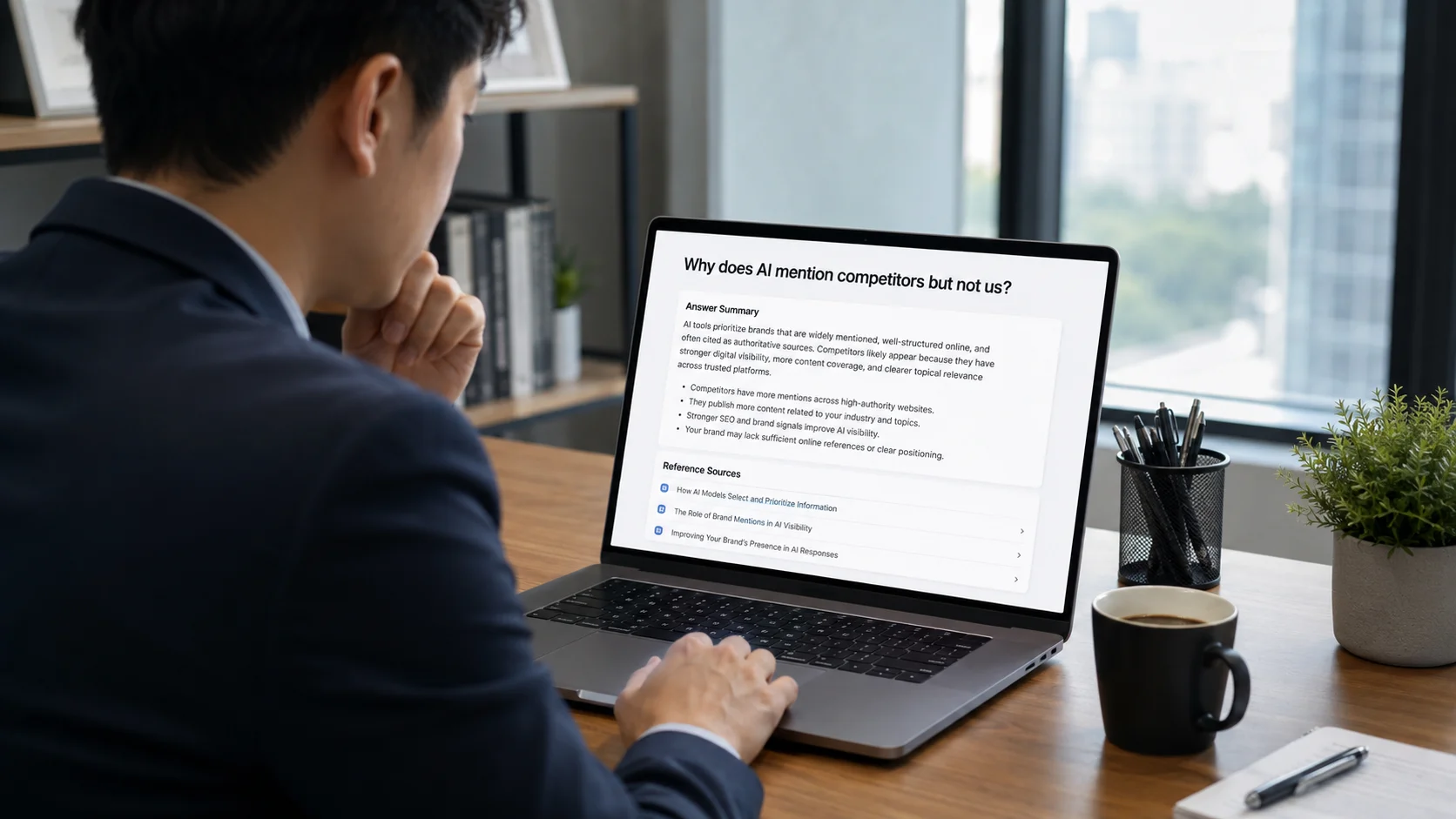
In our daily conversations with clients, this question comes up frequently. Bosses and brand managers see competitors appearing in AI answers without their own brand, and the first reaction is often anxiety: Is our brand not strong enough? Is our website not good enough? Honestly, don't jump to conclusions just yet. Brand mentions in AI responses are not simply a ranking issue; they result from a combination of multiple signals.
Core Answer
If AI mentions competitors but not you, it's usually not because a single page is poorly done, nor does it necessarily mean your brand has no opportunity. More often, it's because AI currently lacks sufficient reason to include you in the answer to that specific question.
To diagnose the problem, you can't just look at "who appears." You need to break it down: Under what types of questions are competitors mentioned? How does AI describe them? Is your brand being recognized as the same type of solution? Are your website content, external mentions, and industry semantics clear enough? Without investigating these questions, directly modifying your website, adding articles, or publishing content can easily become optimization based on gut feeling.
So my advice is to first pinpoint the gap before deciding on the next steps.
Don't Rush to Judge Your Brand; First Understand Why AI Chose Your Competitors
I get asked this a lot, but honestly, who AI mentions is often not a simple ranking by company size. A larger brand isn't guaranteed to appear, while a smaller brand with clear content structure and consistent external information might be more likely to be included in the answer.
You first need to see what type of question the competitor is mentioned in. Recommendation questions, comparison questions, and knowledge-explanation questions each have different underlying logic. If a competitor appears in "recommended service providers," it might be related to third-party content or media mentions. If it appears in "how to choose a solution," it might be related to its content explanation capabilities. If it appears in "brand comparison," it suggests external discussions have already established a semantic association.
If a competitor has more comprehensive product pages, case studies, FAQs, and third-party content, AI is more likely to treat it as a citable source. Using a GEO audit report to first identify "who is mentioned, for which questions, and how they are described" is a much more solid approach than immediately revamping your website. AI not mentioning you doesn't mean you aren't good enough; it means you haven't been understood as the right answer for this question yet.
What You Might Be Lacking Isn't Exposure, But a Brand Rationale AI Can Understand
Many corporate websites are actually quite comprehensive, but AI may not be able to quickly determine which user questions you are best suited to answer. For example, you might have company introductions, product advantages, and service scopes, but if you haven't connected your brand with core product keywords, application scenarios, industry problems, and purchasing needs, AI will struggle to know where you should appear.
This is the difference between GEO and traditional website copywriting. Traditional websites emphasize "who I am and what I have," but AI needs to understand "what problems you can solve, what scenarios you fit, and which needs you relate to." If these semantic relationships are unclear, even extensive page content may not result in stable citations.
Internationally, ChatGPT, Gemini, Google AI Overview, and Perplexity place a higher value on consistent expressions across public web pages and third-party content. In China, Doubao, Kimi, Wenxin Yiyan, Tongyi Qianwen, Quark AI, and Yuanbao are more influenced by content platforms and ecosystem content. So, your goal isn't just to increase exposure, but to ensure different systems can read a consistent, clear, and verifiable brand rationale.
Don't Fixate on a Single Test Result; Monitor Whether Brand Visibility is Improving
AI answers can fluctuate. A single non-appearance doesn't mean there's no GEO opportunity, just as a single appearance doesn't guarantee stability. Many clients, on their first test, ask one question and get anxious when they don't see their brand. But from a performance monitoring perspective, this judgment is too thin.
A more sensible approach is to establish a fixed set of questions and continuously observe the changes for your brand, competitors, and industry keywords across different AI engines. For example, test the same questions every two weeks to see if your brand starts being mentioned, goes from completely invisible to occasional appearances, or shifts from peripheral descriptions to being associated with the core category.
Data analysis should focus on three levels: mention frequency, mention position, and mention context. Only looking at "yes or no" makes it very difficult to know if your optimization is actually working. The key to performance monitoring is identifying which content actions led to visibility changes, and then deciding on the next optimization direction.
Next Steps
You can start a small self-audit today: List 5 questions your customers genuinely ask, and 5 questions related to competitor comparisons. Test these on major AI platforms both internationally and in China. Record who AI mentions, why, and whether it cites specific pages or third-party content.
Next, categorize the results into three groups: First, questions where competitors appear but you don't at all. Second, questions where both you and competitors appear, but your description is less clear. Third, questions where AI mentions the industry but no specific brand. This will give you a clearer picture of whether the issue lies with your website content, external content, or brand semantic expression, rather than just lingering in the anxiety of "competitors have it, we don't."
If you want to see your current situation clearly, start with a basic audit. Check your real visibility across 6 major AI engines in 1 minute. First, find out "if AI sees you, which competitors you're losing to, and where the gaps are in which questions" before deciding on your next optimization steps.
Related Questions
Why did ChatGPT recommend our competitor but not us?
Usually, it's because the competitor has clearer content related to the question, more external mentions, or is more easily understood by AI as the appropriate answer. We recommend first looking at what types of questions the competitor appears in to identify the gap source.
Does AI not mentioning our brand mean our website has too little content?
Not necessarily. Less content can affect recognition, but more content doesn't guarantee AI will understand it. What matters more is whether the content creates clear associations with product keywords, scenario terms, and purchasing questions.
Does AI mentioning our competitor mean they are doing GEO?
It's possible, but you can't assume it directly. A competitor's appearance could stem from SEO fundamentals, third-party content, media mentions, content platform accumulation, or simply the result of long-term brand signal building.
How can I check why AI mentioned a specific competitor?
You can analyze from several angles: the type of question, the context of the answer, cited sources, the competitor's page structure, and external mentions. The focus shouldn't just be on which competitor's name appears, but on understanding the reason AI included them in the answer.
Should we write competitor comparison content specifically for AI?
You can, but we advise against writing content solely to "piggyback" on competitors. A more robust approach is to focus on your customers' real decision-making questions, objectively explaining selection criteria, applicable scenarios, and your own differentiation.
Can brand mentions in AI answers become stable long-term?
They can gradually stabilize, but they won't be permanently fixed. AI answers evolve with data, content updates, question formulation, and system changes. Therefore, continuous monitoring is necessary, rather than stopping observation after a single test.