

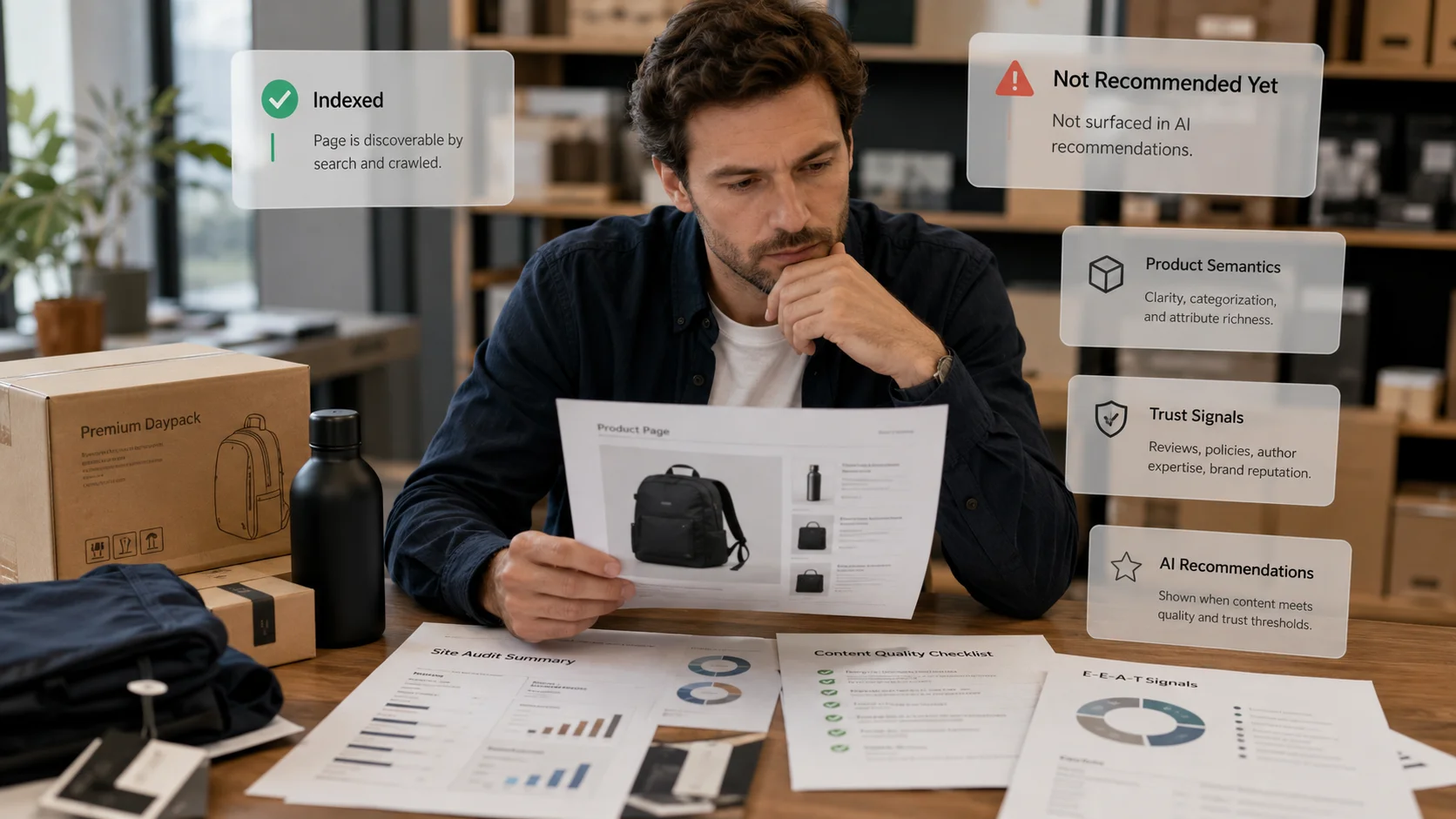
Last week, I was in the middle of a conversation with a marketing lead at an overseas DTC brand.
They sent me a screenshot of Google Search Console, paused for a few seconds, and said, 'Rachel, our website is clearly indexed, so why isn't our brand in any AI recommendation lists?'
I took one look, but I didn't answer right away.
Some of their product pages had organic rankings and were indexed normally. The problem wasn't about whether SEO was done or not; it was about whether the AI had a reason to recommend this product to others.
A page existing doesn't mean the product is understood.
Why isn't website indexing enough?
Many cross-border e-commerce brands simplify this into one question: Why doesn't AI recommend me?
But when you break it down, there are actually three layers.
SEO addresses whether search engines can discover, crawl, index, and rank your pages. GEO optimization, or Generative Engine Optimization, focuses on whether AI can place your product into an explainable purchase scenario. AI Commerce goes a step further, looking at whether the brand, product, reviews, context, risks, after-sales service, and third-party information are sufficient to support a recommendation.
AI isn't just looking for pages. It's organizing answers.
So this isn't a denial of SEO. SEO is still the foundation. It's just that when users move from a Google search box to purchase questions on ChatGPT product recommendation, Gemini AI search, Perplexity shopping query, Google AI Overview, and Google AI Mode, the assets a brand needs to prepare have also changed.
SEO page visibility addresses whether you're in the index
I started working in SEO at a Hong Kong digital marketing company in 2005, back when we were still adapting to the shift from Yahoo to Google.
In the Yahoo era, directories, site structure, and keyword matching were important. In the Google era, links, content quality, page experience, and structured data made the ranking system more mature. Now, in the AI era, search has moved one step further: users don't just want links; they want explanations, comparisons, and recommendations.
This is what I often refer to as the three generations of search engine evolution.
For e-commerce brands, SEO page visibility typically includes Google indexing, product page SEO, title tags and meta descriptions, product page content, internal site structure, external link quality, technical health, and product page structured data like product schema markup.
These assets explain one thing: the page can be found by search engines.
But they don't directly explain another thing: the product can be recommended by AI as an answer.
GEO Product Semantic Visibility addresses whether AI can articulate who you are
Product Semantic Visibility refers to whether AI can understand your product's category, target audience, the problem it solves, its adjacent competitors, and the purchase scenarios where it's worth mentioning.
This isn't about keyword stuffing. It's about structuring product information into clear semantic relationships.
For a product page to be comprehensible to AI, it typically needs to cover category terms, use cases, core specifications, materials or ingredients, functional boundaries, target users, comparison dimensions, purchase concerns, review evidence, and after-sales information.
For example, if an ergonomic office chair page only says 'comfortable, durable, for office use', it's difficult for AI to determine if it's suitable for a home office, back pain sufferers, tall users, or a budget setup.
If the product lacks semantics, it's hard for AI to speak for you.
AI recommendation lists are more like drafts of purchase advice
When a user asks 'best running shoes for flat feet' or 'portable espresso maker for travel', AI usually doesn't just list web pages.
It first understands the user's intent: budget, scenario, audience, risks, and preferences. Then it places candidate brands into an explainable recommendation structure.
This is also the common change brought by ChatGPT, Gemini, Google AI Mode, Perplexity, and Google AI Overview: they are all restructuring the user's decision-making entry point.
For brands, the question shifts from 'Can my page rank?' to 'Can AI include me in this purchase suggestion?'
| Stage | Core Question | Brand Assets to Prepare | Common Misconception |
|---|---|---|---|
| SEO Page Visibility | Can search engines find the page? | Crawlable pages, keywords, titles, internal links, structured data | Assuming indexing equals being recommended |
| GEO Product Semantic Visibility | Can AI understand who the product is for? | Product semantics, scenario content, comparison dimensions, FAQ, third-party content | Only highlighting selling points, not purchase contexts |
| AI Commerce Pre-purchase Trust | Does AI have a reason to recommend you? | Review evidence, return/exchange info, brand entity, media & platform content, risk explanations | Only optimizing the official website, neglecting external trust signals |
The key to AI Commerce is the pre-purchase trust structure
AI Commerce isn't simply 'AI helps users buy things'. More accurately, it's AI participating in the screening, explanation, comparison, and risk assessment before a purchase decision.
Recommending a product means AI needs to answer several questions: Is this brand reliable? What's the risk of the user making a wrong purchase? Are the specifications clear? Is the after-sales process transparent? Do the reviews support the selling points?
For independent websites, the pre-purchase trust structure includes brand entity clarity, product information consistency, user reviews, third-party mentions, return/exchange policies, shipping information, security certifications, and comparison content.
If this information is scattered, ambiguous, or contradictory, AI might see you but be unwilling to recommend you.
At this point, the person I was talking to paused for half a second and said, 'So it's not that it didn't see me, it's that it doesn't dare to recommend me?'
I said, 'That's half right, but we need to break it down further.'
Why does AI recommend competitors more easily?
This concern is valid.
But often, when AI recommends a competitor, it doesn't necessarily mean their product is a better fit; it means their explainable materials are more complete.
Competitors may have left signals across multiple platforms: media reviews, Reddit discussions, YouTube reviews, Amazon reviews, independent review sites, comparison articles, and affiliate content.
Your website might have a lot of content, but might not cover real shopping prompts like 'for beginners', 'for small apartment', 'for sensitive skin', 'under $100', 'for travel', or 'with warranty'.
Your product pages might only talk about features, without addressing concerns: Is it the right size? How is the compatibility? Who is it suitable for? Who isn't it suitable for? Will the return/exchange process be troublesome?
AI is more likely to cite content that can be easily structured into an answer, not just better-looking pages.
From AIPO's perspective, the problem usually lies in PO and subsequent monitoring
When my team and I proposed AIPO, I always resisted making it sound like a complex model. For brand leaders, it should first answer a very practical question: Where exactly is AI breaking down?
It's not about immediately writing more content.
For these kinds of issues, I'd first look at the GEO audit report, not immediately modify the page. The audit needs to cover core category prompts, scenario-based prompts, competitive comparison prompts, purchase concern prompts, and platform differences.
If AI doesn't mention the brand at all, prioritize checking the brand entity, product semantics, and external mentions. This corresponds to website optimization, content planning, and platform publishing.
If AI mentions the brand but doesn't recommend it, prioritize checking review evidence, after-sales information, risk explanations, and third-party content. This corresponds to performance monitoring and data analysis.
If there are significant differences between platforms, don't just look at a single screenshot. The answer organization methods of ChatGPT, Gemini, Google AI Mode, Perplexity, and Google AI Overview differ. You need to continuously monitor AI citation mentions, brand recommendation semantic diagnostics, and semantic position changes.
SEO makes the page visible, GEO makes the product understood, and AI Commerce makes the brand credible within purchase suggestions.
In a similar situation, brands can start with a three-step self-check
Step one: Check page visibility.
Are your important product pages indexed by Google? Are the titles, descriptions, product page structured data, and Product Schema clear? Can the product pages be crawled normally? Without solving these issues, AI search optimization will also lack a foundation.
Step two: Check product semantic visibility.
Can AI articulate your category, target audience, context, and differentiators? Does your content cover real shopping prompts? Do you have FAQs, comparison content, use-case content, and purchase concern content?
Step three: Check the pre-purchase trust structure.
Do you have reviews, media mentions, third-party platform content, after-sales policies, and shipping information? Is the brand entity consistent across your official website, social media, stores, review content, and PR content? Can AI explain 'why recommend you'?
What should different roles look at first?
If you're the head of a cross-border e-commerce brand, I suggest you don't just ask, 'Is my website indexed?' A better question is, 'Can AI place my product into a purchase suggestion?' Start by selecting 10-20 high-value shopping prompts to check if your brand is mentioned, if it's recommended, and if the recommendation reason is accurate.
If you're a CMO, I suggest looking at SEO, content, PR, reviews, affiliate, and social media content together on a single GEO visibility map. Don't just look at organic traffic; also look at the frequency of appearance in AI recommendations, semantic position, and consistency of descriptions.
If you're a Marketing Director, I suggest starting with your product pages and content library. Add scenario-based content, comparison content, FAQs, and return/exchange explanations. Then, have your team record changes in recommendations on ChatGPT, Gemini, Google AI Mode, Perplexity, and Google AI Overview.
If you've confirmed your website is indexed, but your brand still doesn't appear in AI product recommendations, it's more stable to get data first before making decisions based on feelings. Start by identifying whether the issue is with indexing, semantics, or the pre-purchase trust structure.
Back to that question
Later in our conversation, the person stopped asking me 'How do I get AI to index me?' and instead asked another question: 'So, what should we help AI understand first?'
I said, 'That is a much better question for the GEO era.'
From page to product, from product to trust – this is the lesson cross-border e-commerce brands need to learn on the eve of AI Commerce.
First be understood, then be recommended.
Related Questions
Why is my website already indexed by Google, but AI still doesn't recommend my products?
Google indexing means the page can be discovered by search engines, but AI recommendations also require understanding what context your product belongs to, who it's for, and the basis for trust. Page visibility is just the starting point; product semantics and pre-purchase trust influence whether AI will include you in a recommendation answer.
What is the difference between SEO and GEO?
SEO focuses more on whether a page can be crawled, indexed, ranked, and clicked by search engines. GEO focuses more on whether AI can understand the brand and product, and organize them into an answer, comparison, or recommendation list when a user asks a question.
What does Product Semantic Visibility mean?
Product Semantic Visibility refers to whether AI can articulate your product's category, use case, target audience, key differentiators, purchase concerns, and trust signals. It's not simply stacking keywords; it's about structuring product information into a network of relationships that AI can understand.
Does Product Schema help with AI recommendations?
Product Schema can help search systems understand structured information like product name, price, stock, and ratings, but it's usually not a sufficient condition. AI recommendations also require content semantics, external mentions, user reviews, brand entity, and after-sales information to be fully supported.
Why does AI often recommend competitors instead of my brand?
Often, it's not because the competitor's product is a better fit, but because the competitor has left more complete, explainable materials across reviews, comparisons, social media, and third-party platforms. AI finds it easier to recommend brands that can be clearly placed within a purchase context, comparison framework, and trust structure.
Should cross-border e-commerce brands do SEO or GEO first?
It's not recommended to pit them against each other. SEO makes the page discoverable, GEO makes the product understood, and AI Commerce makes the brand more trustworthy in purchase suggestions. For brands in the MOFU stage, it's advisable to first conduct an AI search visibility diagnosis, then decide whether to prioritize pages, semantic content, or trust assets.