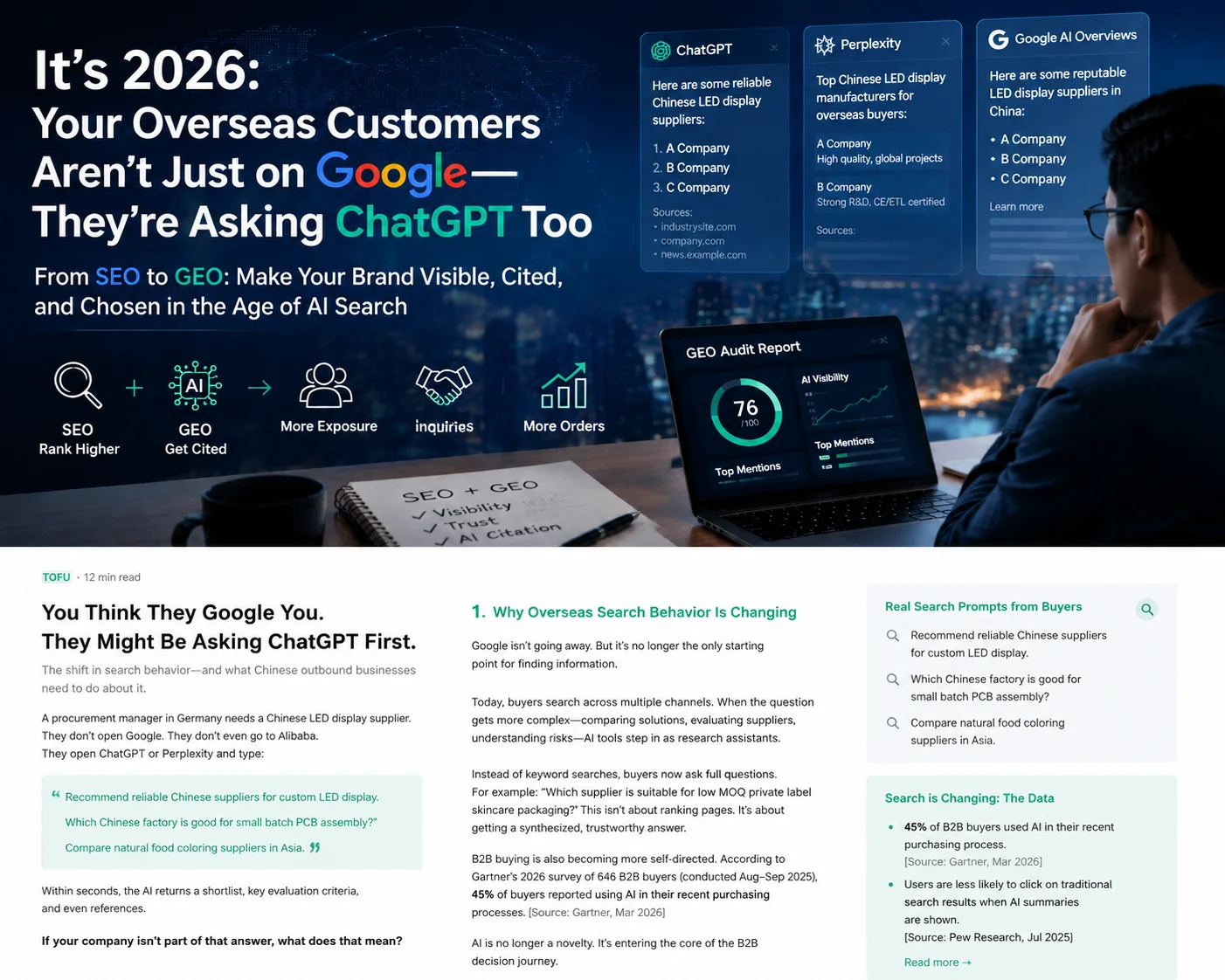
You might think your overseas customers are still searching for you on Google, but the reality is shifting. During a recent project with a small LED display exporter, we observed a procurement manager in North America looking for a "Chinese OEM supplier." Instead of using Google or visiting Alibaba directly, they opened ChatGPT or Perplexity and typed:
- "Recommend reliable Chinese suppliers for custom LED display"
- "Which Chinese factory is good for small batch PCB assembly?"
- "Compare natural food coloring suppliers in Asia"
Within seconds, the AI returned a shortlist of brands and evaluation criteria. The company, while ranking well on Google, did not appear in these AI-driven responses. [Example Scenario] This illustrates that "being found" has extended from Google rankings to whether your brand is understood, cited, and recognized by AI platforms.
Why Overseas Customers' Search Behavior Is Changing
In the past, buyers primarily relied on Google, industry sites, B2B platforms, and social media to source suppliers. Today, AI tools are stepping in to assist with complex problem-solving and decision-making.
Traditional Search Is Still Relevant, But No Longer the Only Starting Point
Overseas buyers still reference Google rankings and social channels, but when comparing suppliers or evaluating multiple options, AI acts as a research assistant.
AI Search Excels at Complex Questions
Buyers now ask full questions instead of typing simple keywords. For example: "Which supplier is suitable for low MOQ private label skincare packaging?" AI provides synthesized answers directly, reducing the need to browse multiple pages.
B2B Decision-Making Is Becoming More Self-Directed
According to a 2026 Gartner survey of 646 B2B buyers conducted between Aug–Sep 2025, 45% reported using AI in recent purchasing processes. [Source: Gartner 2026] This shows AI is entering the core of B2B decision workflows.
How AI Search Differs from Traditional Google Search
| Comparison Aspect | Traditional SEO | GEO / AI Search Optimization |
|---|---|---|
| User Behavior | Enter keywords and browse multiple pages | Ask full questions and wait for AI summary |
| Content Goal | Rankings and clicks | Being understood, cited, and mentioned by AI |
| Content Format | Pages, articles, product listings | Structured answers, FAQs, comparisons, data segments |
| Trust Signals | Backlinks, content quality, page experience | Source credibility, clear brand entities, AI-citable content |
| Monitoring Metrics | Rankings, clicks, traffic, conversions | Brand mentions, source citations, response placement, competitor comparison |
| Optimization Focus | Keywords + page-level improvements | Semantic structure + multi-platform content + monitoring |
ChatGPT Search can search the web for answers and include source links in its responses. [Source: OpenAI 2026] Google AI Overviews provides summaries with links to relevant pages across multiple regions and languages. [Source: Google Blog 2024]
Why Your Google Ranking Doesn’t Guarantee AI Mentions
- Unclear Brand Entity: Websites may only describe products without clarifying the company's identity, service regions, certifications, or applicable use cases. AI struggles to link the brand to specific categories or contexts.
- Lack of Citable Answers: Long articles without definitions, steps, FAQs, comparison tables, or decision checklists are difficult for AI to extract.
- Poor English Content Quality: Many company sites are templated and lack buyer-focused details like MOQ, certifications, delivery, support, or case studies.
- Insufficient External References: AI also looks at third-party sources; relying solely on your website reduces visibility in AI responses.
GEO Challenges for Chinese Exporters vs. Local Competitors
- Language Gap: English content may not align with how overseas buyers phrase their queries.
- Trust Gap: Missing structured information on certifications, testing, capacity, delivery, and after-sales.
- Monitoring Gap: Companies often track Google metrics but don't know if they're cited on ChatGPT, Perplexity, or Google AI Overviews, or how competitors appear.
Example Scenario: A Chinese LED display company ranks on Google but does not appear in AI answers for "outdoor LED display supplier in China," because the website lacks structured content and external references tailored for international buyers. [Example Scenario]
What Content Is More Likely to Be Cited by ChatGPT, Perplexity, and Google AI Overviews?
- ChatGPT Search: Excels at answering complex questions. Public websites can be indexed if they do not block OAI-SearchBot. [Source: OpenAI Help 2026]
- Perplexity: Citable content tends to be structured, clear, and supported by references.
- Google AI Overviews: Summaries include links to relevant pages across multiple languages and countries. [Source: Google Blog 2024]
Should You Still Do Traditional SEO? Yes, But Upgrade to SEO + GEO
- SEO: Ensures your pages are indexed and visible, maintaining traffic and engagement.
- GEO: Ensures your content is understood, cited, and referenced by AI.
- AIPO: Provides a full-cycle method covering diagnosis (GEO checks), execution (website optimization), content distribution, monitoring, and analytics.
Three Actions to Determine If Your Company Needs GEO
- Test AI responses with real buyer questions, e.g., "recommend Chinese suppliers for xxx," and see if your brand appears.
- Check if AI correctly understands your brand: main products, locations, services, and offerings.
- Compare competitor mentions: which competitors appear, from which sources, and how often.
Why Conduct a GEO Audit Before Full Investment
- GEO optimization is not just content creation—it starts with assessing your AI visibility.
- Free GEO Audit: monitors 20 GEO keywords across 2 AI platforms to provide a baseline understanding of AI visibility.
- Disclaimer: Results depend on content quality, industry competition, website infrastructure, and platform policies, and do not guarantee performance.
Conclusion: Redefining Visibility in the Age of AI Search
- Google SEO remains foundational, but AI search is increasingly influencing brand discovery, supplier evaluation, and solution comparison.
- Businesses need to shift from “ranking-focused” thinking to building content that is AI-understandable, citable, and comparable.
- Light CTA: Try a free AIPO GEO Audit to understand your brand's visibility across ChatGPT, Perplexity, and Google AI Overviews.
Want to instantly boost your website's AI search visibility? Try our automated AIPO Audit now and unlock key GEO optimization insights!